What Is a GMless RPG? How TTRPGs Work Without a Game Master
What Is a GMless RPG? Who Runs the World When Nobody Is the GM?
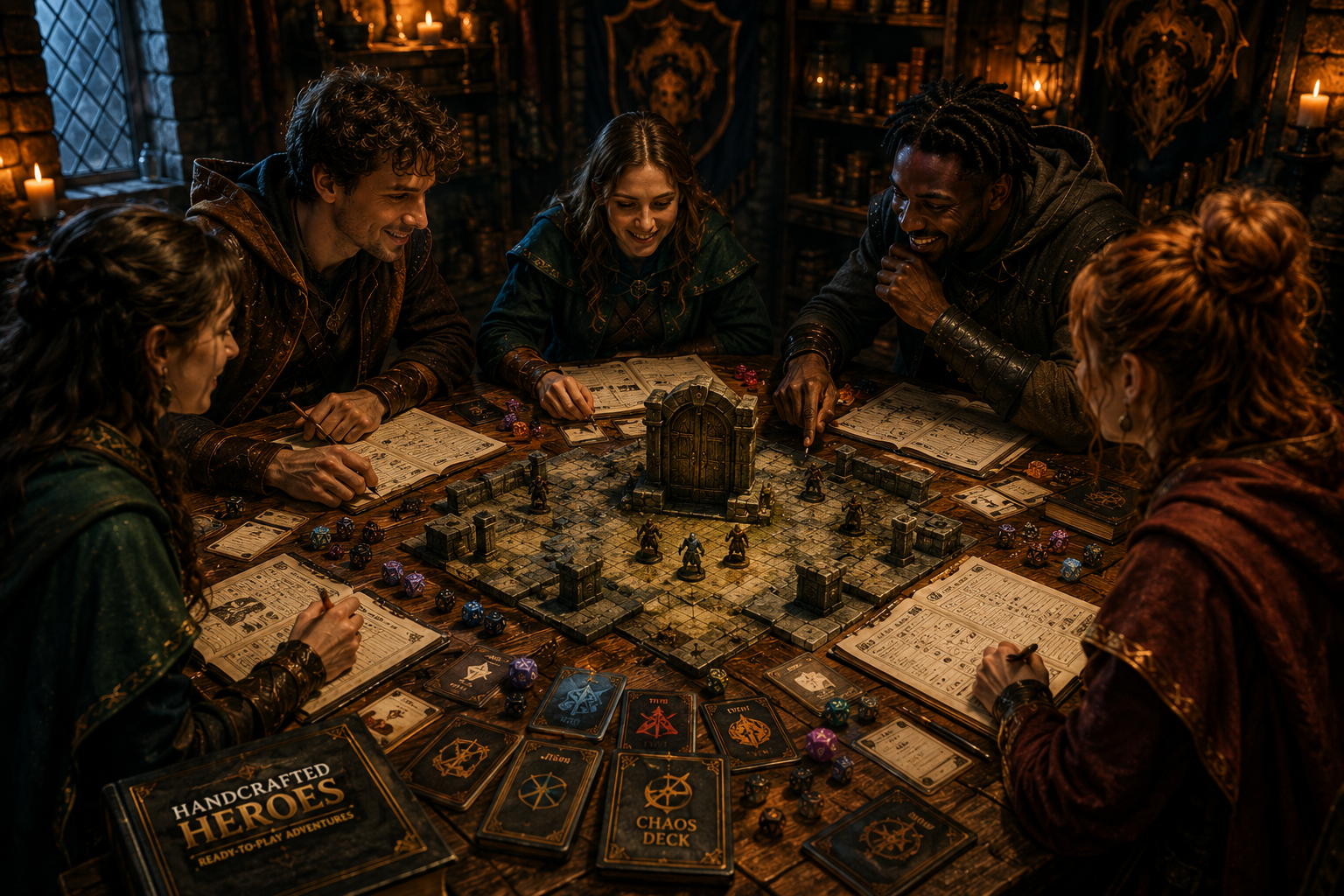
The party reaches a ruined gate. There’s something moving on the other side. Everyone looks around the table. Normally, this is where the Game Master smiles in a deeply unhelpful way.
Except tonight… there isn’t one.
Nobody has secretly prepared the monster.
Nobody has read the next scene.
Nobody sitting at the table knows exactly what waits beyond the gate.
And yet the game continues. That’s the basic idea behind a GMless RPG.
A GMless tabletop role-playing game is a TTRPG that doesn’t require one player to take the traditional role of Game Master. Instead, the responsibilities normally handled by the GM are distributed between the game’s rules, procedures and the players themselves.
That might mean:
- Random tables determine what the party discovers;
- Cards introduce events;
- An oracle answers questions;
- Players take turns establishing scenes;
- A book guides the adventure;
- Or everyone shares responsibility for the world.
There isn’t one universal GMless system.
The important part is simply this: Nobody has to sit outside the party and run everything for everyone else.
And that changes the table in some very interesting ways.
First: What Does a Game Master Normally Do?
To understand GMless play, we need to understand what has disappeared.
Or, more accurately: what has been redistributed.
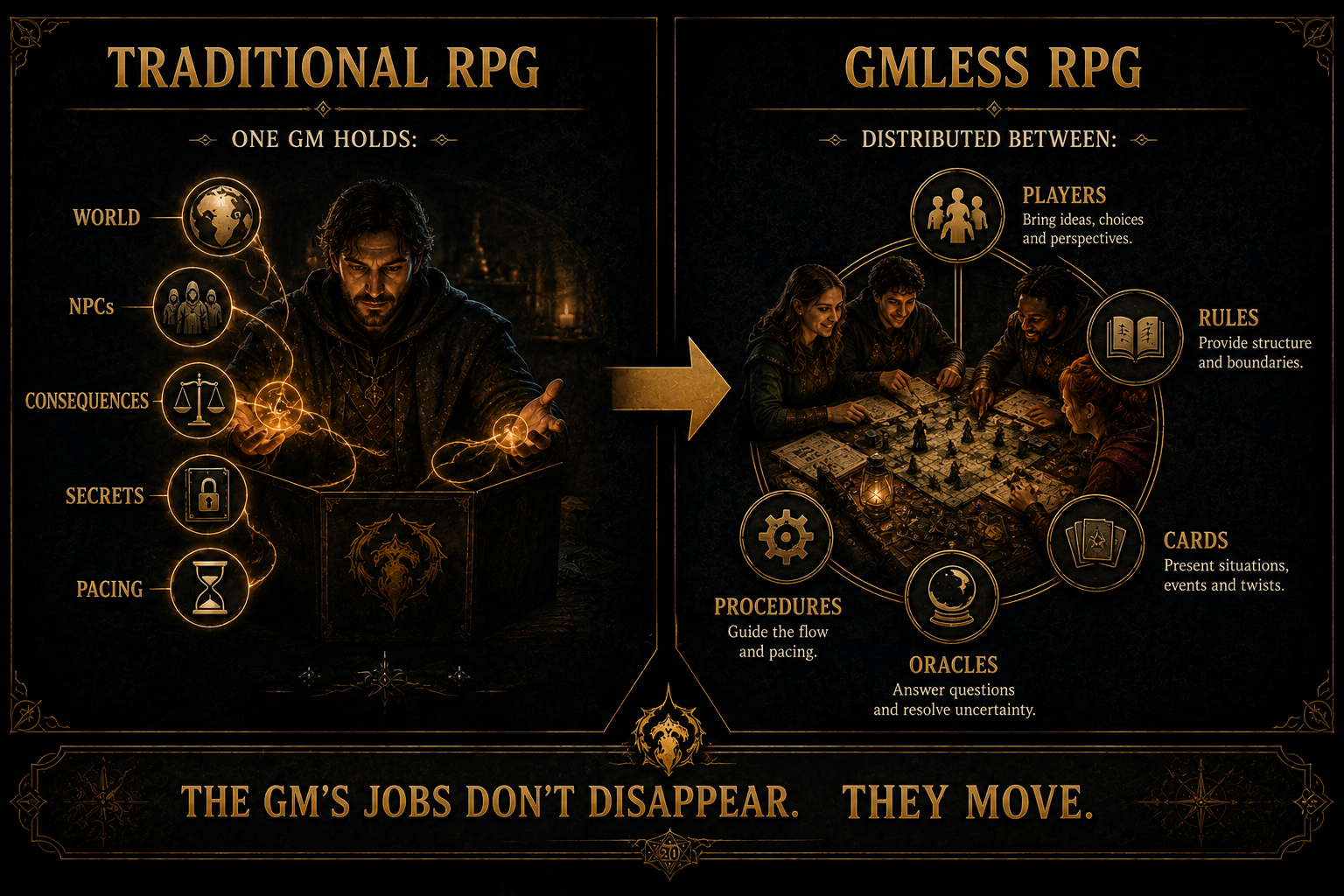
In a traditional tabletop RPG, the Game Master usually performs several jobs simultaneously.
They describe the world.
“The road disappears into a dark forest.”
They portray NPCs.
“The innkeeper lowers his voice. Nobody who enters those woods after sunset comes back.”
They present challenges.
They control enemies.
They interpret rules.
They decide how the world reacts to player choices.
They often prepare the adventure before everyone arrives.
And perhaps most importantly: they know things the players don’t.
What’s behind the door?
Why did the king disappear?
Is the merchant lying?
What happens if the party travels north?
Traditionally, the GM holds that hidden information. Remove the GM and all those responsibilities still need to go somewhere. That’s what a GMless game’s design has to solve.
If you’re still learning the traditional structure, start with our guide to [How a tabletop RPG works].
GMless Doesn’t Mean “Nobody Runs the Game”
This is probably the most important distinction in the entire article.
Remove the GM and you don’t remove:
- The world;
- NPCs;
- Uncertainty;
- Consequences;
- Enemies;
- Story;
- Rules;
- Or surprises.
You remove the assumption that one specific human must personally control all of them.
The game might take part of that responsibility. The players might take another part. Randomness might handle another.
Think of traditional GM responsibilities as a handful of cards.
WORLD
NPCs
RULES
CONSEQUENCES
HIDDEN INFORMATION
PACING
A traditional RPG gives most of those cards to one person. A GMless RPG deals them differently. That’s the real innovation.
So Who Decides What Happens?
Depends on the game.
This is where GMless RPGs become much more diverse than the label suggests.
The Rules Can Decide
Some games contain procedures telling the group what happens next.
- Roll on a table.
- Draw a card.
- Follow a prompt.
- Resolve an event.
The game itself provides information nobody at the table deliberately chose.
For example:
The party enters the forest.
Draw a card.
A stranger needs your help.
Now the players interpret that result.
Who? What happened? Why should they care?
The procedure creates the spark. The players turn it into fiction.
An Oracle Can Answer Questions
We’ve already met this concept in solo RPGs.
Suppose nobody knows whether the village has been abandoned.
Ask:
“Are there people still living here?”
Roll.
Yes, but…
Now interpret.
Yes…
but they’re hiding.
Yes…
but only one family remains.
Yes…
but they don’t seem entirely human anymore.
The oracle creates uncertainty without requiring another person to secretly know the answer.
We explain this mechanic in more detail in our guide to [Playing tabletop RPGs solo], where oracles are especially common.
Players Can Share Narrative Authority
Another approach is simply to distribute the world among the players. One player introduces an NPC. Another establishes a location. Someone else describes a complication. Some systems formalize who has authority at any given moment. Others allow the group to negotiate collaboratively.
This can produce a very different experience from:
GM creates world → players explore it.
Instead, everyone participates in creating and exploring simultaneously.
Shared narration has been part of GMless design for years; systems and hacks have experimented with rotating narration, ritual phrases and explicit procedures that allow players to introduce obstacles or redirect scenes without assigning permanent GM authority to one participant.
But How Can the Game Surprise You?
This is the question. If nobody knows what’s behind the door… who put something behind the door?
The system can.
Imagine the party opens a crypt. Nobody prepared its contents. The game tells you to roll on a discovery table.
You get:
“Signs of recent occupation.”
Another roll:
“Someone is watching.”
Now the table knows two new things. Someone has been here recently.
And somebody may still be nearby.
Who? You don’t know.
Why? You don’t know.
Good. Keep playing.
GMless games often rely on procedural uncertainty instead of a human being the sole keeper of secrets.
- Cards.
- Dice.
- Tables.
- Prompts.
- Hidden information.
- Random events.
- Structured questions.
These mechanics don’t necessarily write the adventure.
They create things the players must react to.
Recent RPG-design discussions continue to explore exactly this problem: how procedural systems can preserve uncertainty when no GM privately holds the answer.
And that gives us one of the most useful ways to think about GMless design:
The system doesn’t need to know the whole story. It only needs to know enough to surprise the table with the next problem.
Let’s Play Thirty Seconds of a GMless RPG
Four players control four adventurers. Nobody is GM. The party reaches an abandoned monastery.
The game’s exploration procedure asks: What condition is the location in?
Roll.
Recently disturbed.
The players agree that several footprints cross the dusty entrance.
Someone asks the oracle:
“Are the footprints human?”
Roll.
No.
Another player asks:
“Do we recognize them?”
Roll.
Yes, but…
The ranger recognizes them as wolf tracks. But they’re much too large.
Now someone establishes:
“There are claw marks around the monastery door.”
The group agrees that fits the established fiction. The party enters. Nobody knew about the giant wolves five minutes ago. Nobody wrote the scene beforehand.
But the players didn’t arbitrarily decide:
“We fight giant wolves now.”
The game’s procedures and their interpretations discovered the scene together.
That’s one form of GMless play.
GMless Doesn’t Mean Rules-Light
Another misconception. A GMless game can be extremely simple. Or mechanically substantial.
Removing the GM tells you something about how responsibilities are distributed.
It doesn’t automatically tell you:
- How many pages the rulebook has;
- Whether combat is tactical;
- Whether miniatures are used;
- Whether the game is narrative;
- Whether it uses dice;
- Or how difficult it is to learn.
There are one-page GMless games.
There are procedural dungeon crawlers.
There are journaling games.
There are collaborative story games.
There are tactical experiences.
Itch.io currently treats GM-Less as a gameplay category alongside things like Solo RPG, Two Player, one-shot, dice and diceless play, which illustrates how independently these properties can combine.
So: GMless ≠ rules-light.
Just as: GMless ≠ solo.
GMless, Solo and Duet Are Not the Same Thing
This deserves a table.
| Traditional RPG | Duet RPG | Solo RPG | GMless Group RPG | |
|---|---|---|---|---|
| Humans playing | Usually 3+ | 2 | 1 | 2+ |
| Dedicated GM | Usually yes | Sometimes | No | No |
| Players control characters | Yes | Yes | Yes | Yes |
| World controlled by | GM | GM/shared | Player + system | Group + system |
| Surprises generated by | GM + rules | GM/system | Oracles/procedures | Players + procedures |
| Shared narration | Depends | Depends | N/A | Often |
The key distinction is:
Solo describes how many people are playing.
GMless describes whether one person has the dedicated Game Master role.
A solo RPG is therefore usually GMless. But a GMless RPG does not have to be solo.
You could have five people around the table and no GM at all.
If your group is just a pair, we’ve also looked specifically at [Playing tabletop RPGs with only two people].
Why Would a Group Want to Play Without a GM?
Now we reach the interesting part.
Because the obvious response might be:
“But we already have a GM. Why remove them?”
You don’t have to. GM-led play is extraordinary.
The GM can create deliberate mysteries. Tailor consequences. Control pacing. Portray recurring characters. Build a world with intention.
GMless games aren’t an upgrade from traditional RPGs. They’re a different solution.
And sometimes they solve very specific table problems.
Everyone Gets to Play a Character
Your forever GM knows this pain.
Everyone else arrives:
“Here’s my wizard!”
“Here’s my rogue!”
“Here’s my paladin!”
The GM arrives:
“Here are the seventeen people I’m going to pretend to be tonight.”
Some GMs love that role. Others occasionally want to be inside the party instead of running the world around it. GMless play makes that possible.
Recent 2026 recommendations for GMless games explicitly cite giving a long-time GM the opportunity to experience the player side of the table as one reason groups seek the format.
Preparation Can Be Distributed
This is a big one.
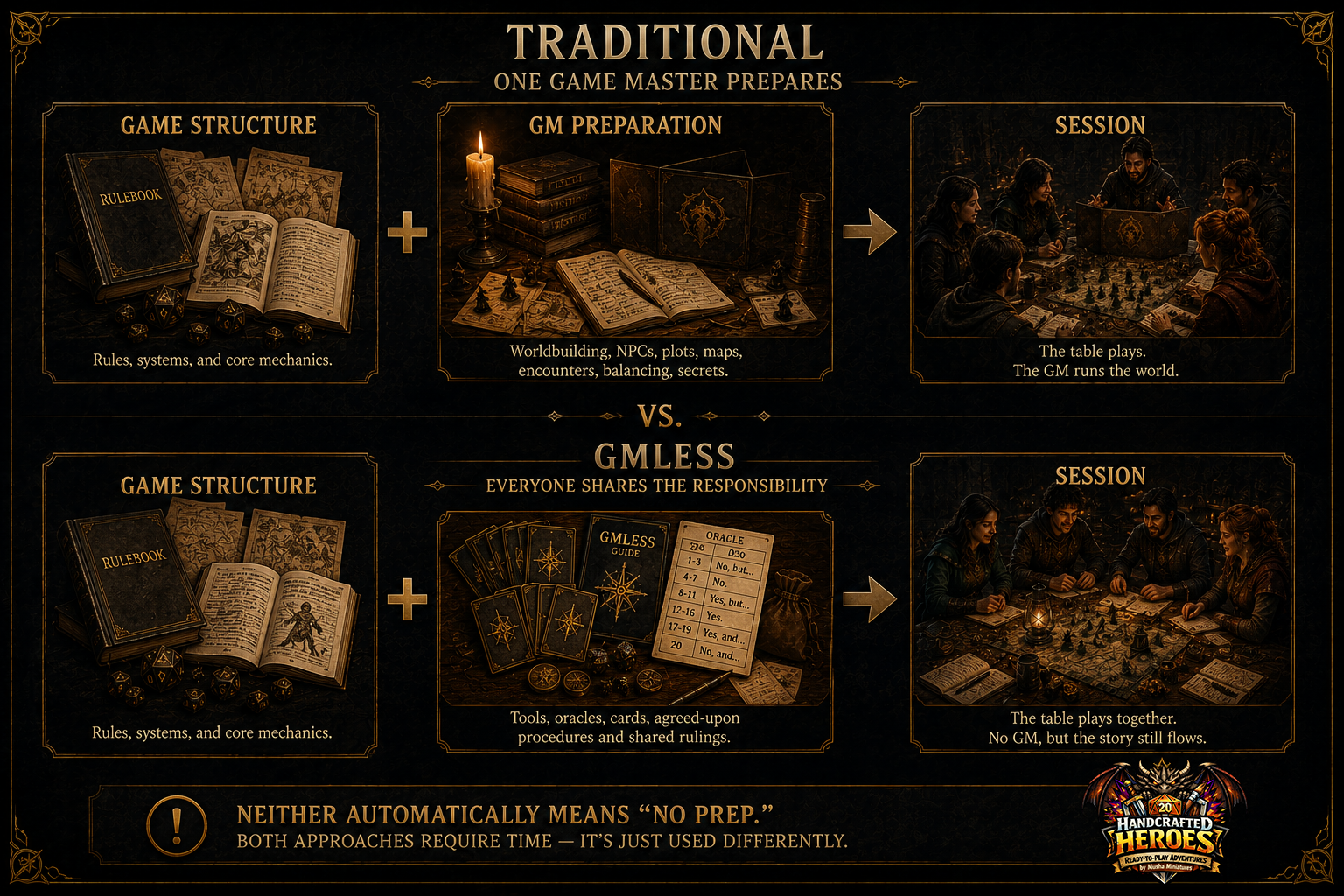
Traditional RPG preparation can involve:
- Reading the adventure;
- Preparing encounters;
- Learning NPCs;
- Studying maps;
- Checking rules;
- Anticipating player choices;
- Organizing materials.
GMless systems can move some of that work into procedures used during play.
Instead of one person preparing:
“What happens if they enter the forest?”
the table discovers what happens when they enter the forest.
That doesn’t mean: GMless = zero preparation.
Some games still require everyone to understand procedures. Materials may need setup. Rules need learning.
But the preparation burden can be different and more distributed. That’s an important distinction.
Nobody Becomes the Organizational Bottleneck
Here’s the very Handcrafted Heroes problem.
Five people want to play.
One person normally GMs.
That person is busy.
No game.
Again.
A GMless format can remove that dependency. Not because Game Masters are unnecessary. Because sometimes the group wants the option to play without waiting for one particular person to prepare everything first.
That’s a very different message from:
“GMs are obsolete.”
And it’s the message we’d defend.
Does GMless Mean No Preparation?
No. And I want this very clear because “no GM” can easily be misunderstood as:
Open box → absolutely nobody needs to know anything → magic happens.
The game still needs structure.
Somebody needs to understand how scenes begin.
How uncertainty is resolved.
How enemies behave.
How information is generated.
How the adventure progresses.
The difference is where that preparation lives.
In a traditional RPG, a significant amount may live in the GM’s head and notes.
In a GMless game, more of it may live in:
- The rulebook;
- Cards;
- Tables;
- Scenario structure;
- Enemy behavior;
- Prompts;
- And shared procedures.
Good GMless design doesn’t eliminate structure.
It moves structure from a person into the experience.
That’s a principle worth remembering.
Are GMless RPGs Good for Beginners?
They can be. But “no GM” does not automatically mean “easier.” A traditional game with an experienced GM can actually be extremely beginner-friendly.
The new player only needs to say:
“I want to climb the wall.”
The GM handles everything else.
In a GMless game, new players may need to understand more about:
- How scenes work;
- When to consult procedures;
- How to interpret results;
- And how narrative responsibility is shared.
So there are two separate kinds of accessibility.
Player Accessibility
How much does one new player need to understand?
Traditional GM-led games can be excellent here.
Table Accessibility
How difficult is it for the entire group to get the game running?
GMless systems can be extremely interesting here because nobody necessarily needs to become the permanent organizer/narrator.
That’s a distinction generic “GMless is easier!” claims miss. And it’s much more useful.
If this is everyone’s first RPG, our guide to the [Best tabletop RPG games for beginners] can help you choose based on the whole group’s needs rather than GM structure alone.
What Can GMless Games Do Particularly Well?
Different designs emphasize different things, but several strengths appear repeatedly.
Shared Ownership
Nobody owns the world alone.
When everyone helps create locations, NPCs and consequences, the setting can feel genuinely collective.
Nobody knows exactly where the story is heading.
Because nobody is driving alone.
Emergent Storytelling
Traditional adventures can also be highly emergent.
But GMless procedures can push this even further.
A card appears. A table generates a complication. Another player interprets it in a way you never expected.
The story exists because multiple systems and imaginations collide.
Flexible Groups
Two people tonight? Possible.
Four next week? Depending on the game, also possible.
Nobody willing to GM? Potentially not a problem.
This flexibility is one reason GMless and cooperative RPGs can work particularly well for groups whose biggest obstacle isn’t enthusiasm.
It’s logistics.
A traditional campaign often relies on one person being available, prepared and willing to run the session. A GMless game can distribute that dependency across the table. That doesn’t guarantee everyone will magically be free on Friday.
Sadly, no RPG mechanic has defeated adult calendars yet.
But it can remove one specific point of failure:
“We can’t play because our GM can’t run tonight.”
And for some groups, that’s enough to turn a cancelled session into an actual adventure.
If getting everyone together is the bigger problem, you may also want to explore [Playing a tabletop RPG with only two people].
Where GMless Games Can Struggle
There are trade-offs.
And this is where we absolutely don’t want to pretend that removing the GM automatically improves the experience.
It changes it.
Sometimes wonderfully. Sometimes in ways your group won’t enjoy.
Nobody Has Final Narrative Authority
A traditional GM can simply decide:
“Yes. That’s what’s behind the door.”
A shared table might instead need to interpret a result together.
Usually that’s part of the fun.
But occasionally:
- Player A thinks the oracle result means one thing.
- Player B sees something completely different.
- Player C has already invented an ancient cult.
- Player D just wanted to open the door.
Now the table needs agreement.
Good GMless systems provide procedures that help resolve this. But players still need to be comfortable building on each other’s ideas instead of protecting their own version of the story.
Shared Creativity Can Feel Like Work
Some players love being asked:
“What strange feature does this city have?”
Others immediately think:
“I don’t know. I came here to play my fighter.”
That’s valid.
Traditional role distribution allows players to focus heavily on their own characters while the GM handles the world.
GMless games can ask everyone to contribute more broadly.
If that’s exciting?
Great.
If it feels like being handed homework during game night?
The format may simply not fit your group.
Mystery Works Differently
A Game Master can create a deliberate secret.
They know:
- Who committed the murder;
- What the monster actually is;
- What the villain wants;
- What waits beneath the castle.
The players uncover something that already exists behind the screen.
In GMless play, mysteries often need different tools.
Maybe clues generate the answer gradually.
Maybe nobody knows the truth until enough information has emerged.
Maybe a deck or scenario book contains hidden information.
Maybe the group collectively discovers the explanation through play.
That can be brilliant. But it creates a different feeling from solving a mystery deliberately constructed by another person.
Pacing Belongs to Everyone
Traditional GM:
“We cut to the following morning.”
Done.
GMless table: someone has to recognize that the current scene has run its course.
This sounds tiny. It isn’t.
Pacing is one of the invisible jobs GMs perform constantly.
When everyone shares narrative responsibility, the group may need explicit tools or simply good table habits for:
- Ending scenes;
- Moving forward;
- Cutting repetitive discussion;
- And recognizing when the story needs another complication.
This gets easier with practice. But it’s still a skill.
Does a GMless RPG Still Have Combat?
It can.
Absolutely.
But once again: GMless describes role structure, not gameplay genre.
A GMless RPG might focus almost entirely on conversation and storytelling.
Another might include:
- Miniatures;
- Battle maps;
- Enemy statistics;
- Initiative;
- Tactical positioning;
- Abilities;
- And detailed combat procedures.
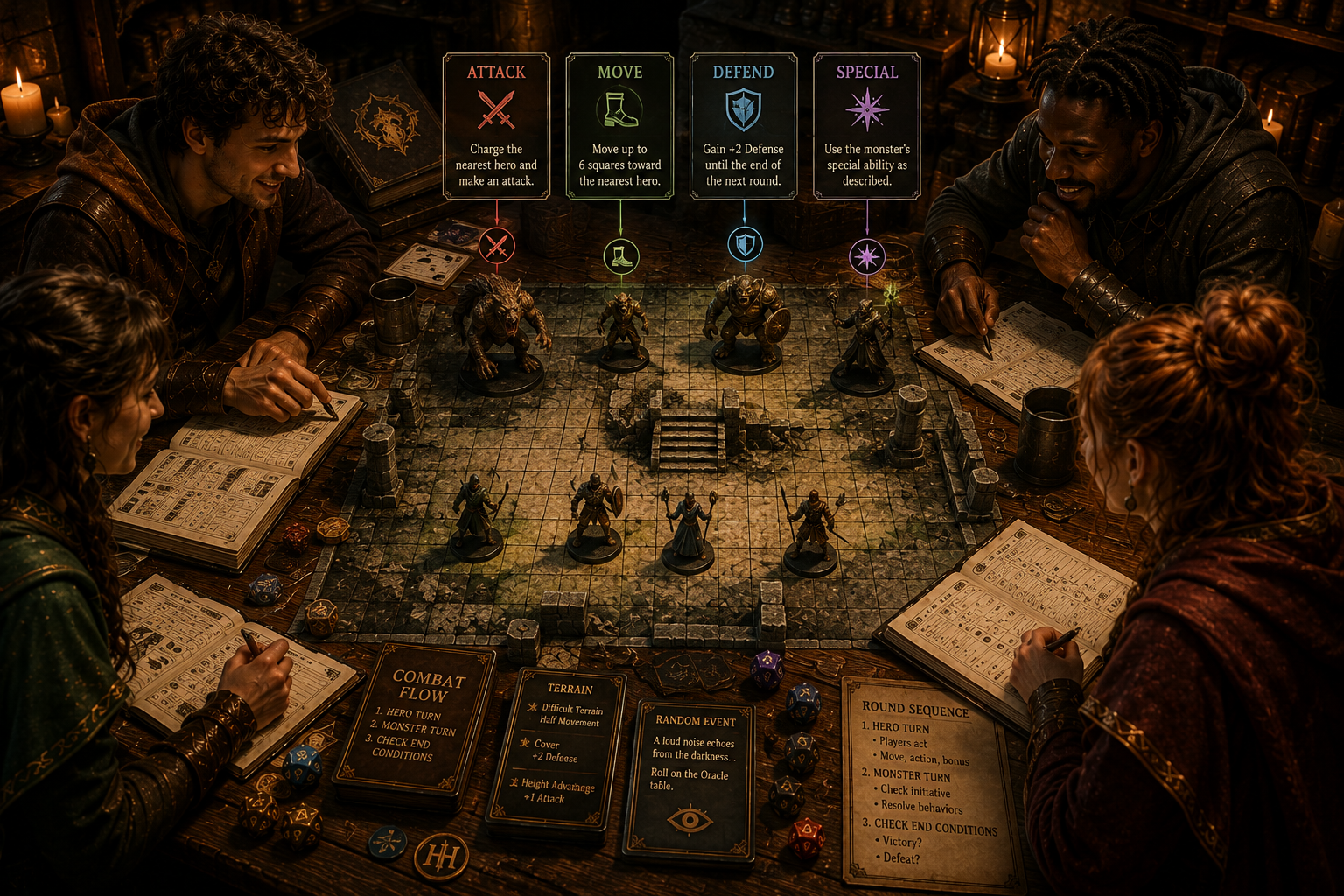
The interesting design question becomes:
Who controls the enemies?
Several solutions are possible.
Enemies might follow behavior rules.
For example:
Attack the nearest wounded character.
Or:
If surrounded, retreat toward the nearest exit.
Cards may determine actions.
Dice may select targets. Players may share enemy control. Or one player may temporarily resolve enemy behavior without gaining broader GM authority.
This is where good procedural design becomes especially visible. The game needs opponents to behave without requiring one participant to secretly become the GM again.
Can a GMless RPG Have a Campaign?
Yes. GMless does not mean one-shot.
A cooperative game can support:
- One evening;
- A short series of adventures;
- Or a continuing campaign.
The real challenge is continuity.
A longer experience needs ways to remember:
- What changed;
- Which NPCs matter;
- What threats remain;
- How locations evolved;
- What consequences previous choices created.
Traditionally, much of that continuity lives with the GM.
In a GMless campaign, the game may instead rely more heavily on:
- Campaign sheets;
- Shared journals;
- World maps;
- Relationship trackers;
- Cards;
- Persistent scenario states;
- Or other records everyone can consult.
And there’s something particularly interesting about this.
When nobody owns the world alone, everyone can become responsible for remembering it. The campaign becomes genuinely shared territory.
If you’re deciding how long your game should run, compare [One-shot vs Campaign] before committing to a format.
Can a One-Shot Be GMless?
Also yes. In fact, the combination makes a lot of sense.
One evening.
No permanent GM.
A complete story.
A game whose procedures already know how to move everything forward. That can be a very accessible format for a group that simply wants to sit down and discover something together.
But here’s the important caveat: low commitment does not automatically mean low complexity.
A four-hour GMless one-shot can still have unusual procedures that everyone needs to understand.
So when introducing new players, we’d still ask:
How quickly can this particular game teach the group what to do?
Not merely:
Does it have a GM?
If you’re considering a single-session game first, here’s **[What a one-shot RPG is]** and why the format works so well for short adventures.
Is GMless Better Than Having a Game Master?
No. And having a Game Master isn’t better either.
They’re different creative structures. A skilled GM can do things that are difficult to reproduce procedurally.
- They can read the room.
- Notice when a player is disengaged.
- Change an encounter in seconds.
- Build deliberate foreshadowing.
- Play an NPC differently because they remember what happened six sessions ago.
- Quietly abandon an entire planned storyline because the party has become emotionally invested in a random fisherman named Gerald.
Human improvisation is incredibly powerful.
GMless play offers different strengths:
- Shared discovery;
- Distributed ownership;
- Less dependence on one specific participant;
- And the chance for everybody to enter the adventure as a character.
The mistake is treating the comparison as:
human GM vs automated replacement GM.
That’s too simplistic.
A good GMless system doesn’t necessarily try to reproduce a traditional GM perfectly.
It asks:
What happens if we build the experience around not needing one in the first place?
That’s a much more interesting question.
What About the “Forever GM”?
Every long-running group seems to have one.
The person who says:
“Sure, I’ll run this one.”
Then runs the next one. And the next. And five years later owns fourteen rulebooks, thirty folders of notes and hasn’t made a player character since 2021.
Some people genuinely love being the forever GM.
Excellent. Leave them alone. They’re thriving.
Others would really like to sit on the opposite side of the screen occasionally.
GMless games can make that possible without requiring another group member to suddenly learn how to run a traditional campaign.
The GM doesn’t disappear from the hobby.
They get to become a player again.
That’s one of the most compelling uses of the format.
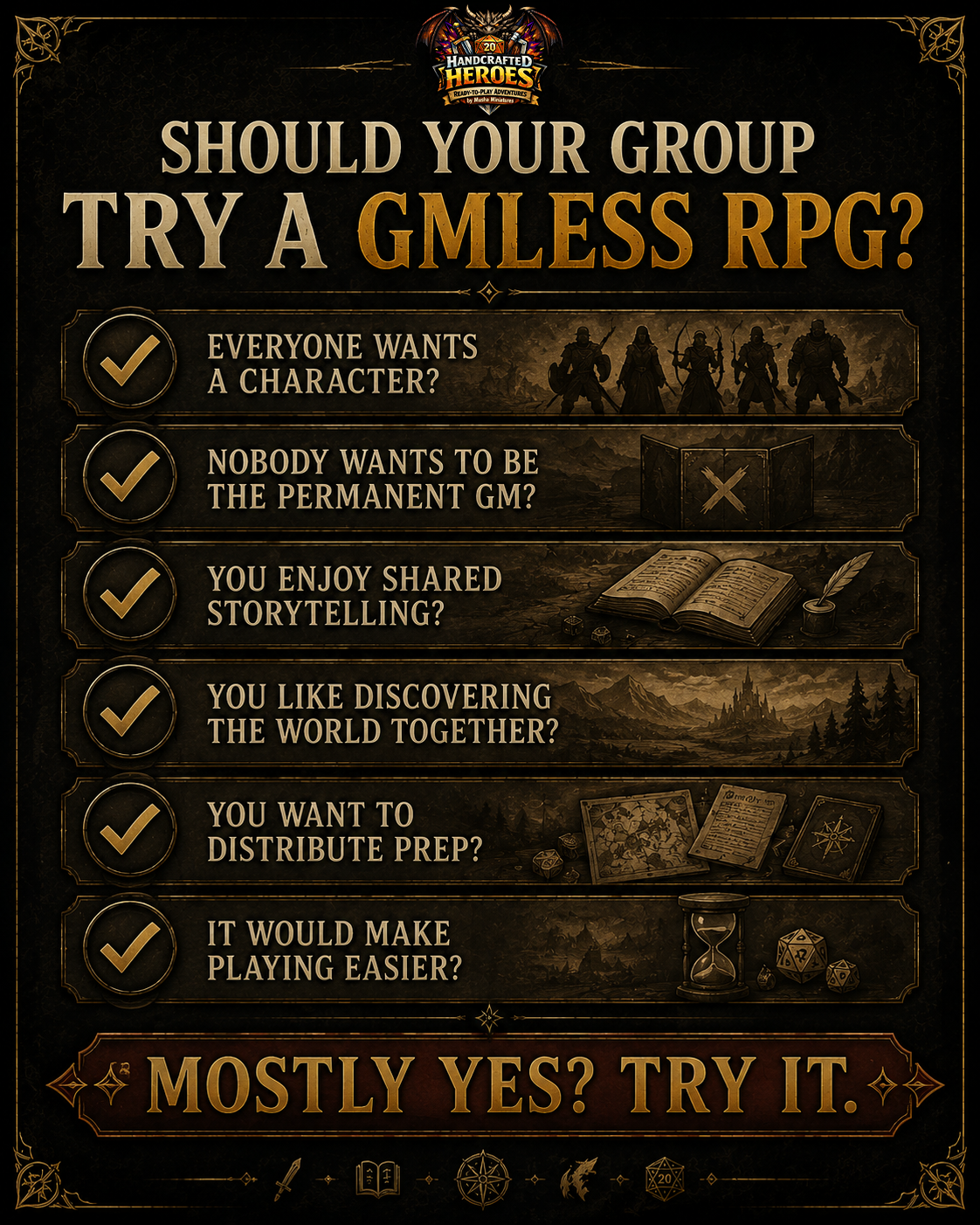
The GMless Test: Is It Right for Your Group?
Before choosing a GMless RPG, I’d ask these six questions.
1. Does anyone genuinely want to GM?
If yes, you don’t need to remove the role merely because GMless sounds novel.
Let people do the thing they enjoy.
2. Does everyone want a character?
If the usual GM keeps wishing they could join the party, GMless becomes much more interesting.
3. Are we comfortable improvising together?
Shared narration works best when people are willing to accept and build on ideas that aren’t their own.
4. Do we like discovering the story rather than having one person prepare it?
That’s often one of the biggest differences.
5. Are we trying to reduce preparation?
Look closely at the actual game.
Don’t assume GMless means zero prep.
Ask where the preparation has moved.
6. Would distributing responsibility make it easier for us to play?
This might be the most important question of all.
If yes?
It’s worth trying.
How We’d Introduce a Group to GMless Play
Not with a lecture. Not by explaining every possible form of shared narrative authority.
And definitely not by telling the forever GM:
“We’ve automated you.”
I’d start small. Choose a game with clear procedures. Preferably one designed specifically for GMless play rather than heavily modifying something that assumes a GM.
Use a one-shot or otherwise contained first experience.
Make sure everyone understands:
- When the rules speak;
- When players decide;
- How questions are resolved;
- And who narrates the outcome.
Then start playing. The format usually makes much more sense after the first few unexpected results.
There’s a moment where someone asks:
“So… what’s inside the chest?”
Everyone looks around.
Someone rolls.
The system answers: Something dangerous and valuable.
Suddenly the table starts creating possibilities. That moment explains GMless RPGs better than twenty pages of theory.
What Do You Need to Play a GMless RPG?
Potentially very little.
You need:
- The game;
- The players;
- Characters, if the game uses them;
- Whatever randomizers or cards it requires;
- And an understanding of its shared procedures.
You don’t inherently need:
- Miniatures;
- Maps;
- Terrain;
- A GM screen;
- Or elaborate preparation.
But again, GMless and component-light aren’t synonyms.
A GMless game may use extensive physical components because those components are part of how the world runs itself.
Cards might replace hidden GM information.
Tokens might track enemy behavior.
Maps might structure exploration.
Tables might generate encounters.
Physical systems can do some of the work another human would normally perform.
And this is one reason GMless tabletop design can become so interesting from a tactile perspective.
If you’re building your first table from scratch, here’s [What you actually need to play a tabletop RPG].
GMless Doesn’t Remove the Game Master. It Redistributes the Role.
This is the idea I’d remember.
Traditional RPG:
One person carries most of the world.
GMless RPG:
The world is carried by the table and the game together.
That’s why describing GMless as simply:
“D&D, but without the DM.”
doesn’t quite work.
The interesting part isn’t what’s missing. It’s what replaces the old structure.
- Procedures.
- Randomness.
- Shared authority.
- Physical components.
- Player interpretation.
- Collective decisions.
- And, ideally, enough uncertainty that nobody knows exactly what happens next.
At Handcrafted Heroes, that’s the part of GMless design we find especially compelling.
Not the idea of eliminating Game Masters.
The idea of eliminating the requirement that one person must always carry the entire adventure before everyone else gets to play.
Because sometimes the problem isn’t that nobody wants an adventure. It’s that everyone wants to be inside it.
One Table. No Screen. Still an Adventure.
A traditional Game Master can create extraordinary experiences. So can a well-designed GMless system.
The two don’t have to compete. They can even live in the same gaming group.
Campaign this month. GMless one-shot next weekend. Solo adventure Tuesday night. Duet game when only two people are free.
The deeper you go into tabletop RPGs, the less useful one rigid idea of:
“This is how an RPG is supposed to work.”
becomes.
There are many ways to distribute characters. Many ways to create uncertainty. Many ways to tell stories. And many ways to decide what waits behind the door.
Sometimes one person knows. Sometimes nobody does. Either way… someone still has to open it.
Musha
Handcrafted Heroes Founder