How to Play a Tabletop RPG: Your First Session Explained
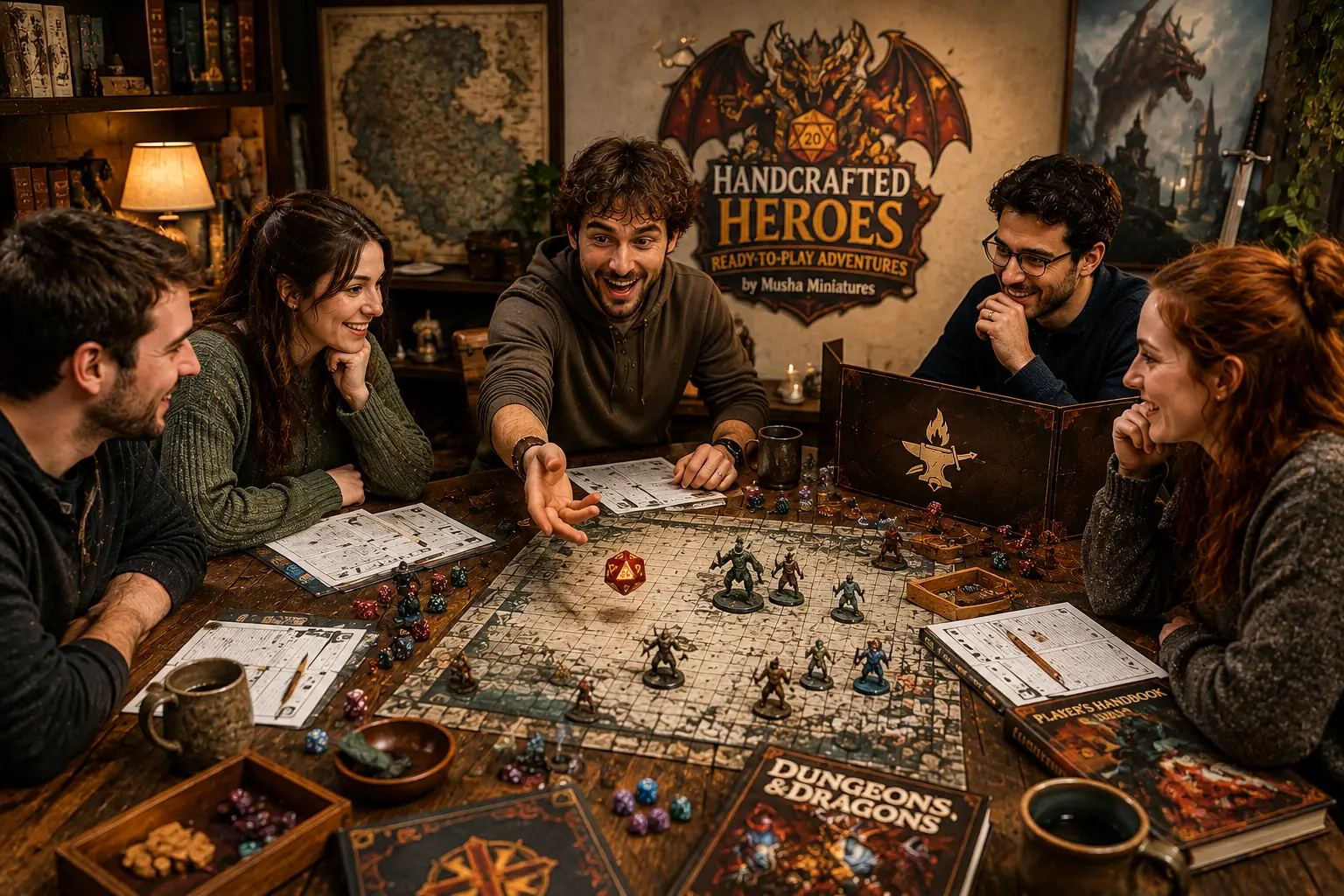
How to Play a Tabletop RPG: Your First Session, Step by Step
You found a game.
Three friends said yes.
Someone bought snacks.
There are seven different dice on the table and nobody is entirely sure which one is the d12.
Good.
You’re ready.
Your first tabletop RPG session doesn’t require encyclopedic knowledge of the rules, years of acting experience or a perfectly optimized character. You need to understand one simple rhythm: The world presents a situation. You decide what your character does. The game tells you when the outcome needs to be resolved. Then the world changes because of what happened.
That’s the heartbeat of a tabletop role-playing game. If you’ve already read our guide to [What a tabletop RPG is], you know the basic idea. Now we’re going to sit down at the table and actually play one.
Before the Adventure: What Should You Prepare?
Less than your nervous brain is currently suggesting.
The exact preparation depends on the game you’re playing, but a first session usually needs some version of:
- The rules for your chosen game;
- Characters or character sheets;
- Whatever the game uses to resolve actions, often dice;
- An adventure, scenario or starting situation;
- Somewhere to play.
That somewhere can be a kitchen table, a gaming room or an online voice call. You don’t need an elaborate physical setup to make the game legitimate. You also don’t need to read every rule before sitting down. The person running the game will generally need more familiarity with the rules than the other players, but even the GM doesn’t need perfect recall. Rulebooks exist because people forget rules. Use them.
For a first experience, a starter set, quickstart adventure, pre-generated characters or beginner-friendly one-shot can dramatically reduce the amount everyone needs to learn beforehand. Current beginner resources commonly recommend exactly this approach rather than expecting newcomers to master an entire system before their first game.
Meet Your Character
Your character is the one part of the game you control directly.
Not the dungeon.
Not the dragon.
Not whether the suspicious innkeeper is secretly working for the villain.
Your character.
Depending on the game, you may create them from scratch or receive a ready-made character designed for the adventure. Either approach works. For your first session, you don’t need to understand every number on the character sheet before you begin. Start with three things.
Ready to make your own? Our beginner guide shows you [How to create your first RPG character from concept to character sheet].
What is your character good at?
Maybe they’re strong. Persuasive. Sneaky. Magical. Excellent at tracking monsters through forests. Terrible at resisting obviously cursed objects.
Your character sheet translates those strengths and weaknesses into game mechanics.
What do they want?
It doesn’t need to be a twelve-page backstory. “I want to prove that I’m worthy of becoming a knight.” That’s enough.
So is: “I’m looking for my missing brother.”
Or: “I heard there was treasure.”
Motivation gives you something to fall back on whenever you don’t know what your character would do.
How do you want to play them?
Quiet and thoughtful? Reckless? Suspicious? Heroic?
You don’t need to decide everything before the first scene. Characters often become interesting because of what happens during play, not because somebody wrote their entire biography beforehand.
The GM Sets the Scene. Then It’s Your Turn.
Imagine your first adventure begins like this:
Rain hammers against the windows of the inn. The front door opens and a wounded guard stumbles inside. He drops a blood-covered sword onto the floor.
“They took the bridge.”
That’s it.
The game has begun.
There probably isn’t a flashing objective saying:
QUEST STARTED: RECAPTURE THE BRIDGE
Instead, the Game Master has given the table a situation. Now the players respond. One might ask the guard what happened. Another checks his wounds. Someone looks outside. The rogue quietly inspects the sword. And, statistically speaking, somebody will ask the innkeeper what food is available despite the apparent emergency.
All of those are valid actions. This is the first skill to learn in a tabletop RPG: when the GM describes a situation, imagine that you’re actually there and decide what you want your character to do.
You don’t need to search your character sheet for a button. Just describe the action.
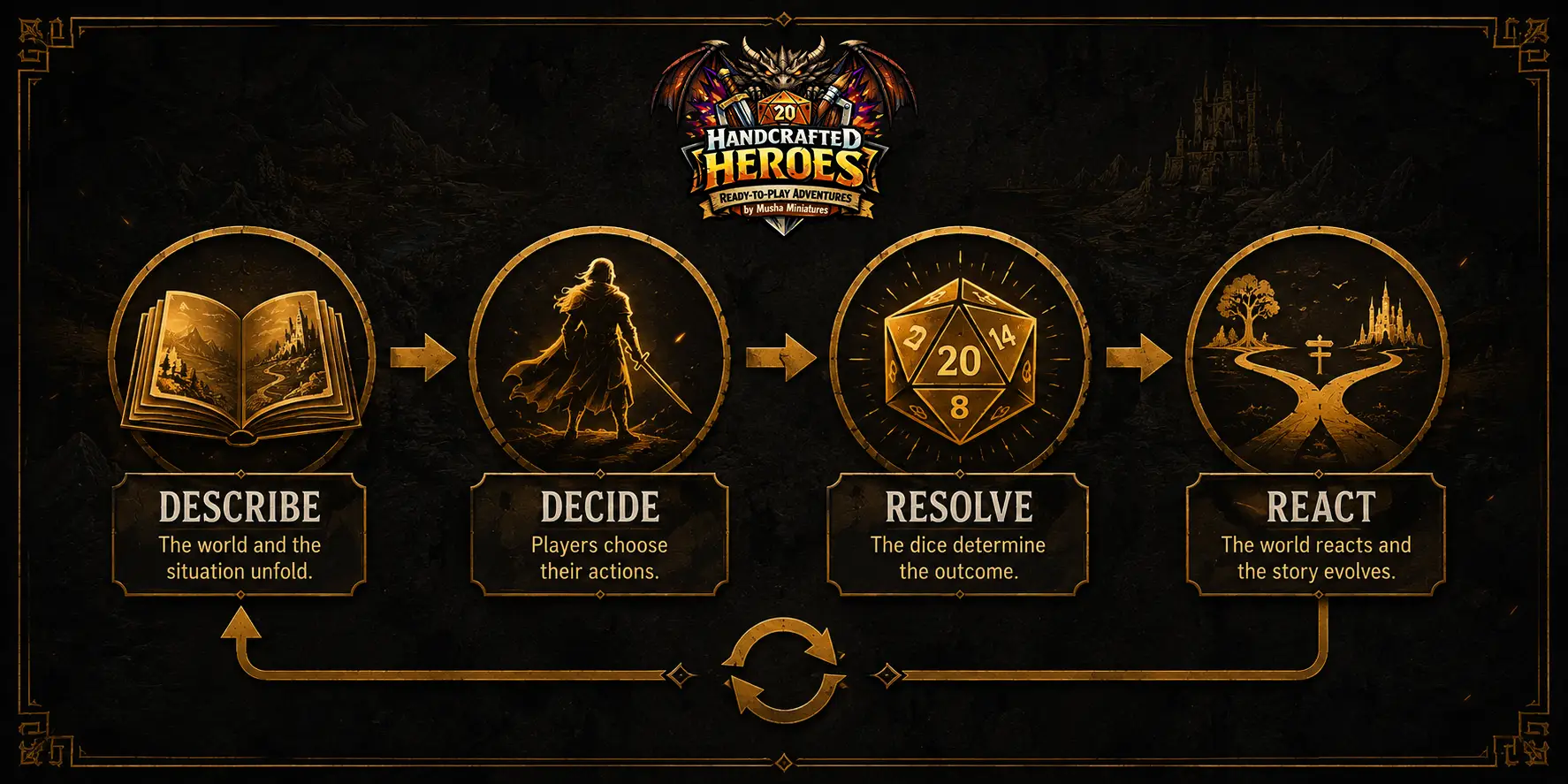
The TTRPG Loop: Describe → Decide → Resolve → React
Most tabletop RPG sessions can be understood through a surprisingly simple loop.
1. Describe
The GM — or the game’s equivalent narrative system — establishes what’s happening.
The bridge is occupied by six armed raiders.
2. Decide
The players decide how their characters respond.
Can I sneak underneath the bridge and listen to them?
3. Resolve
If the outcome is uncertain and meaningful, the rules may step in.
The game might ask for a roll.
Make a Stealth check.
4. React
The result changes the situation.
Success? You reach the underside of the bridge unnoticed.
Failure? Maybe a raider hears something.
Now the world is different.
And the loop begins again.
Describe → Decide → Resolve → React.
That’s more useful to understand before your first session than memorizing dozens of individual rules.
So… When Do You Actually Roll the Dice?
Not every time you do something. This is one of the most useful things a beginner can learn.
Imagine you say:
“I walk across the room and open the unlocked door.”
Unless something unusual is happening, you probably don’t need to roll.
Now imagine:
“I run across the collapsing bridge and try to grab the rope before it falls into the ravine.”
Different situation.
The outcome is uncertain. Failure matters. That’s where many RPG systems bring in dice or another resolution mechanic.
Exactly which die you roll, what you add to it and what counts as success depends entirely on the game you’re playing. In D&D, you’ll frequently encounter a twenty-sided die — the famous d20. Other systems use different dice, dice pools, cards or entirely different mechanics.
The important beginner lesson isn’t:
I need to know when to roll a d20.
It’s:
Describe what you want to do first. Let the game tell you when mechanics are needed.
You play your character.
You don’t play the character sheet.
What If You Fail a Roll?
Something interesting should happen. Imagine you’re trying to climb through the window of a nobleman’s house without being noticed. You roll badly.
That doesn’t necessarily mean:
You fail to climb. Nothing happens.
Maybe you get inside…
but a guard sees you.
Maybe you make enough noise to wake someone upstairs.
Maybe your cloak catches on the window and leaves behind evidence.
Maybe you have to choose between dropping your weapon or falling.
Different games and different GMs handle failure differently, but one principle is extremely useful: failure in an RPG is not the same thing as losing the game.
Failure creates consequences. And consequences create stories.
Some of the moments your group remembers years later will begin with an absolutely terrible dice roll.
Then Someone Draws a Sword
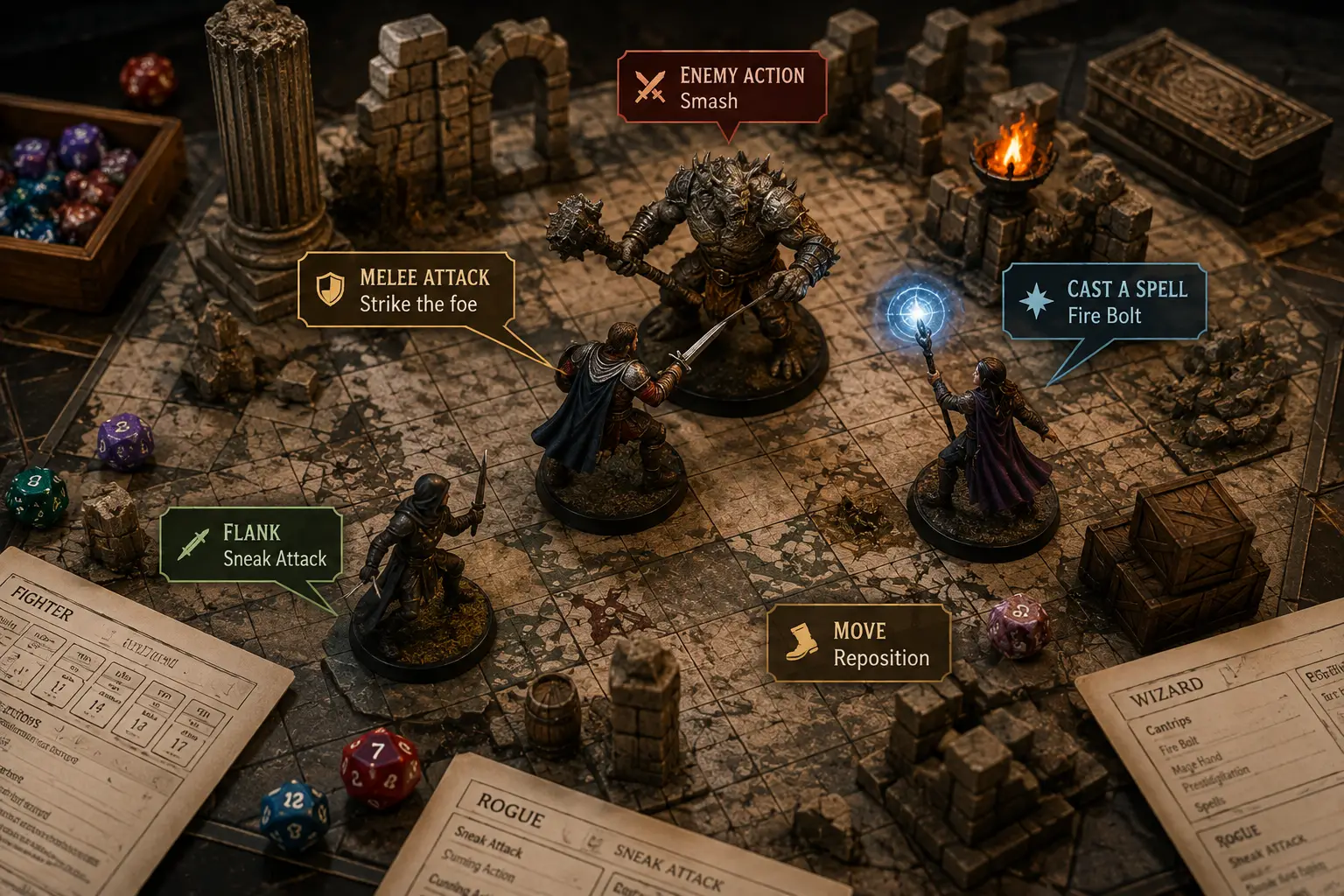
Sooner or later, especially in fantasy RPGs, talking may stop working. Combat begins. This is often the moment where the rules become more structured. Depending on the system, you may determine who acts first, move characters around a map, choose attacks or abilities, track damage and take turns until the encounter ends.
But underneath those additional rules, you’re still doing the same thing: the game describes the situation → you decide what to do → mechanics resolve uncertainty → the situation changes.
Your fighter might charge the nearest enemy.
Your wizard might cast a spell.
Your rogue might hide behind a ruined wall.
Your bard might attempt to convince everyone that violence is unnecessary despite having started the fight three minutes earlier.
The rules become more detailed because positioning, timing and consequences matter more.
But combat isn’t a separate game.
It’s another kind of scene.
Do You Have to Act?
No. This deserves its own section because the word role-playing scares more newcomers than it should. You do not need to perform. You don’t need a voice. You don’t need theatrical improvisation experience. And nobody should expect your first session to look like an edited Actual Play show.
If your character wants to intimidate a bandit, you could say:
“Tell me where they took the prisoners or you’ll regret staying behind.”
That’s role-playing.
But you can also say:
“I try to intimidate him into telling us where the prisoners went.”
That’s role-playing too.
You’re making a decision as your character. The performance is optional. Over time, you might discover that you enjoy speaking in character. Or you might never do it. Neither makes you a better or worse player.
The goal isn’t to impress the table. It’s to contribute to what the table is creating together.
You Are Allowed to Ask Questions
Actually, please do. A first-time player might imagine everyone else at the table has memorized several hundred pages of rules and is silently waiting for them to make a mistake. They’re not. Experienced tables look things up too.
Ask:
“Which die is that?”
“Can my character do this?”
“What does this ability mean?”
“Do I know anything about this monster?”
“Wait, where are we again?”
All perfectly reasonable.
And when nobody knows a rule? The group checks it. The GM makes a temporary ruling. You keep playing.
One of the worst ways to learn a tabletop RPG is to spend so much time worrying about playing correctly that you forget to actually play it.
Recent first-time GM discussions show exactly this concern: newcomers frequently worry about knowing enough before starting, while experienced players commonly advise them to use beginner material, take the session slowly and simply look up rules when necessary.
Your First Session Will Probably Be a Little Messy
Someone will forget an ability. Someone will misunderstand a rule. The GM may need five minutes to find something. A player will develop an emotional attachment to an NPC who was invented twelve seconds ago. The encounter expected to take twenty minutes might take an hour. The carefully prepared puzzle might be solved instantly. The completely irrelevant locked cupboard might consume half the evening.
That’s not the session going wrong. That’s tabletop role-playing.
Unlike a video game, the experience is being created live by the people sitting around the table. A little unpredictability isn’t a bug. It’s where many of the best stories come from.
What Happens When the Session Ends?
Eventually someone looks at the clock. It’s much later than expected. The adventure may be finished. Or the party may be halfway through a dungeon with a very angry troll standing between them and the exit.
If you’re playing a one-shot, the story will usually aim for some form of resolution during that session.
If you’re playing a campaign, the group records where everyone finished, keeps character sheets and notes, and continues the story next time.
Characters may gain experience. Relationships change. Mysteries remain unresolved. Someone starts a group chat exclusively dedicated to memes about the evening. And something subtle happens.
The story stops being the adventure the GM prepared. It becomes: the adventure your group played.
Those aren’t quite the same thing. That’s the magic trick at the center of tabletop RPGs.
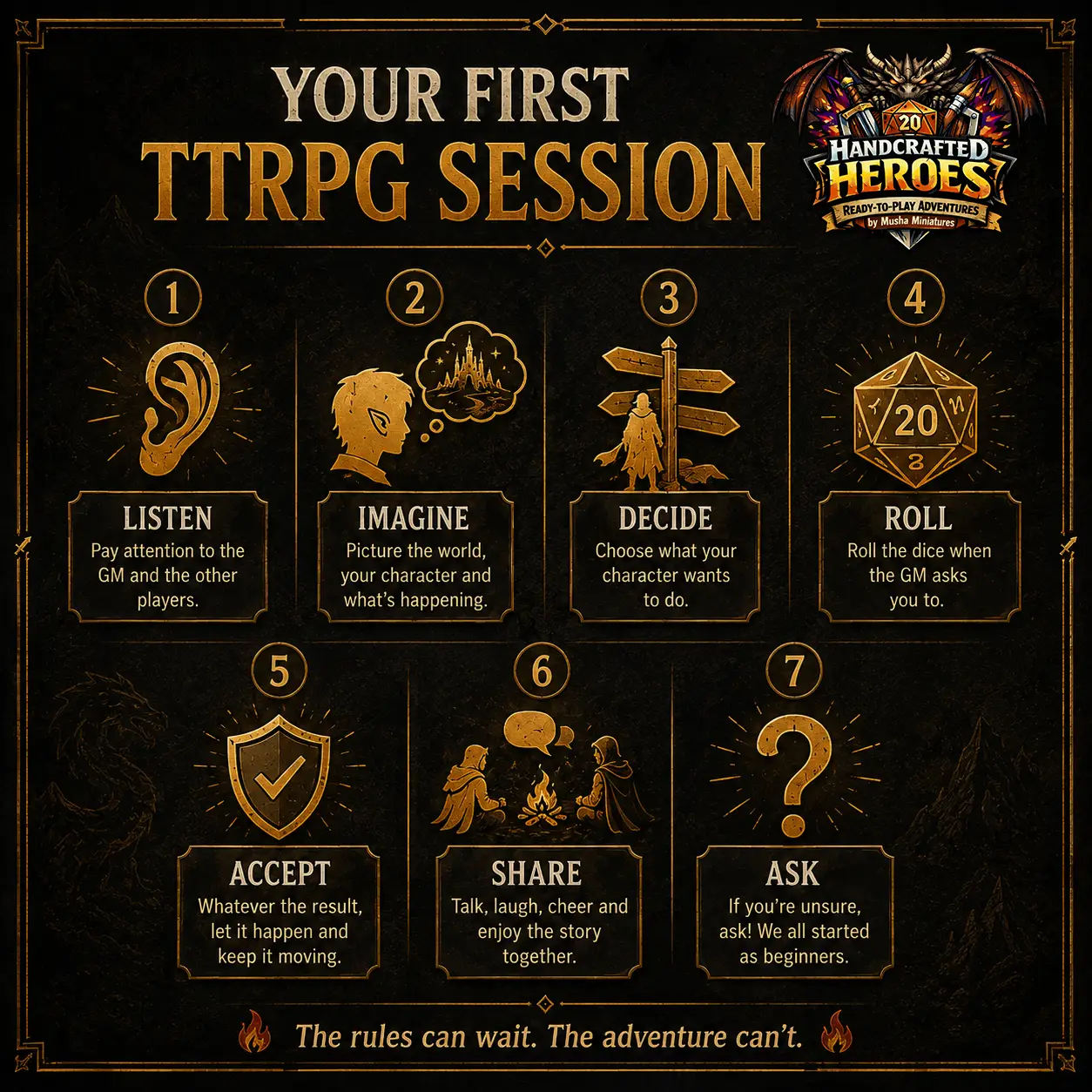
Your First TTRPG Session Cheat Sheet
You don’t need to remember this entire article when you sit down.
Remember this:
Listen
Understand the situation your character is currently facing.
Imagine
Forget the character sheet for a second. What would you want to do if you were standing there?
Decide
Tell the table what your character attempts.
Roll when asked
Don’t hunt for rolls. Describe actions first.
Accept the consequences
Success changes the story. Failure changes it too.
Share the spotlight
Your character matters. So do everyone else’s.
Ask questions
Nobody expects you to know everything.
Have fun with bad decisions
Sometimes opening the obviously cursed chest is a terrible strategic choice.
It may also be an excellent story choice.
One Last Thing Before You Roll
There is a point where preparing to play becomes another way of postponing playing.
You don’t need to know every rule. You don’t need the perfect character. You don’t need a professionally painted battlefield. You don’t need to know whether this will become a campaign lasting three years.
You need a game. You need the people required to play it. And you need somebody to begin the first scene. The rest can be learned at the table.
Because tabletop RPGs aren’t really something you understand completely before you play them. They’re something you understand by playing.
So pick up the dice. Someone has to open that suspicious door.
Musha
Handcrafted Heroes Founder