What Dice Do You Need for D&D? Meet Your First Dice Set
Seven dice. That’s usually how it starts. A tiny pyramid that refuses to roll properly. A perfectly ordinary six-sided die. A mysterious twelve-sided one nobody seems to use until
suddenly everyone needs it. And, of course, the twenty-sided die. The one everybody watches. If you’re preparing for your first Dungeons & Dragons session, you might be wondering whether you need all of them, what they’re called, or why your friend owns an entire velvet bag filled with approximately four hundred dice. Let’s start with the important part.
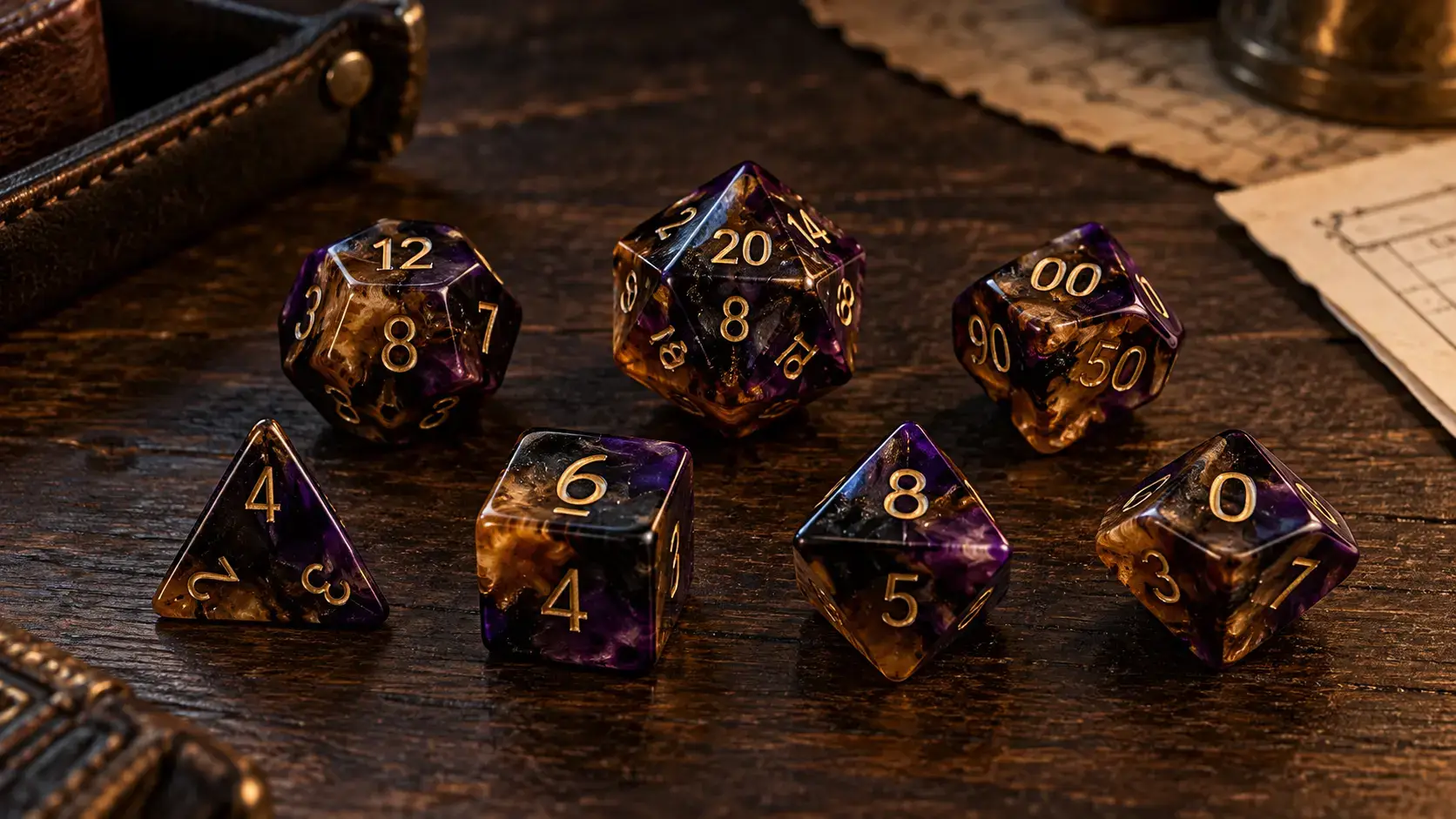
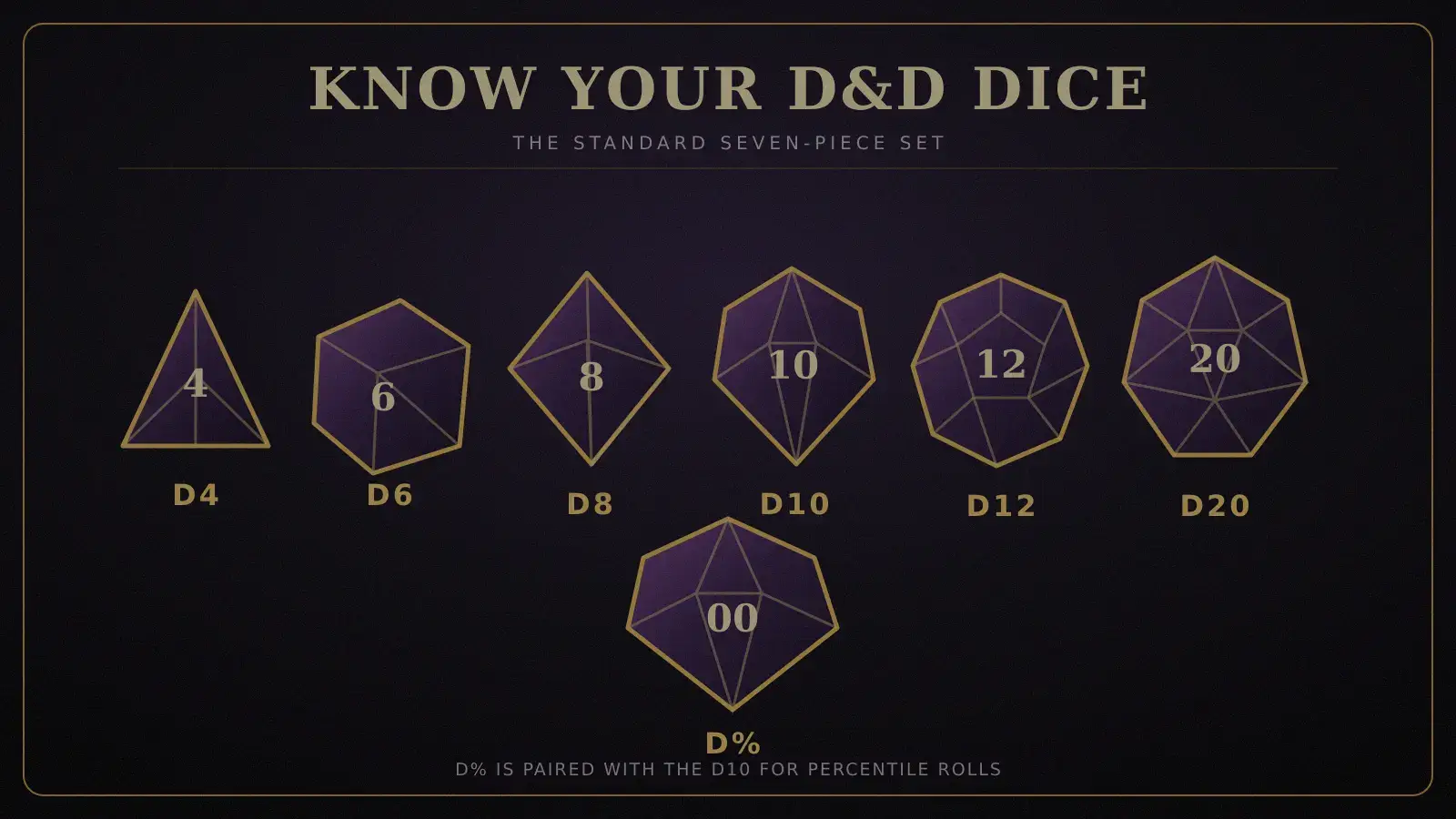
To play Dungeons & Dragons, a standard seven-piece polyhedral dice set is an excellent starting point. It contains the dice commonly used throughout the game: a d4, d6, d8, d10, d12, d20 and a second ten-sided die marked in tens, usually called a percentile die. You don’t need expensive dice. You don’t need metal dice. You certainly don’t need twelve matching sets before your first adventure. But understanding what each die does will make your first session much easier. And once you understand them, you may discover why so many tabletop players become strangely attached to these little pieces of plastic, resin or metal.
First, What Does the “D” Actually Mean?
You’ll see combinations like these everywhere in D&D: 1d20, 2d6 and 1d8 + 3. They might look like mathematical instructions written by a wizard who refuses to explain himself. Fortunately, they’re much simpler than they appear. The letter d stands for die or dice in standard dice notation. The number after it tells you how many sides the die has. So: d20 means a twenty-sided die. d6 means a six-sided die. d8 means an eight-sided die. And when there’s a number before the d, it tells you how many dice to roll.
For example, 2d6 means roll two six-sided dice and add their results together. If the instruction says 2d6 + 3, you roll two six-sided dice, add the results, then add three. That’s it. You’ve just learned how to read a large portion of the dice instructions you’ll encounter in Dungeons & Dragons. Now let’s meet the actual dice.
The Seven Dice in a Standard D&D Set
A typical D&D dice set contains seven physical dice, but only six different basic die types. That’s because the two ten-sided dice serve different purposes when used together. Here’s the entire collection.
| Die | Sides | Common Uses in D&D |
|---|---|---|
| d4 | 4 | Small damage rolls, healing and certain effects |
| d6 | 6 | Weapon damage, spells and many other rolls |
| d8 | 8 | Weapon damage, healing and class abilities |
| d10 | 10 | Damage, class abilities and percentile rolls |
| d12 | 12 | Certain weapons, abilities and damage rolls |
| d20 | 20 | Attack rolls, ability checks and saving throws |
| d% | 10, marked in tens | Percentile rolls when paired with a d10 |
These are common examples, not exclusive uses. The specific dice required depend on the rules and abilities involved.
The d20: The Die That Decides Your Fate
If D&D had a mascot made of geometry, it would probably be the d20. The twenty-sided die is central to the game’s most familiar mechanics. You use it for three especially important kinds of rolls: Attack rolls, to determine whether an attack hits. Ability checks, to resolve uncertain tasks involving a character’s abilities or skills. Saving throws, to determine whether a character resists or avoids certain harmful effects. Imagine your rogue wants to sneak past a sleeping guard. The Dungeon Master asks for a Dexterity (Stealth) check.
You roll your d20. Then you add the relevant modifier and any applicable proficiency bonus. The total determines whether you succeed against the difficulty set by the rules or DM. If you’re still learning when to roll and what happens afterward, our guide to [how to play a tabletop RPG] walks you through your first session. The important detail is that the number showing on the die isn’t always your final result. Your character’s abilities matter too. And here’s something beginners often misunderstand:
Rolling a natural 20 on an ability check doesn’t automatically mean you can accomplish absolutely anything. Under the standard D&D rules, a natural 20 automatically hits on an attack roll, but ability checks work differently. So no, rolling a 20 doesn’t necessarily convince the king to hand over his kingdom. Nice try, though.
The d4: Small, Sharp and Surprisingly Useful
The d4 is the little pyramid-shaped die. It has four sides. It also has a remarkable talent for becoming the most unpleasant object to step on barefoot. In D&D, you’ll encounter d4 rolls in various abilities, spells and damage calculations. For example, a dagger deals 1d4 piercing damage under the standard weapon rules. Certain healing effects and class features also use d4s. One practical detail: not every d4 displays its result in exactly the same way. Some have numbers positioned near the points.
Others place numbers along the edges. Check how your particular die is meant to be read. If everyone at the table agrees which number counts, you’re good.
The d6: The Familiar One
You’ve probably rolled this die long before discovering D&D. It’s the standard six-sided die used in countless board games. In Dungeons & Dragons, it’s everywhere. Weapon damage. Spell damage. Certain class abilities. Random tables. And plenty of other situations. A greatsword, for example, traditionally deals 2d6 damage. That means rolling two six-sided dice and adding their results. If you roll a 3 and a 5: 3 + 5 = 8 Then apply any relevant damage modifiers. Simple. The d6 might be the least mysterious die in your collection, but you’ll probably use it quite a lot.
The d8: A Very Busy Die
The eight-sided die is another common sight. It appears in weapon damage, healing spells and many class features. A longsword wielded with one hand, for example, commonly uses a d8 for its damage die. You’ll also encounter d8s in certain healing effects and character abilities. This is one of those dice that quietly becomes essential without receiving nearly as much attention as the d20. The d20 gets the dramatic moment. The d8 gets the work done.
The d10 and d%: Two Dice, One Special Trick
These are the dice that confuse beginners most often. Both have ten sides. But one usually displays: 0–9 while the other displays: 00–90 The second die is commonly called the percentile die, or d%. Together, they allow you to generate a result from 1 to 100. For example: Your percentile die shows 40. Your regular d10 shows 7. The result is: 47. Easy. But what if both show zero? 00 + 0 = 100 when using the standard percentile convention. And if the percentile die shows 00 while the regular d10 shows 6?
That’s 6, not 106. This system is commonly used for percentile tables and random results. One important distinction: the d% isn’t a separate hundred-sided physical die. It’s normally a ten-sided die marked in tens, paired with another d10. Although yes, actual hundred-sided dice exist. And yes, somebody at your table probably owns one.
The d12: The Underrated One
The twelve-sided die doesn’t always get much attention. Until the barbarian arrives. A greataxe, for example, uses a d12 for its standard damage die. Other abilities and effects also call for twelve-sided dice. It’s a distinctive shape, feels satisfying to roll and tends to be used less frequently than the d20 or d6 in many games. But when the rules ask for one, you’ll be glad it’s in your set. Especially if you’re the person holding the greataxe.
How Many Dice Do You Actually Need to Start Playing?
Here’s the answer your wallet has been waiting for. One standard seven-piece set is enough to get started. Dice are only one part of your setup. Here’s what you actually
need to play a tabletop RPG, including the essentials and optional accessories. You can share it with other players. You can use a digital dice roller. You can borrow dice from your Dungeon Master. You don’t even need to own physical dice if your group is happy using digital tools. The game cares about the result.
Not how expensive the object producing it happens to be. So why do some players own multiple sets? There are a few practical reasons.
Rolling Several Dice at Once
Some spells and abilities require multiple dice of the same type. For example, a spell might deal 8d6 damage. With one d6, you can roll eight times and add the results. Perfectly valid. But having eight d6s makes that process considerably faster. And there’s something undeniably satisfying about rolling a handful of dice across the table.
Keeping Dice Close to Each Player
Sharing one set between five people works. But eventually, somebody will need the d8. Someone else has it. It’s underneath their character sheet. They’re looking for it. The wizard has somehow acquired three d20s. Nobody remembers who brought the percentile die. Having a personal set is simply convenient.
Rolling With Advantage or Disadvantage
In D&D, certain circumstances give you Advantage or Disadvantage on a d20 roll. With Advantage, you roll two d20s and use the higher result. With Disadvantage, you use the lower result. You can roll the same d20 twice, but having two makes the process faster. This is how the official D&D 2024 rules describe the mechanic. And that’s it. Extra dice are convenient. Not mandatory.
Do Different D&D Classes Need Different Dice?
They use the same types of dice. But some characters will reach for certain dice more often than others. A fighter using a greatsword may frequently roll d6s for damage. A barbarian wielding a greataxe may become particularly familiar with the d12. A spellcaster might need several d6s or d8s depending on their spells. A rogue may eventually roll multiple d6s for Sneak Attack. But the important thing is this: You don’t need to buy a different kind of dice set for every class.
The standard polyhedral set covers the normal dice types used throughout D&D. What changes is how frequently you use each one. Still deciding which kind of hero to play? Start with our guide to [creating your first RPG character]. And as your character develops, you may discover that certain dice become particularly important to them. Which brings us to something interesting.
Your Dice Don’t Make Your Character Stronger
Let’s get this out of the way. Metal dice don’t roll higher. Expensive dice don’t improve your attack bonus. A beautiful handmade d20 doesn’t give you Advantage. And purple dice do not automatically make your wizard more powerful. We have tested the emotional theory extensively. The mechanical results remain disappointing. A fair die should give every face the same probability of appearing. For a standard d20, that means each individual face has a 5% probability. A natural 20 is exciting because it is one of twenty equally likely results, not because the die has decided to reward your bravery.
But players still develop attachments to particular dice. Why? Because tabletop gaming isn’t only about probability. It’s also about ritual.
Why Do Players Get So Attached to Their Dice?
Ask an experienced tabletop player about their favorite dice and you may receive a surprisingly detailed answer. Maybe it was their first set. Maybe the colors match their character. Maybe it was a gift from their gaming group. Maybe that particular d20 rolled the critical hit that defeated the final boss. Or maybe they simply think it looks beautiful. There’s something special about having a physical object associated with your adventures. A die can become part of the memory of a session.
You remember the moment everyone leaned toward the table. The sound of the roll. The silence. The result. And the absolute chaos that followed. The die didn’t create the story. But it was there when the story happened. That’s part of the appeal of physical tabletop accessories. They’re functional objects that can gradually become personal. Dice aren’t the only tabletop accessories that become part of a character’s story. We explored something similar in our guide to whether you need miniatures
to play D&D.
Resin, Acrylic or Metal: Does the Material Matter?
For ordinary D&D gameplay, the most important thing is that your dice are readable, practical and reasonably fair. For a broader look at trays, towers and other useful extras, see our guide to the [best TTRPG accessories for beginners]. Different materials change the physical experience more than the rules.
Acrylic and Plastic Dice
Usually affordable. Lightweight. Widely available. Perfectly suitable for beginners. If you’re buying your first set and don’t know what you like yet, this is a sensible starting point.
Resin Dice
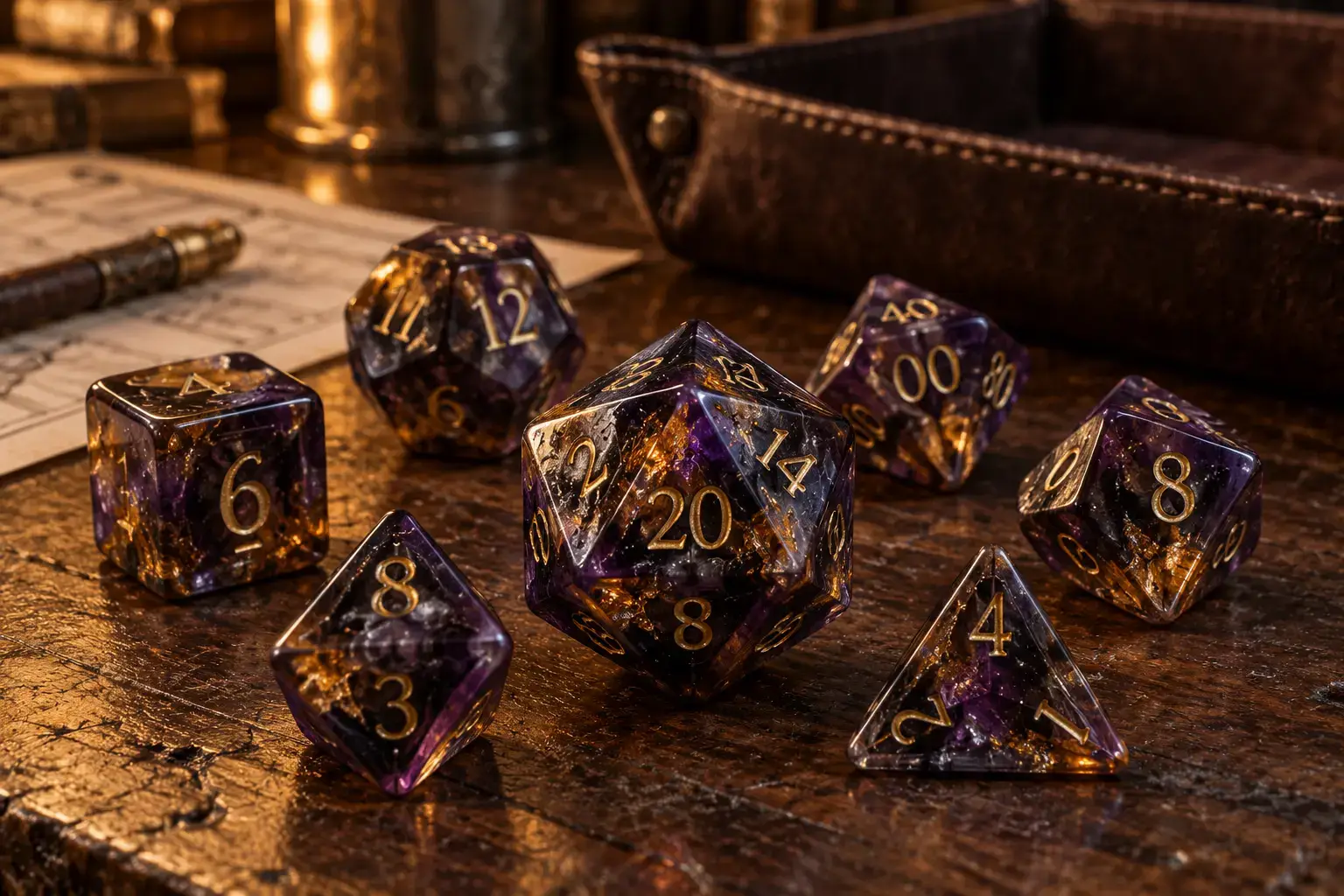
Resin allows for interesting visual effects. Transparent colors. Swirls. Embedded decorative elements. Layered pigments. Handcrafted finishes. A well-made resin set can feel particularly personal because the visual possibilities are so broad. However, decorative elements and manufacturing quality can affect balance, so appearance alone doesn’t guarantee a perfectly fair die.
Metal Dice
Metal dice feel substantially heavier. They can produce a satisfying roll, although they may also be louder and harder on delicate playing surfaces. A dice tray is a good idea. Especially if your table is made from something you would prefer not to dent.
Handmade Dice
Handmade dice can offer a level of customization that mass-produced sets don’t always provide. Unique colors. Special numbering. Custom symbols. Personalized designs. At Handcrafted Heroes, this is one of the parts of the hobby we enjoy exploring ourselves. We’ve been experimenting with sculpting custom dice, creating silicone molds and casting resin. And, like most handcrafted projects, the process has involved a few lessons. Including the discovery that pouring resin too quickly is an excellent way to introduce bubbles into something you were hoping would be perfectly clear.
That’s part of making things by hand. Experiment. Make mistakes. Improve the process. Try again. But none of that changes the advice we’d give a beginner: Start with a functional set. Discover what you enjoy. Collect the beautiful ones later.
Can You Play D&D Without Physical Dice?
Absolutely. Digital dice rollers can perform the same mechanical function. They’re particularly useful when: you’re playing online; you haven’t bought a set yet; you need to roll a large number of dice; or you simply prefer digital tools. Some virtual tabletop platforms can also calculate modifiers and resolve rolls directly from character sheets. That’s convenient. But there’s a difference between convenience and preference. Some players love clicking a button and immediately seeing the result. Others love picking up a physical d20, shaking it and throwing it onto the table while everyone watches.
Neither is the correct way. They’re different ways of enjoying the same game. If your group meets remotely, we’ll also cover [how to play tabletop RPGs online], including digital dice and virtual tabletops.
The Three Dice Mistakes Beginners Make
There are a few things worth checking before your first session.
1. Rolling the Wrong Die
Your DM asks for a d12. You confidently roll a d20. It happens. The shapes can look surprisingly similar when you’re new. Keep your dice arranged somewhere visible until you recognize them easily. You’ll learn quickly.
2. Forgetting the Modifier
Your d20 shows 11. You announce:
“Eleven!”
But your character has a +5 bonus. Your actual total is 16. Remember that many D&D rolls combine the die result with numbers from your character sheet. The die is only part of the calculation.
3. Treating Every Roll Like a d20 Roll
Not every situation uses the d20. You may roll a d20 to determine whether an attack hits. Then roll a different die to determine damage. That’s an important distinction. The d20 often helps determine whether something happens. Other dice frequently help determine how much happens. It’s a useful mental shortcut, even though individual rules can work differently.
Your First D&D Dice Checklist
Before your first game, make sure you can answer these questions.
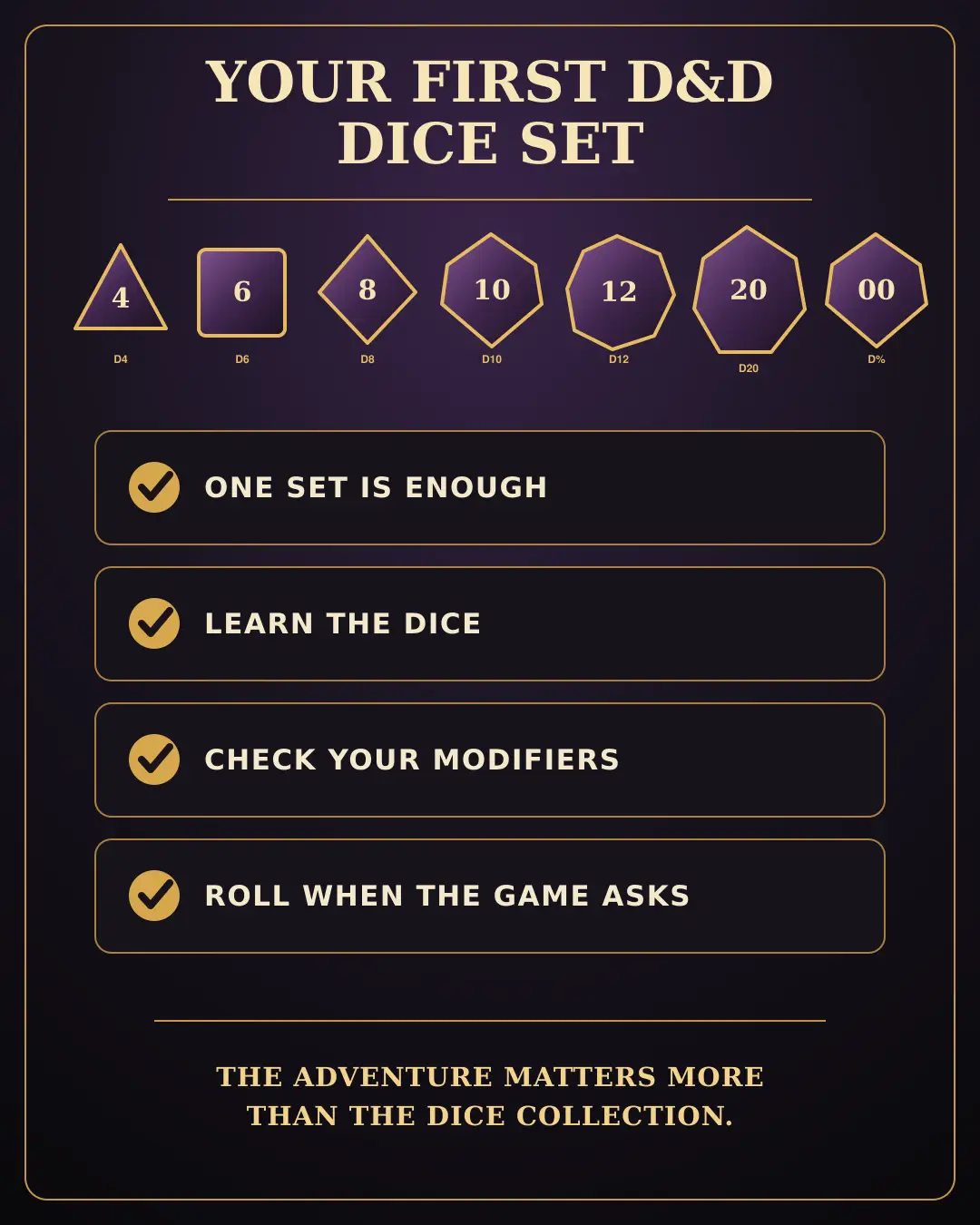
Do I have access to a complete polyhedral set? A standard seven-piece set is enough.
Can I recognize each die? d4, d6, d8, d10, d12, d20 and percentile d10.
Do I understand dice notation? 1d20, 2d6, 1d8 + 3.
Do I know where my character’s modifiers are? Your character sheet will help.
Do I understand that not every action requires a
roll? Describe what you want to do first.
Do I need extra dice? Probably not yet.
Do I need expensive dice? Definitely not.
Have I already started looking at another set because the colors match my character? Ah. Welcome to the hobby.
One Set. Thousands of Possible Stories.
You don’t need a collection to start playing D&D. You need a way to resolve the game’s rolls. A standard seven-piece polyhedral set does that beautifully. The d20 will help determine whether your attacks land, whether you resist danger and whether your character succeeds at uncertain tasks. The other dice will help determine damage, healing and countless other outcomes. Over time, you may collect more. Different colors. Different materials. Custom designs. Dice that remind you of particular characters or adventures. That’s part of the fun.
But your first set doesn’t need to be special before you play. It becomes special because of what happens while you’re using it. Maybe your first d20 will roll a natural 20 at exactly the right moment. Maybe it will betray you spectacularly. Maybe you’ll spend your first session discovering that the person who insisted they understood the rules has been using the wrong die for an hour. Whatever happens, you’ll have a story. And that’s what the dice are really there for.
Now roll for initiative.
Musha
Handcrafted Heroes