Can You Play a Tabletop RPG by Yourself? A Beginner’s Guide to Solo RPGs
Can You Play a Tabletop RPG by Yourself? Welcome to Solo RPGs
The party is ready.
The dice are on the table.
The adventure is waiting.
There’s only one small problem.
You’re the entire party.
Good news: that’s not actually a problem. You can absolutely play a tabletop RPG by yourself.
A solo RPG is a role-playing game played by one person, usually using rules, prompts, random tables, cards or an oracle to perform some of the jobs that would normally belong to a Game Master or other players. Modiphius describes solo RPGs in essentially those terms: pen-and-paper role-playing experiences designed for a single player without requiring a separate GM, using tools such as random tables, worksheets and story guidance to create events.
And this isn’t simply a workaround invented because your regular group cancelled.
Solo role-playing has games specifically designed around it, solo modes added to traditional RPGs, and even established RPG lines publishing dedicated one-player adventures. Ironsworn, for example, is officially designed for solo, cooperative and guided play.
So yes.
One person.
One character.
One world.
Still a tabletop RPG.
Wait — How Can an RPG Work Without Other Players?
That’s usually the first question. Traditional tabletop role-playing works because the player doesn’t know everything.
The GM knows what’s behind the door. The player decides whether to open it. That uncertainty creates discovery.
If you’re both the player and the GM, wouldn’t you already know what’s behind the door? You could. But solo RPGs have developed ways around that problem. Instead of deciding every answer yourself, you let procedures generate uncertainty.
Imagine your character arrives at an abandoned watchtower.
You wonder:
“Is somebody still inside?”
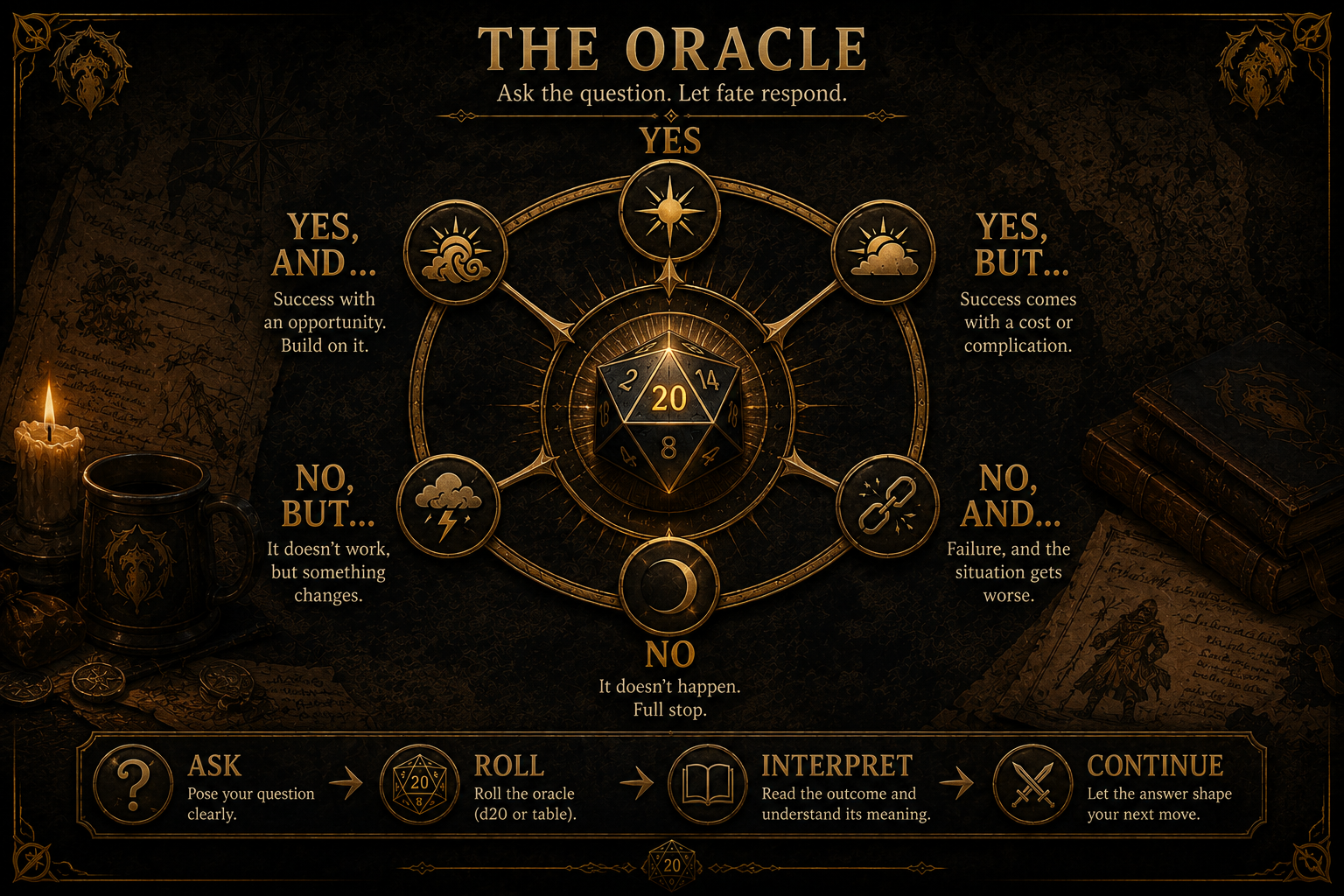
You ask the game’s oracle.
Roll.
The answer might be:
Yes, but…
Now you have to interpret that. Someone is inside…
but they’re injured.
but they’re hiding from something.
but they don’t want you there.
You didn’t know that before you rolled. Now you do. And suddenly the story has something new to respond to.
That’s solo role-playing.
If you’re completely new to the medium, our guide to [What a tabletop RPG actually is] explains the basic player–world interaction first.
Meet the Oracle
No crystal ball required. In solo RPG terminology, an oracle is a procedure used to answer questions that would normally be resolved by another person.
It might be as simple as:
Yes / No
or as nuanced as:
Yes, and…
Yes…
Yes, but…
No, but…
No…
No, and…
Other oracles generate:
- Locations;
- NPC motivations;
- Events;
- Complications;
- Weather;
- Treasure;
- Dangers;
- Relationships;
- Or completely unexpected twists.
The point is not for the oracle to write the story for you. It’s to introduce information you didn’t consciously choose.
Think of it as the world throwing something back across the table.
Only the table happens to have one chair.
A Solo Session Still Uses the Same RPG Loop
This is important. Solo play isn’t fundamentally a different medium.
Remember our basic loop?
Describe → Decide → Resolve → React.
It still works.
Describe
You establish the current situation.
Your ranger reaches the ruins just before sunset.
Decide
You decide what your character does.
I search the courtyard for signs of recent movement.
Resolve
The game’s rules handle uncertain actions.
Maybe you roll a skill check.
Then you ask the oracle something the character couldn’t know:
“Has somebody been here recently?”
React
The result creates new fiction.
Yes, but…
You find fresh tracks.
But they aren’t human.
Now what? The loop continues. That’s why someone familiar with traditional TTRPGs will recognize solo play surprisingly quickly.
If that loop is still unfamiliar, see the [Basic rhythm of playing a tabletop RPG] before continuing.
Solo RPGs Don’t All Work the Same Way
This is where the category becomes much broader than newcomers usually expect.
There are several very different approaches.
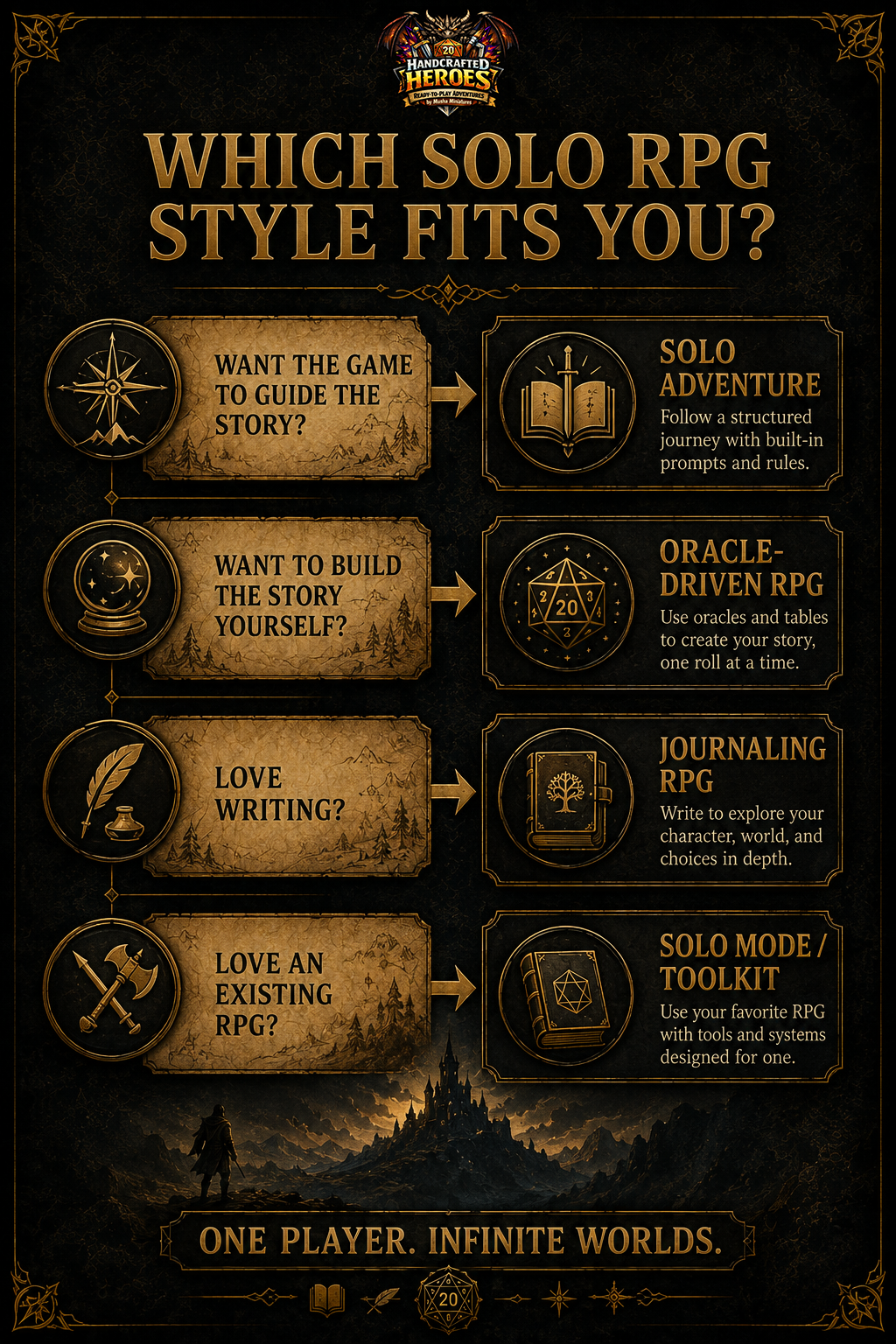
1. Games Designed for Solo Play
Some RPGs build solo play directly into their design.
Ironsworn is one of the clearest examples: its official site describes the game as supporting solo, co-op and guided play rather than treating solo as an afterthought.
In games like this, procedures for generating discoveries, consequences and story developments are part of the core experience.
You aren’t adapting the game.
You’re playing it as intended.
2. Traditional RPGs With a Solo Mode
Another game may normally use a Game Master but provide additional rules specifically for playing alone.
The One Ring’s Strider Mode is an official example. Free League describes it as additional and modified rules designed to facilitate solo play, including guidance and tools specifically for the solo player.
This approach lets you experience an existing RPG world while changing how narrative responsibility is handled.
3. Solo Adventure Books
Then there are experiences much closer to an interactive adventure.
You’re given a scenario.
You make decisions.
The book directs you through different situations depending on your choices and rolls.
Chaosium has an entire range of Solo Call of Cthulhu adventures. Its free Alone Against the Flames is explicitly a one-player scenario where your choices determine how the horror story develops, and Chaosium presents it as a way to learn Call of Cthulhu while playing.
This is arguably one of the easiest ways to understand solo RPGs if the idea of generating an entire world yourself still feels intimidating.
4. Journaling RPGs
Some solo games lean heavily into writing.
You receive prompts.
Make decisions.
Record what happens from the perspective of your character.
The resulting experience can sit somewhere between:
- Role-playing;
- Creative writing;
- Worldbuilding;
- And journaling.
That doesn’t make it “less RPG.” The role-playing is still happening through decisions made from inside a character’s perspective.
Modiphius itself notes this overlap when describing solo RPGs, observing that some players view them as guided journaling or creative-writing tools.
5. Traditional RPG + Solo Toolkit
Finally, some players take a game they already know and add:
- An oracle;
- Random tables;
- Encounter generators;
- NPC generators;
- And other solo tools.
This is the most flexible approach. It’s also the one that asks the most from you.
You aren’t simply playing. You’re partially designing the procedure that keeps the adventure surprising.
For a complete beginner, I’d usually start with a game or scenario built for solo play before doing this.
“But Aren’t I Just Making Everything Up?”
Yes. And no. You’re already making things up in a normal RPG.
The difference is who introduces the unexpected information.
At a normal table:
GM: “There’s a dragon behind the door.”
You didn’t choose that.
During solo play:
Oracle: Extreme Yes + Danger
Now you interpret what that means.
Maybe:
There’s not merely someone behind the door.
There’s something enormous behind it.
Your interpretation creates the fiction.
The random result prevents you from fully controlling it.
This creates a peculiar and very satisfying creative tension: you are both discovering and creating the story at the same time.
That’s not identical to playing with a GM. It doesn’t need to be.
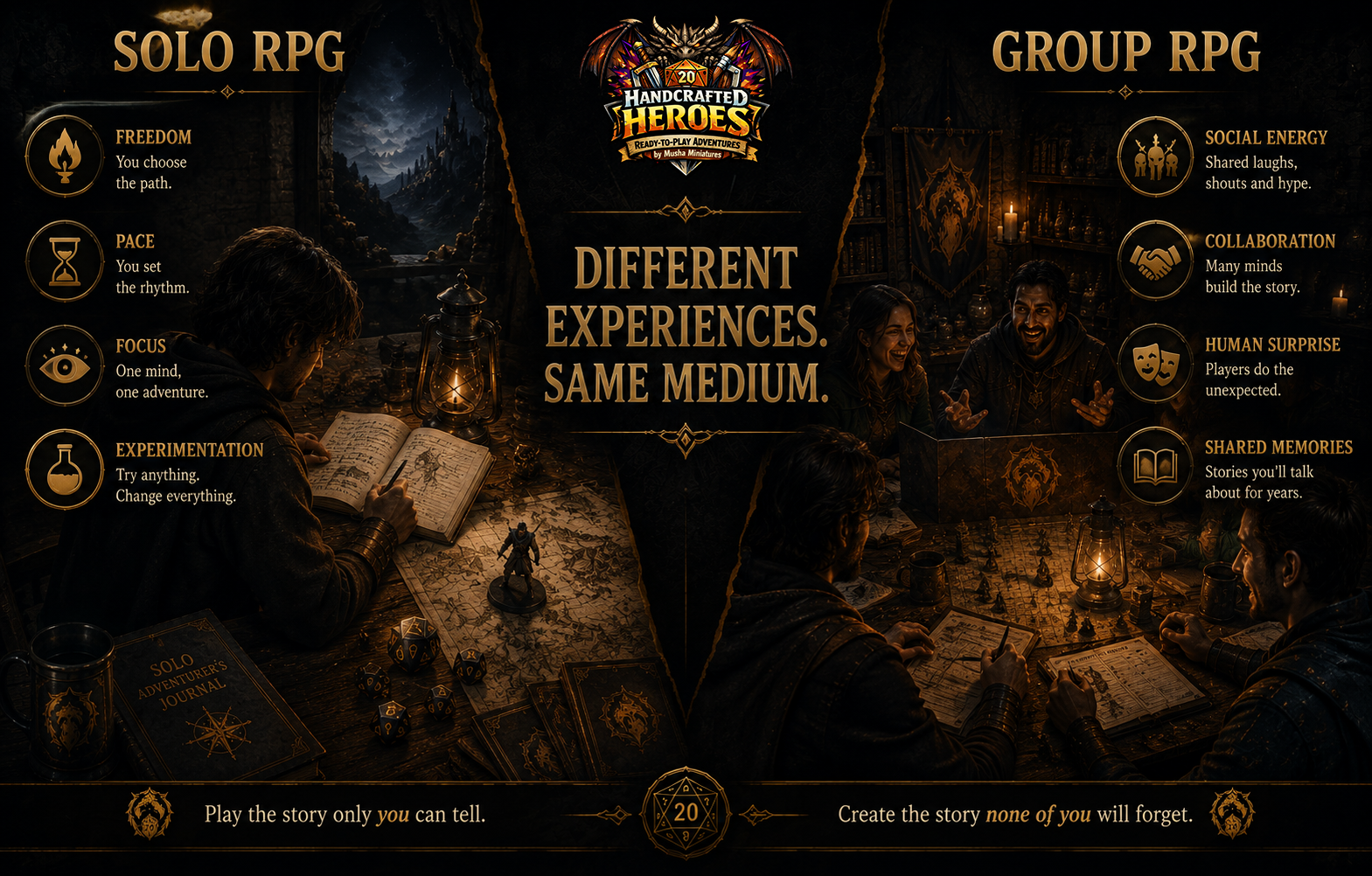
Solo RPG vs Duet RPG
These terms can get confused, so let’s separate them.
| Solo RPG | Duet RPG | |
|---|---|---|
| Humans playing | 1 | 2 |
| Traditional GM required | No | Sometimes |
| Characters | One or more | One or more |
| World generation | Rules/oracles/prompts/player | GM, shared rules or prompts |
| Social interaction | None required | Central between two people |
| Scheduling | Extremely easy | Very easy |
A solo RPG has one actual human player.
A duet RPG has two.
The number of fictional characters doesn’t matter.
You could control an entire six-person adventuring party by yourself and still be playing solo.
If there are two of you, read our guide to [Playing tabletop RPGs with only two players] instead.
Why Would You Play an RPG Alone?
The obvious answer is:
“Because nobody else is available.”
That’s certainly one reason.
But reducing solo RPGs to a substitute for group play misses most of their appeal.
You Can Play Whenever You Want
No calendars.
No group chat.
No:
“Can everyone do the 17th?”
You have thirty minutes free?
Play.
Sunday morning?
Play.
Everyone else cancelled?
Their loss.
This makes solo RPGs particularly interesting for people who love tabletop role-playing but struggle with regular scheduling.
You Control the Pace
Want to spend twenty minutes writing your character’s conversation with an old friend? Do it.
Want to skip an uninteresting journey with one sentence? Do it.
Want to spend an entire evening investigating a mysterious shrine nobody else would care about? Nobody is waiting for their turn.
Solo play can become unusually reflective because there is no social pressure to keep scenes moving for other people.
You Can Explore Weird Ideas
Maybe there’s a character concept you love but wouldn’t bring to your normal campaign.
Maybe you want:
- A completely pacifist knight;
- An elderly wizard;
- A villain;
- A merchant;
- A lonely ranger exploring ruins;
- Or someone whose primary goal is absolutely not saving the world.
Solo play lets you explore experiments without asking an entire group to build its evening around them.
You Can Learn a System
This is underrated.
Playing alone can give you time to understand:
- Character sheets;
- Checks;
- Combat;
- Resource systems;
- And rules interactions
without four people watching while you search the book.
Some official solo products are explicitly structured this way. Chaosium’s Alone Against the Flames, for example, is offered as a solo adventure that teaches Call of Cthulhu during play.
What Solo RPGs Lose
Let’s not pretend the format has no trade-offs.
It does.
The Table Doesn’t Surprise You in the Same Way
No oracle can perfectly recreate another human being saying:
“I seduce the dragon.”
when you had built an entire tactical plan around fighting it.
Group RPGs generate chaos because different people have genuinely independent minds.
Solo systems simulate uncertainty.
They don’t simulate your friend Marco making a decision nobody with access to rational thought could have predicted.
You Lose Social Energy
The laughter.
Arguments.
Shared victories.
Everyone watching the die stop rolling.
Those moments are fundamentally social. If that’s the main thing you love about RPGs, solo play may complement group gaming rather than replace it.
You Carry More Creative Responsibility
At a normal table, somebody else keeps feeding the world back to you.
Solo?
Even with excellent tools, you usually do more interpretation.
Some players find that liberating.
Others find it tiring.
Neither reaction is wrong.
Can You Play D&D Alone?
Technically, you can adapt many traditional RPGs for solo play by adding an oracle or other GM-emulation tools.
But D&D’s standard structure is designed around a Dungeon Master and a party, so playing it alone usually requires more adaptation than choosing a system explicitly designed for solo play.
For a complete beginner who simply wants to discover what solo role-playing feels like, I’d usually choose:
a dedicated solo RPG
or
an official solo scenario for an existing system
before trying to convert a traditional campaign manually.
The goal of your first solo session shouldn’t be to prove you can engineer the system. It should be to discover whether you enjoy the experience.
What Are Some Real Solo RPG Options?
I’m not turning this article into a ranking because that’s a different search intent.
But it helps to see how different the category can be.
Ironsworn
Fantasy adventuring built from the ground up to support solo, co-op and guided play.
The One Ring + Strider Mode
A traditional RPG adapted through official additional rules for solo journeys in Middle-earth.
Solo Call of Cthulhu
Structured one-player horror scenarios, including the free Alone Against the Flames.
Star Trek Adventures: Captain’s Log
A standalone solo RPG designed specifically around creating a single-player Star Trek story using guidance, tables and worksheets.
Look at how different those are.
Fantasy sandbox.
Middle-earth journey.
Interactive horror.
Star Trek captain’s log.
“Solo RPG” isn’t a genre.
It’s a way of distributing narrative responsibility.
And that opens an enormous range of possibilities.
What Do You Need for Your First Solo RPG?
Potentially even less than a normal table.
At minimum:
A solo-capable game or scenario
Preferably something designed for the format when you’re learning.
Your character
One protagonist is usually the easiest start.
The game’s resolution tools
Dice, cards, tables or whatever the system uses.
Something to record what happens
Notebook.
Character sheet.
Digital document.
Journal.
Whatever works.
Time
That’s it.
No group required.
Miniatures?
Optional.
Maps?
Optional.
Music?
Optional.
But if those physical elements help you imagine the world, use them.
Solo play doesn’t mean abandoning the tabletop part of tabletop RPGs.
You can build a gorgeous miniature dungeon for an audience of exactly one.
We fully support this behavior.
For a broader equipment breakdown, see [What you actually need to play a tabletop RPG].
Your First Solo Adventure in Five Minutes
Here’s the simplest demonstration I can give you.
Take a character.
Let’s say: Mira, a wandering knight searching for her missing sister.
Start somewhere.
Mira reaches an abandoned chapel at sunset. Her sister’s horse is tied outside.
Now ask: Is the chapel door open?
Roll your oracle.
No, but…
Interpret: The door is locked. But there’s light coming through one of the windows.
What does Mira do?
She approaches the window quietly.
Does anyone notice her?
Roll.
Yes.
Who?
Use a random table or invent possibilities, then roll.
A frightened priest.
He opens the door. Mira asks about her sister. Does he know where she is?
Roll.
Yes, but…
He knows. But he refuses to tell her unless she helps him first. And there you go.
You now have:
- A character;
- A location;
- A mystery;
- An NPC;
- A complication;
- And a new objective.
Nobody wrote that exact sequence beforehand. You discovered it by playing. That’s the moment solo RPGs click.
The HH Solo Test
Before choosing solo play, ask yourself five things.
Do I enjoy creating as well as discovering?
Solo RPGs ask you to interpret.
If you love filling in imaginative gaps, that’s a feature.
Do I want structure or freedom?
A guided solo adventure gives you more structure.
An oracle-driven sandbox gives you enormous freedom.
Start where you’re comfortable.
Do I want to write everything down?
You don’t have to. A few notes may be enough.
Choose a system that matches how much journaling you actually enjoy.
Do I want tactical gameplay?
If yes, choose a solo system that supports it rather than assuming every solo RPG is narrative journaling.
Am I trying solo because I can’t find a group — or because solo itself sounds interesting?
Both are valid.
But they may lead you toward different games.
Solo, Duet and GMless Are Three Different Things
We’re going to need this distinction for where the blog goes next.
Solo
One person. No other human required.
Duet
Two people. Often GM + player, but not necessarily.
GMless
No traditional Game Master.
And here’s the important bit: GMless does not automatically mean solo.
A GMless RPG can have:
- One player;
- Two players;
- Five players.
The difference isn’t how many people are at the table.
It’s where the Game Master’s responsibilities go. Into:
- Rules;
- Cards;
- Procedures;
- Shared narration;
- Oracles;
- Or some combination of them.
And that’s exactly the door we’re going through next. What a GMless RPG actually is →
Being Alone Doesn’t Mean the World Has to Be Empty
Group tabletop RPGs are extraordinary because several people create something none of them could have predicted alone.
Solo RPGs can’t recreate that.
They offer something else.
You can follow one character as slowly as you want.
Explore a world nobody else needs to care about.
Stop whenever you want. Start whenever you want.
Let dice turn your plans against you.
Discover characters you never intended to meet.
And watch a story grow from a conversation between:
your decisions
and
the game’s uncertainty.
Maybe your regular party is unavailable. Maybe you’ve never had a party. Maybe you played with six people yesterday and still want another adventure today.
You don’t need permission. Open the book. Pick up the dice. Ask the world a question. Then find out what it says back.
Musha
Handcrafted Heroes Founder