One-Shot vs Campaign: Which TTRPG Format Is Right for Your Group?
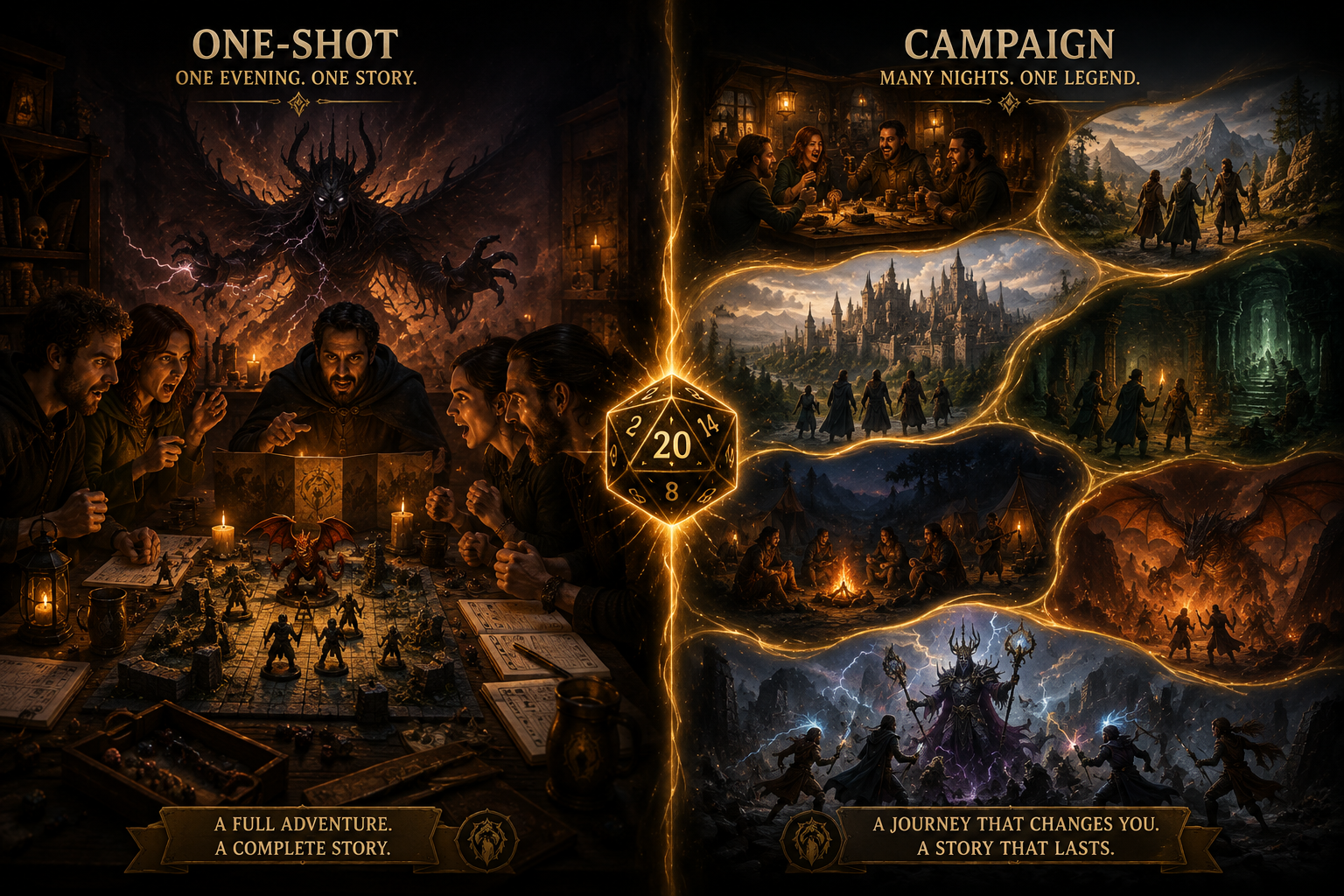
One-Shot vs Campaign: Which Adventure Fits Your Table?
There’s a question every tabletop group eventually has to answer.
Not:
“Which game should we play?”
But:
“How much adventure are we actually signing up for?”
Maybe you’ve finally managed to get five friends around the same table and want a complete story before midnight.
Maybe you’ve found the group. Everyone can meet regularly, people are already talking about their characters between sessions, and somebody has created a campaign Discord before session zero has even happened.
Those tables probably shouldn’t choose the same format.
A one-shot is designed to tell a self-contained story in one session.
A campaign connects multiple sessions into a continuing story where characters, relationships and the world can develop over time. Current beginner-oriented definitions generally make exactly this distinction: one-shot means one complete session with no continuing commitment, whereas campaigns involve recurring sessions and ongoing narrative development.
Neither format is the “real” way to play a tabletop RPG.
They’re tools for creating different kinds of memories.
The trick is choosing the one your group will actually enjoy — and actually manage to play.
New to the hobby entirely? Start with What a tabletop RPG actually is →
First, the Short Answer
Choose a one-shot if your group wants:
- A complete adventure in one evening;
- Minimal scheduling commitment;
- To try a new system;
- To introduce new players;
- To experiment with unusual characters;
- Or simply to play tonight without deciding what you’re doing for the next six months.
Choose a campaign if your group wants:
- Characters that grow over time;
- Recurring NPCs and villains;
- Long-term consequences;
- Deeper relationships;
- Larger mysteries;
- And a world everyone can return to session after session.
And choose neither based purely on prestige.
A twelve-month campaign is not automatically more meaningful than a four-hour one-shot.
Length creates possibilities. It doesn’t guarantee quality.
If you’re still unsure [What a one-shot is], start with our complete guide to one-session RPG adventures.
The Biggest Difference Isn’t Story Length. It’s Commitment.
Imagine someone messages the group:
“Free Saturday? I’ve got a fantasy one-shot.”
You need one evening.
Now:
“I’m starting a campaign. Every other Thursday. Probably for the next year.”
That requires something different.
Not necessarily more enthusiasm.
More continuity.
Campaigns depend on recurring availability. People need to remember what happened. Characters need to return. The GM may need to prepare future sessions. When somebody disappears for three months because life happened, the story has to absorb that.
A one-shot doesn’t eliminate scheduling. You still need everyone in the same place at the same time. It simply turns scheduling into one successful event rather than an ongoing requirement.
For adult groups especially, that difference can be enormous.
And that’s why asking:
“What can our group realistically sustain?”
is usually more useful than asking:
“Which format is better?”
One-Shot: One Night Has to Matter
Short-form adventures have a strange advantage. They can’t procrastinate. If your group has four hours, the adventure doesn’t have twelve sessions to explain why the abandoned monastery matters.
Something needs to happen.
A door opens.
Someone disappears.
A body is found.
The village catches fire.
A stranger delivers a message nobody was supposed to receive.
The players have a reason to act now. That creates momentum. And because the characters may only exist for one evening, players can sometimes take bigger risks.
D&D’s own discussion of one-shots points to exactly this freedom: characters can make dramatic mistakes or unusual choices that might derail a long-running campaign but become memorable in a self-contained adventure.
Your paladin wants to challenge the demon alone? Terrible idea. Possibly excellent one-shot material.
Campaign: Time Becomes Part of the Story
Campaigns have the opposite superpower.
They can wait.
An NPC introduced tonight can become important six months later.
The sword you found at level three may matter at level nine.
A minor decision your party forgot about can return unexpectedly.
A rival can slowly become an ally.
An ally can slowly become something much worse.
And your character doesn’t just complete an adventure.
They accumulate history.
The nervous apprentice from session one might eventually become the person standing between an army and the kingdom. That transformation feels different when the table has actually spent months getting there. Campaigns turn real-world time into emotional weight.
That’s very difficult for a one-shot to reproduce.
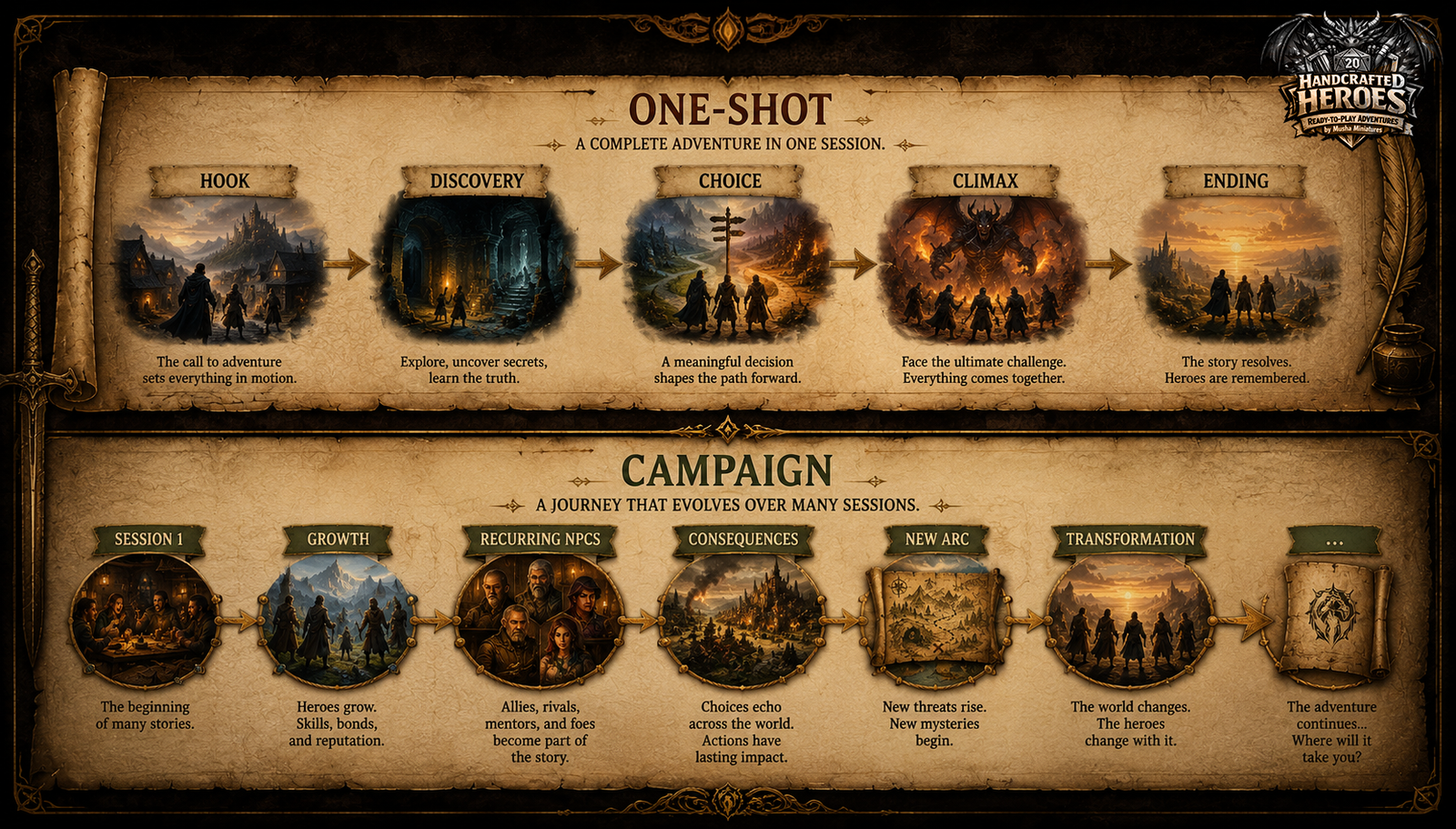
One-Shot vs Campaign: The Quick Comparison
| One-Shot | Campaign | |
|---|---|---|
| Duration | Usually one session | Multiple connected sessions |
| Commitment | One evening | Recurring |
| Character growth | Limited but possible | Major part of the experience |
| Story scope | Focused | Broad |
| Recurring NPCs | Limited | Often important |
| Scheduling pressure | Lower | Higher |
| Trying new systems | Excellent | Bigger commitment |
| New players | Excellent entry point | Works, but asks for more commitment |
| Long-term consequences | Limited to the story | Central |
| Experimentation | Very high | Choices may follow characters for months |
A current StartPlaying comparison frames the same basic trade-off around single-session/self-contained play versus multiple connected sessions with recurring narrative and characters.
But this table still doesn’t answer the important question. Because your group isn’t a spreadsheet. So let’s choose based on the table you actually have.
“We’ve Never Played a TTRPG Before.”
We’d usually start with a one-shot.
Not because beginners are incapable of campaigns.
Quite the opposite.
You might finish your first session and immediately want twenty more.
But a one-shot removes a decision you don’t yet have enough information to make:
“Do I want to commit to this for months?”
- First discover whether you enjoy:
- Making decisions in character;
- Sharing narrative space;
- Using the rules;
- Combat, if the game includes it;
- And simply sitting around a table pretending that a goblin has legal authority to collect bridge tolls.
Then decide whether you want more. A one-shot lets the answer come from experience rather than theory.
If your group hasn’t even chosen a system yet, start with our guide to the [Best tabletop RPG games for beginners].
“We Already Know We Want a Huge Fantasy Story.”
Play the campaign.
There is no reason to deliberately avoid commitment when commitment is exactly what excites everyone.
Your players are already designing characters. Someone wants a redemption arc. Someone else has written three generations of family history. The GM has a map. A frighteningly large map. There are kingdoms. Factions. Dates. Possibly lunar cycles.
This group does not need somebody telling them:
“Maybe just try a little one-shot first.”
Go build the saga.
The advantage of a campaign isn’t simply having more content. It’s continuity. Players begin making decisions today while knowing those decisions may still matter months from now. That changes how people interact with the world.
“We’re All Busy and Getting Everyone Together Is Difficult.”
One-shot.
Or possibly mini campaign. This is where format should follow reality. If organizing five adults produces a diplomatic crisis involving twelve calendars and three time zones, building your entire experience around weekly continuity may create unnecessary friction.
A one-shot gives you something very valuable: closure.
You play. You finish.
The next time the group manages to meet, you can play something else without needing everyone to remember exactly why Duke Alaric hates you.
If getting the whole party together is the real problem, you may also want to explore [Playing a tabletop RPG with only two people].
This doesn’t mean busy people cannot have campaigns. Of course they can. It means the format should serve your lives rather than asking your lives to serve the format.
That’s one of the reasons short-form adventures interest us so much at Handcrafted Heroes.
The goal isn’t to make stories shorter. It’s to increase the chance that they actually reach the table.
“We Want Characters We Can Fall in Love With.”
Campaign.
Probably. One-shots can create unforgettable characters. Sometimes alarmingly quickly. But campaigns allow something one evening cannot: shared history.
Your party develops jokes nobody outside the group understands. Characters establish routines. Relationships become complicated.
Players stop saying:
“the blacksmith NPC”
and start saying:
“Oh no. Not Brenna.”
Death feels different when someone has played the same character for eighteen months.
So does victory. If character evolution is the thing your table values above everything else, campaigns have a major advantage.
“We Want to Try a New RPG System.”
One-shot. Almost every time.
Suppose your D&D group becomes curious about horror.
You don’t need to abandon your campaign and commit immediately to eighteen months of Call of Cthulhu.
Run an evening. Try the mechanics. See how the tone feels. Discover whether your players enjoy investigation. Maybe everybody becomes obsessed.
Great. Now you can build something longer.
Maybe everybody concludes:
“Excellent game. I never want to feel that stressed again.”
Also useful information.
One-shots function brilliantly as experiments. And experiments are one of the healthiest ways to explore how enormous the TTRPG medium really is.
Choose your first tabletop RPG →
“Our GM Is Already Exhausted.”
This one requires nuance. A shorter adventure doesn’t automatically mean zero preparation.
A one-shot still needs:
- Characters;
- Rules;
- Encounters or scenes;
- NPCs;
- A structure;
- Possibly maps and miniatures;
- And enough familiarity to keep the story moving.
In fact, one-shot pacing can be demanding because the GM has less time to recover from detours.
Recent 2026 discussions among DMs still describe preparation as a meaningful workload for both campaigns and one-shots, especially when designing encounters, descriptions and bespoke scenes. But there is an important difference. A prepared one-shot has a finite preparation horizon.
The GM isn’t automatically preparing:
- Next week’s session;
- The consequence of tonight’s decision;
- The next level;
- The next region;
- And what happens when the party decides the campaign is now somehow about opening a bakery.
For an overloaded GM, a well-prepared published one-shot can therefore be extremely refreshing.
And there’s another possibility: don’t use a traditional GM at all.
What About a Mini Campaign?
This is where the binary breaks.
You don’t have to choose between: one evening and two years of your life.
A mini campaign occupies the middle. Maybe three sessions. Five. Eight. Long enough for characters to grow and consequences to accumulate. Short enough that everybody can see the finish line.
For many modern groups, this is an incredibly interesting format.
You get:
- More character development than a one-shot;
- Recurring NPCs;
- Larger decisions;
- Multiple locations;
- And a genuine story arc,
- Without requiring indefinite continuity.
Think of it like this:
One-shot = movie
Mini campaign = limited series
Full campaign = long-running show
Not exact. But useful.
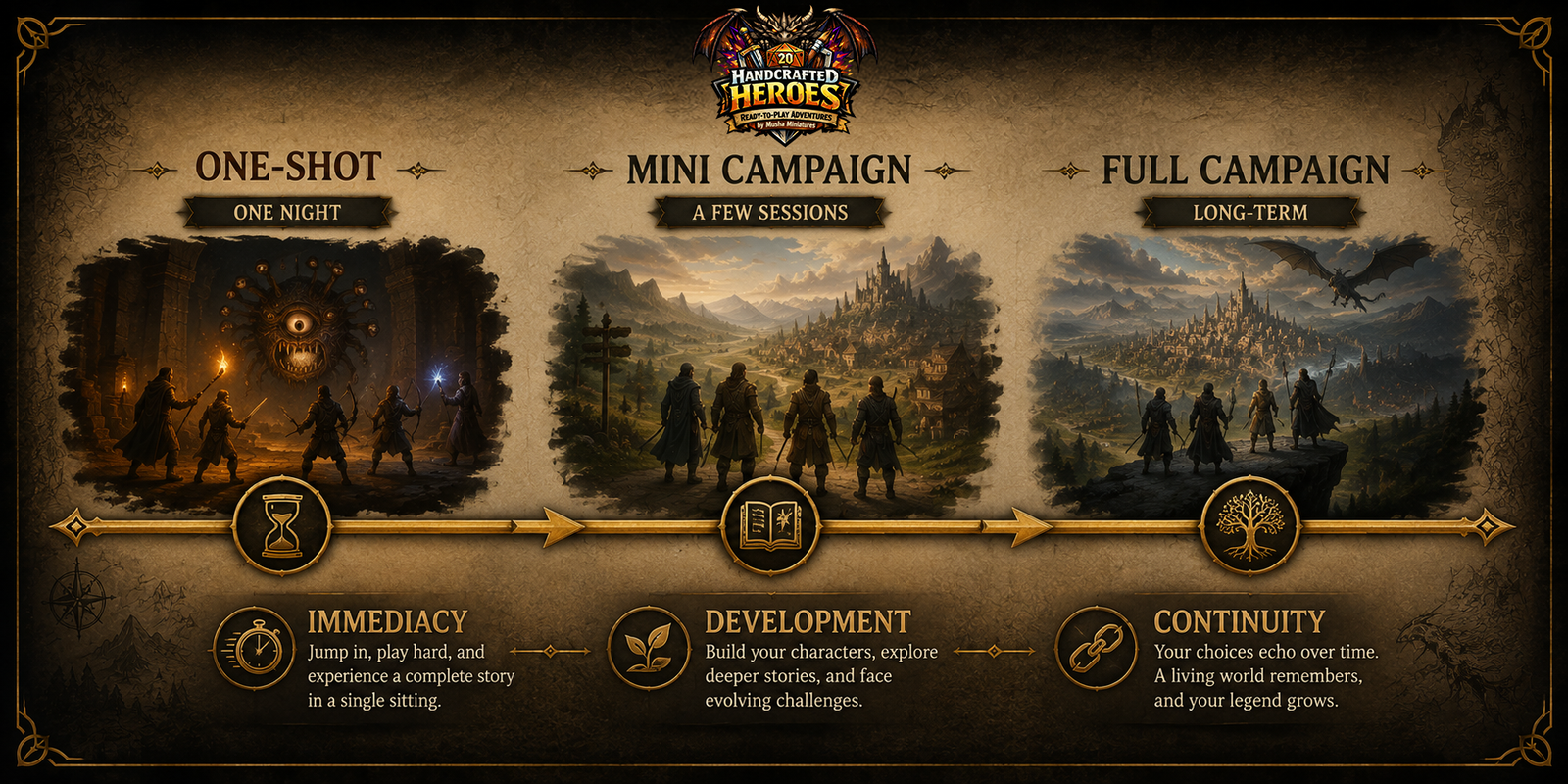
Which Format Needs More Preparation?
Usually a campaign requires more total preparation. But that’s not quite the whole story. A campaign allows the GM to prepare incrementally. Session happens. Players make decisions. The GM prepares what follows.
A one-shot needs enough of its structure ready before the evening begins because there’s no next session to postpone the ending into.
So preparation behaves differently.
If you’re wondering what belongs on the table in the first place, here’s What you actually need to play a tabletop RPG →
One-shot preparation tends to be:
compressed.
You need enough material to support one complete evening.
Campaign preparation tends to be:
cumulative.
Each session creates new possibilities and responsibilities.
That’s why comparing prep purely in hours can be misleading.
The real question is:
“Do we want a finite package or an evolving responsibility?”
For some GMs, the second is the entire joy of the hobby.
For others, it’s precisely what prevents them from running more often.
Which Format Gives Players More Freedom?
Neither automatically. This is important. A campaign can be extremely railroaded. A one-shot can be extremely open. Or the opposite.
Time affects scope, not necessarily agency. A one-shot probably shouldn’t offer twelve continents to explore. But inside its smaller playground, the characters can still have meaningful choices.
Imagine:
A plague has reached a mountain village. The cure exists, but only one of two rival factions can provide it.
That’s a small adventure space.
But players might decide:
- Who to trust;
- What they’re willing to trade;
- Whether either faction deserves power;
- Whether there’s a third solution;
- And who gets the cure if there isn’t enough.
That’s meaningful agency. A one-shot doesn’t need infinite possibilities. It needs choices that change what happens.
The Real Trade-Off: Breadth vs Depth
This is the distinction I’d remember.
One-shots concentrate.
Few characters.
Few locations.
Immediate conflict.
Limited time.
The adventure says:
This matters tonight.
Campaigns accumulate.
More locations.
More relationships.
More history.
Consequences stacked on consequences.
The campaign says:
This will matter later.
Neither is inherently more immersive.
They’re immersive in different ways.
One-shot immersion comes from intensity.
Campaign immersion comes from continuity.
And some groups want both. That’s where mini campaigns become particularly powerful.
The HH Adventure Format Test
Instead of asking “Which is better?”, ask your group these six questions.
1. How many sessions can we realistically commit to?
Not ideally. Realistically.
2. Do we want character growth to be a major part of the experience?
If yes, longer formats gain value.
3. Are we learning a new system?
A one-shot lowers the cost of experimentation.
4. Does somebody genuinely want to run a long campaign?
Not:
“I suppose I can GM.”
Genuinely wants to.
5. Does the story need time?
Some ideas want a night. Some want a season. Some want years.
6. Would we rather finish something short or begin something enormous?
There is no universally correct answer.
But it’s a very useful question.
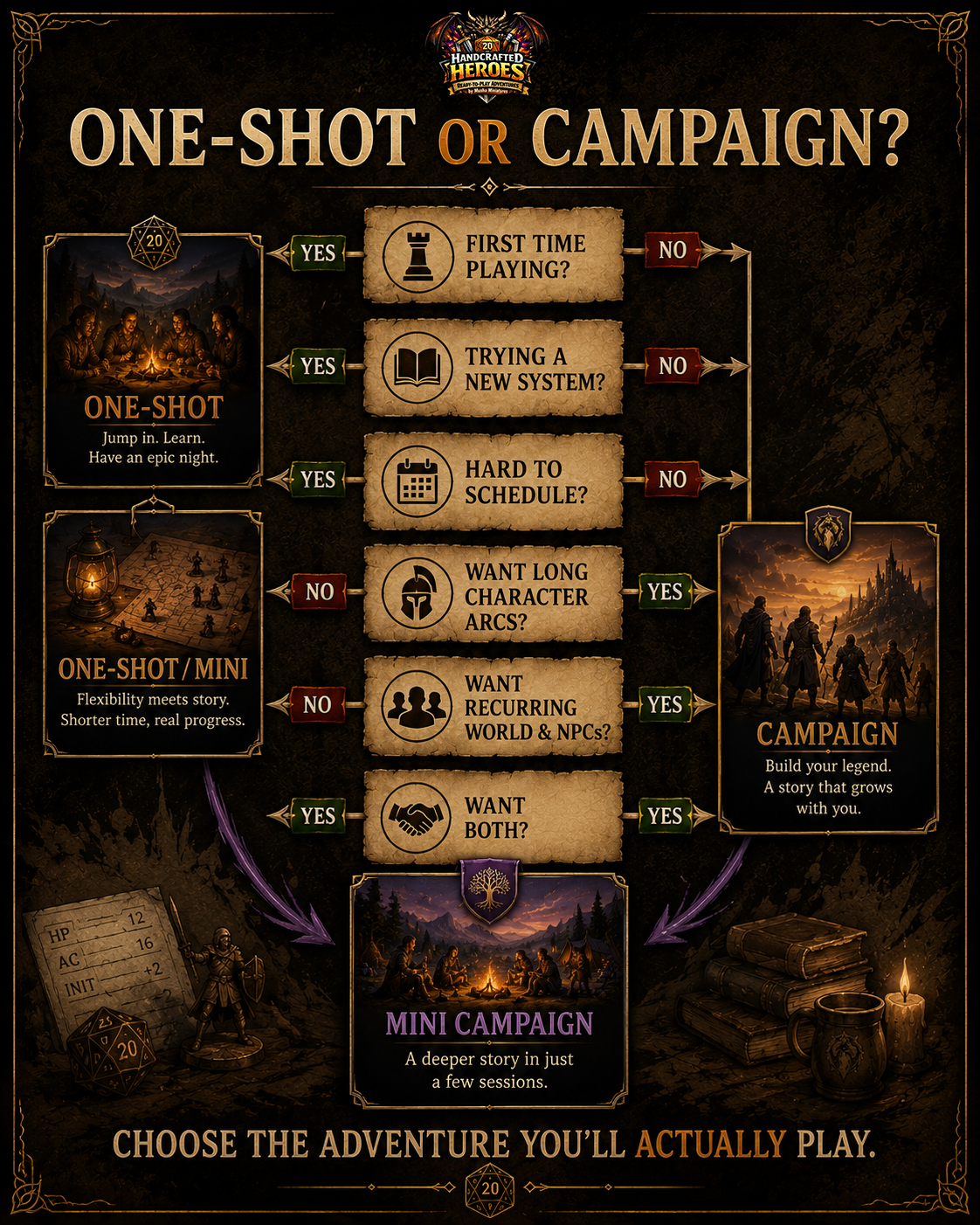
And What About Beginners?
Here’s our preference. If nobody at the table has played before: start small.
Not necessarily because the rules are simpler. Because the decision is smaller. You aren’t asking everyone to join a campaign. You’re asking them to share an evening. Give people pre-generated characters if appropriate.
Use a clear adventure. Teach rules when they matter. Finish something.
Then ask:
“Do we want to play again?”
If the answer is an immediate:
“When?”
Congratulations.
Your campaign problem may have just solved itself.
If the mechanics themselves still feel mysterious, see how your first tabletop RPG session works before choosing your format. How your first tabletop RPG session works →
Don’t Let Ambition Kill the Adventure
There is a particular kind of tabletop tragedy. Someone creates an incredible campaign. A continent. Factions. Gods. Political systems. Twenty important NPCs. A villain with four phases. Players write elaborate characters. Everyone is excited. Then calendars come out. Silence.
Tuesday doesn’t work. Franco can’t do Thursday. Someone works weekends. Two people are away next month. The campaign remains magnificent. And completely imaginary. Meanwhile, a four-hour one-shot actually played this Saturday creates a story everyone at the table can remember.
This isn’t an argument against campaigns.
It’s an argument for matching ambition to opportunity. The format should help the adventure happen. Not become another obstacle between the group and the table.
So: One-Shot or Campaign?
Choose a one-shot when you value: immediacy, experimentation, accessibility and closure.
Choose a campaign when you value: continuity, character development, accumulated consequences and long-term worldbuilding.
Choose a mini campaign when you want: some of both.
And remember that none of these decisions needs to be permanent. Today’s one-shot can introduce characters you desperately want to see again. A mini campaign can grow. A long campaign can pause while your group tries something completely different.
The best format isn’t the one with the most pages, sessions or lore. It’s the one that gives your table the right amount of space to create something memorable. Sometimes that takes two years. Sometimes it takes four hours.
Both count.
Musha
Handcrafted Heroes Founder