How to Create Your First RPG Character: From Idea to Adventure
How to Create Your First RPG Character: From Idea to Adventure
Forget the character sheet for a minute.
Seriously. Put it down.
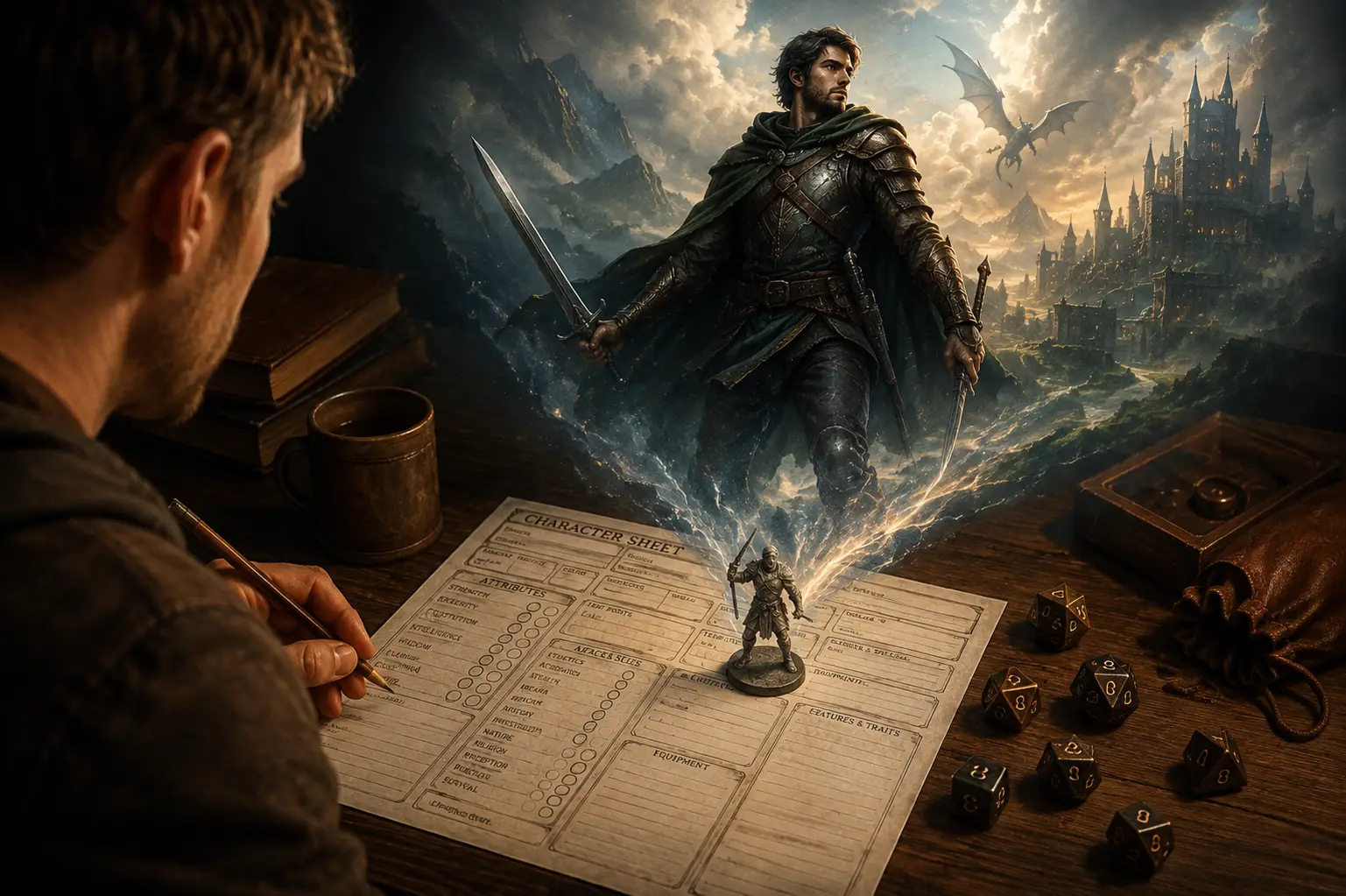
Before your first RPG character becomes a collection of numbers, abilities, equipment and suspiciously specific proficiencies, they need to become something much simpler: someone you want to play.
Maybe you want to be a knight who protects everyone except themselves. A thief who is excellent at stealing but terrible at lying. A wizard fascinated by magic they absolutely should not be studying. A healer who has seen enough heroes die and refuses to lose another one.
That’s already enough to begin.
Different tabletop RPGs turn characters into mechanics in very different ways. Some ask you to choose classes and abilities. Some use playbooks. Some generate parts of your history through dice. Others can have a character ready in minutes.
So this isn’t going to tell you which number belongs in which box. Instead, we’re going to build the part that exists before the numbers. By the end, you’ll have a character concept strong enough to take into almost any RPG system and ask:
“Okay. How does this game turn them into someone I can play?”
If you’re still getting familiar with the hobby itself, start with [What a tabletop RPG actually is] before building your first hero.
Start With One Sentence
Your first character doesn’t need a biography. They need a hook. Try to describe them in one sentence.
Not:
Elarion Thanduil was born in the year 487 of the Third Celestial Age to Lord Amandil of—
We don’t know whether we like Elarion yet.
Try:
A disgraced knight who has promised never to abandon someone again.
Now we have something.
Or:
A cheerful thief who steals from terrible people for surprisingly good reasons.
Or:
A young wizard who knows far more about forbidden magic than they admit.
Each sentence gives us several things at once.
An identity, a tone, a possible problem and most importantly: somewhere to go.
This kind of high-level concept is also common advice in current character-creation guides, which frequently recommend establishing a simple character idea before diving into classes, statistics and equipment. Your sentence doesn’t need to be original enough to win an award.
It needs to make you think:
“I’d like to see what happens to this person.”
That’s the test.
Let’s Build Someone Together
We’re going to create one character throughout this guide. Not because you should copy her. Because watching decisions accumulate is much easier than staring at a blank character sheet.
Our starting sentence:
A former city guard who failed to protect someone important and now refuses to leave anyone behind.
We’ll call her Mara for now. That’s all we know.
No class.
No statistics.
No equipment list.
No twelve-page tragedy.
But we already have the beginning of a person. Now let’s make her playable.
What Is Your Character Good At?
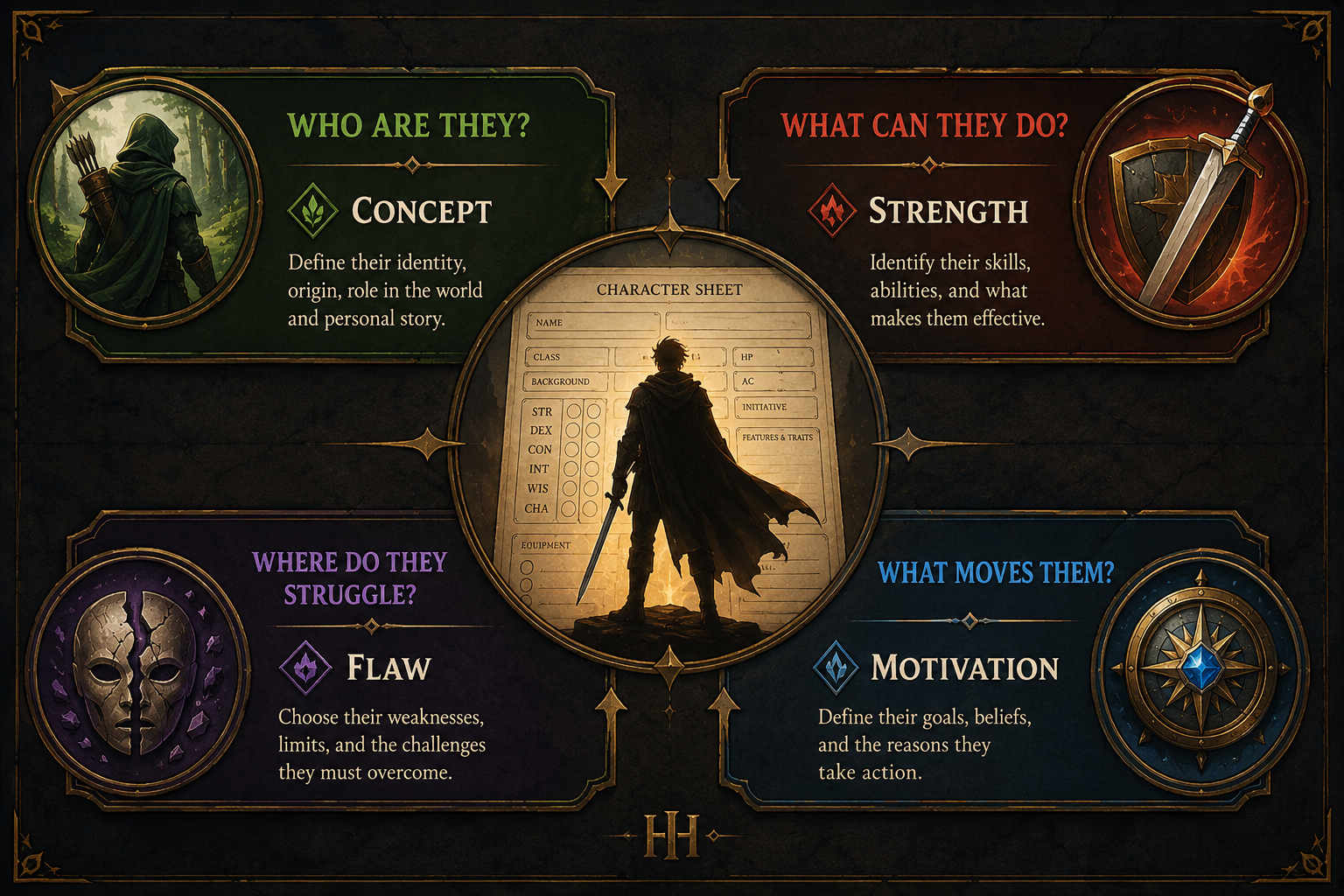
Every adventurer needs ways to affect the world. You don’t need mechanical terminology yet. Just imagine situations: a locked door, an angry guard, a wounded friend, a monster approaching through the trees.
What do you imagine your character doing? Mara probably isn’t going to disappear into the shadows. She probably isn’t opening an ancient spellbook either.
We imagine her:
- Standing between danger and someone else;
- Reading whether a situation is about to turn violent;
- Holding her ground;
- Protecting people;
- And keeping calm when everyone else panics.
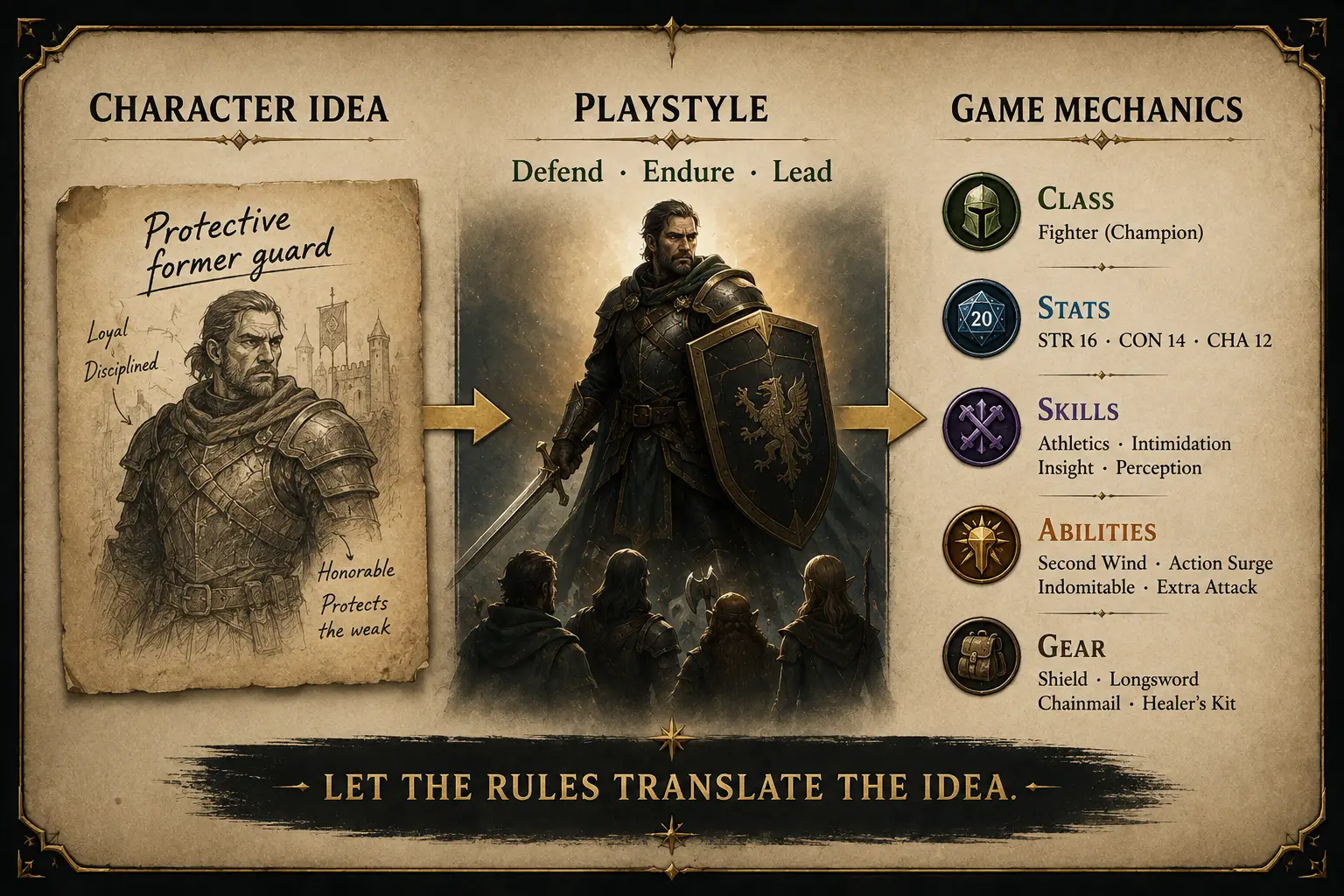
That’s enough. Later, whatever RPG we’re playing might translate those ideas into:
- Attributes;
- Skills;
- A class;
- Special abilities;
- Equipment;
- Or something completely different.
Concept first. Translation second.
This matters because not every RPG even uses the familiar class-and-six-stat model. Character creation structures vary substantially between systems, from class-based fantasy games to lifepath systems where careers and events help create the character’s past.
Don’t begin by asking:
“Which stat should be highest?”
Begin with:
“What do I want to be good at doing?”
The numbers will make much more sense afterwards.
Give Them Something They’re Bad At
Perfect characters are surprisingly difficult to play.
Imagine Mara is:
- Strong;
- Brave;
- Intelligent;
- Charming;
- Perceptive;
- Patient;
- Excellent with weapons;
- And emotionally well-adjusted.
Congratulations. We’ve created a job applicant.Not necessarily an interesting adventurer. Weakness creates decisions. Maybe Mara is terrible at trusting authority.
Now imagine a captain tells her:
“Leave the village. We have this under control.”
Suddenly her flaw matters.
Maybe she’s reckless when someone else is in danger.
Now:
“The bridge is collapsing. You can’t save both of them.”
matters differently to her than it would to another character.
A useful weakness isn’t simply:
“My character has low Dexterity.”
That’s mechanical weakness.
What we’re looking for here is something that can influence choices.
- Fear.
- Pride.
- Naivety.
- Greed.
- Impatience.
- An inability to let something go.
- A tendency to trust the wrong people.
A character flaw is interesting when it occasionally makes the easy decision harder.
Give Them Something They Want
This might be the most useful question in character creation.
Not:
“What happened during their childhood?”
Ask:
“What do they want now?”
Mara wants to make sure nobody under her protection is abandoned again.
Great.
That gives her a reason to act.
Your character might want:
- Revenge;
- Recognition;
- Knowledge;
- Wealth;
- Redemption;
- Freedom;
- A missing family member;
- The truth;
- A place to belong;
- Or simply enough money to never sleep in a stable again.
The goal doesn’t need to be enormous.
“I want to become king.”
works.
So does:
“I want to prove to my sister that I wasn’t wasting my life.”
The second might actually give you more interesting scenes.
Goals create momentum because when the GM asks:
“What do you do?”
your character already has something pulling them forward.
Your Backstory Is Not Your Character
This is where new players sometimes get trapped. They think creating a deep character means writing a deep past. So they arrive at Session One with six pages of history, kingdoms, wars, dead relatives, a mysterious mentor, three betrayals, a prophecy, an unresolved incident involving a dragon, and then the adventure starts… and none of it tells them what their character should do.
Backstory can be useful. But a character isn’t interesting because many things have happened to them. They’re interesting because those things affect what they do now.
For Mara, we don’t need six pages.
Maybe this is enough:
Mara served in the city watch. During a riot, she followed an order to hold her position instead of helping trapped civilians. Someone she loved died. She left the watch soon after.
Done.
Now her distrust of authority makes sense. Her protectiveness makes sense. Her goal makes sense, and we’ve left enormous empty spaces for the game to fill.
Current character-creation advice increasingly makes a similar recommendation: keep the initial concept and backstory manageable rather than trying to complete an entire fictional biography before play begins.
Your first session should add to your character. Not merely reveal information you’ve already written.
Leave Some Doors Closed
Here’s a trick. Don’t answer everything.
- Who exactly died because Mara followed that order?
Maybe we know.
Maybe we don’t.
- Was the captain who gave the order actually wrong?
Unknown.
- Does Mara’s former unit hate her for leaving?
Could be.
- Is someone from her past going to appear later?
That’s the Game Master’s problem now.
A useful RPG backstory contains doors the adventure can open. Try leaving two or three questions unresolved.
For example:
- Who does your character owe something to?
- Who might still be looking for them?
- What happened that they don’t fully understand?
Those questions give the GM material without dictating the answers.
In GMless play, they can instead become prompts or unresolved threads that the game’s procedures bring back later.
And if nobody at your table has that traditional role, those open questions can work just as well in a [GMless RPG].
Build Someone Who Will Actually Join the Party
We need to discuss the lone wolf. You know the character.
- Dark hood.
- Tragic past.
- Trusts nobody.
- Works alone.
- Doesn’t care about money.
- Doesn’t care about saving people.
- Doesn’t want friends.
- Doesn’t take orders.
- Refuses to enter taverns on principle.
The party receives a quest.
“Why would my character go with them?”
Excellent question. Why did you create a character who doesn’t want to play the game?
You can absolutely play:
- An antisocial character;
- A suspicious character;
- A reluctant hero;
- A selfish character;
- Or someone who initially dislikes the rest of the party.
But give them a reason to stay. Maybe your lone wolf doesn’t trust the party… but needs them.
Maybe Mara isn’t interested in treasure… but someone needs protection.
Maybe your selfish rogue has discovered that these idiots are somehow the closest thing they have to family.
Conflict between characters can be great. A character fundamentally designed to reject every adventure usually isn’t.
Remember: TTRPGs are collaborative games.
Create someone who gives the other players something to work with.
If this is your first time at the table, our guide to [How your first tabletop RPG session works] will also help explain why party collaboration matters.
Give the Other Characters Something to Discover
There’s another extreme.
The player who explains everything immediately.
“Hello. I’m Mara. I’m a former guard. Someone died because I followed an order six years ago, which is why I distrust authority and have recurring nightmares every Wednesday.”
Efficient.
Perhaps slightly less dramatic than intended. Your character can have information the other characters don’t know yet.
Notice the distinction: not necessarily information the other players don’t know.
- Secrets between characters can create wonderful role-playing.
- Secrets deliberately kept from the people you’re actually playing with can sometimes create confusion instead.
Maybe everyone at the table knows Mara used to be a guard. Their characters don’t. Now when someone recognizes her old insignia three sessions later, the players understand why the moment matters and can help make it interesting. You don’t need a giant secret.
Just give the character layers that can emerge through play.
Personality Is More Useful as a Pattern Than a List
Character sheets sometimes encourage lists:
- Personality Trait.
- Ideal.
- Bond.
- Flaw.
Those can help. But here’s another way to think about personality:
- How does this person tend to respond under pressure?
When threatened, do they:
- Fight;
- Joke;
- Freeze;
- Negotiate;
- Get angry;
- Protect someone else;
- Pretend they’re not afraid?
Mara becomes quieter when frightened.
Good. That’s playable.
How do they behave around authority? Guarded.
How do they respond to somebody weaker asking for help? Almost incapable of refusing.
Now we have behavioral patterns.
You don’t need to remember:
Mara enjoys autumn weather, hates turnips and collects ceramic birds.
Unless ceramic birds somehow become extremely important.
Which, knowing tabletop RPGs, they probably will.
You Don’t Need a Voice
Your character now has:
- A concept;
- Strengths;
- Weaknesses;
- Motivation;
- History;
- Behavior.
Still missing? Absolutely no accent whatsoever. That’s fine. Role-playing doesn’t require acting.
You can say:
“Mara looks at the captain and says, ‘I’ve heard that promise before.’”
Or:
“Mara doesn’t trust him. She tells the captain she’s staying with the villagers.”
Both are role-playing.
You’re making decisions from the character’s perspective. Everything else is performance style. Optional.
Now Open the Rulebook
We have a person. Now we let the game translate her. Suppose we’re playing a fantasy RPG with classes and we look at the available options.
Which one supports:
- Protecting allies;
- Physical resilience;
- Experience with weapons;
- Holding dangerous enemies back? Maybe Fighter, or Paladin. Maybe something completely different depending on the system. Now class choice has context.
We’re not asking:
“Which class is strongest?”
We’re asking:
“Which mechanics help me play Mara?”
This same principle applies beyond classes.
Attributes
Which strengths matter mechanically?
Skills
What did this character learn before the adventure?
Abilities
What do you want to be able to do during play?
Equipment
What would this person reasonably carry — and what does the game allow?
Species, ancestry, heritage or equivalent
If the system uses one, how does it interact with the character idea and setting?
Background
If the game formalizes background mechanically, which option best supports what we’ve already established? The exact order depends on the RPG. Follow your game’s character-creation rules.
We’re not replacing them. We’re giving those choices a reason to exist.
Don’t Optimize the Fun Out of Your First Character
You’re going to encounter character build… lots of them.
- Best beginner build.
- Most damage.
- Strongest multiclass.
- Perfect ability distribution.
- Optimal equipment.
And if optimizing characters is fun for you? Great! That’s part of the hobby too. But your first character doesn’t need to be mathematically perfect. They need to be functional enough for the game and interesting enough that you want to make decisions for them.
There’s an important difference between:
“I want my character to be competent at the thing they’re supposed to do.”
and:
“I need to reproduce the statistically strongest build somebody calculated online.”
The first is useful.
The second is optional.
Ask experienced players or the GM if a mechanical choice will make the character frustrating to play. Beyond that? Choose things you actually want to use. A slightly less optimized ability that makes you excited every time it appears on the sheet may be worth far more to your first experience than a theoretical advantage you don’t understand.
Pregenerated Characters Are Not “Training Wheels”
Maybe you’ve reached this point and thought:
This still sounds like work.
Fine. Use a pregen.
A pregenerated character is simply a character whose mechanical setup has already been completed. Good introductory adventures often provide them because they remove character creation from the list of things new players need to understand before playing.
That lets you learn:
- What your abilities actually do;
- Which parts of the character sheet matter during play;
- How your character contributes to the group;
- What kinds of decisions you enjoy making;
- And which mechanics you want to understand better next time.
All while actually playing. Then, when you create your own character later, words like skills, attributes, abilities, equipment and actions aren’t abstract boxes on a sheet anymore. You’ve seen them work. There’s also nothing stopping you from making a pregenerated character your own.
Maybe the sheet says:
Human fighter. Former soldier.
That’s mechanics and a starting point.
You can still decide that she left the army after refusing an order, that she hates horses, that she writes letters to her younger brother after every battle, that she’s terrified of magic but refuses to admit it.
The character sheet may have been prepared for you. The character you play at the table is still yours.
Pregenerated characters can be especially useful when you’re still learning [How your first tabletop RPG session works].
Your Character Needs a Reason to Join the Adventure
This may be the single most useful character-creation tip we can give a new player. Create someone who can actually participate in the game.
You are absolutely allowed to make:
- A suspicious rogue;
- A reluctant hero;
- A grumpy mercenary;
- An antisocial wizard;
- A knight who doesn’t trust easily.
Those can all be great characters.
The problem begins when your concept becomes:
“My character doesn’t trust anyone, doesn’t care about the mission, refuses to work with groups and would rather leave.”
There’s a technical term for that character. Someone who probably wouldn’t be in this adventure.
Tabletop RPGs are collaborative. Your character doesn’t need to like everyone. They don’t need to agree with everyone. They can argue, keep secrets, compete, become rivals. But underneath all of that, you need some reason to keep sitting around the same imaginary campfire.
Maybe you need the party, maybe you believe in the mission, maybe you’re being paid, maybe one of the other characters saved your life, maybe you’re pursuing the same enemy for completely different reasons.
Whatever it is, give yourself a hook that answers:
Why don’t I simply walk away?
That single answer can make role-playing dramatically easier.
Give Your Character a Connection to Someone Else
Want to make a new character feel real quickly?
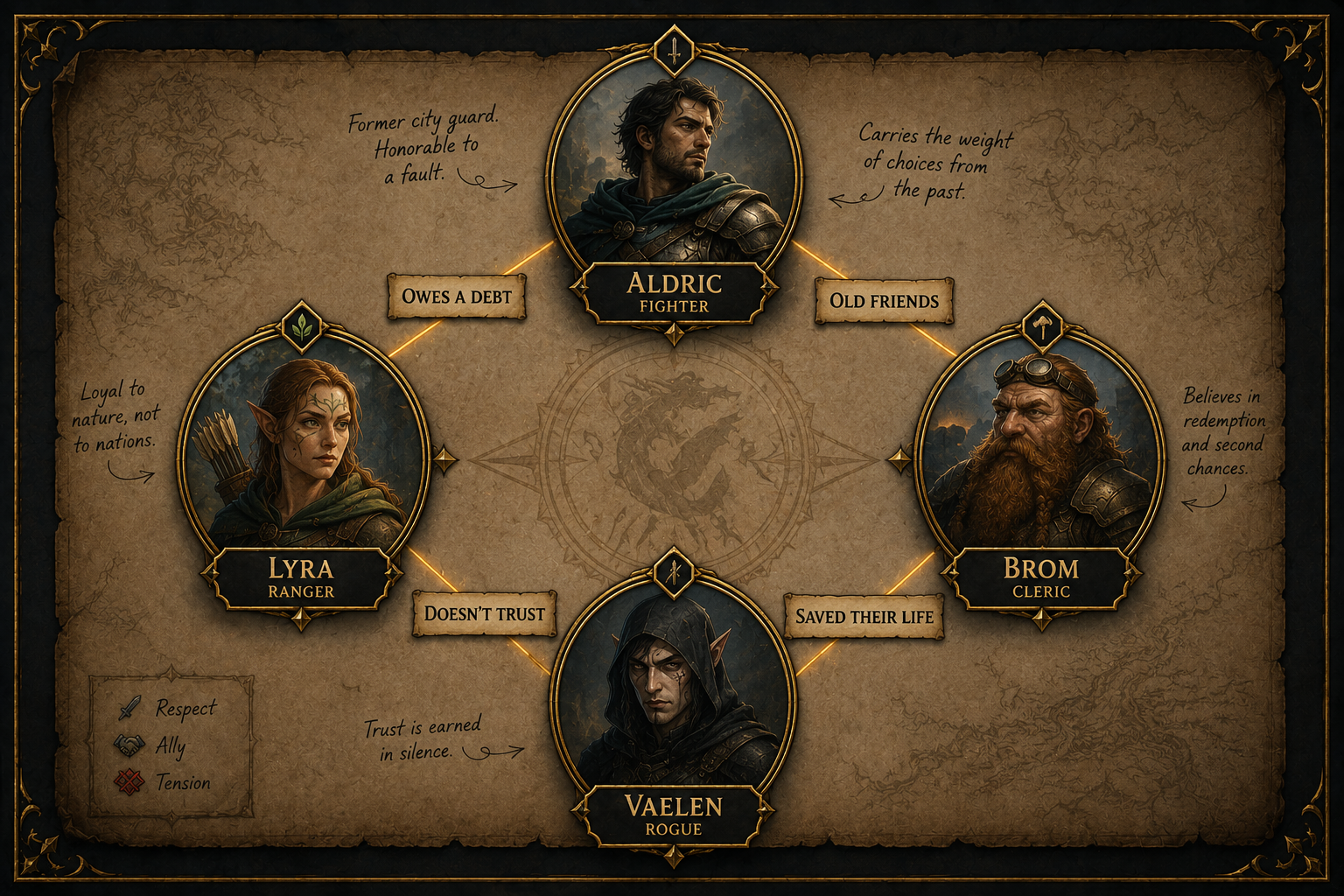
Don’t create them in isolation. Connect them to another character.
Maybe:
- You grew up together;
- You owe them money;
- You fought on opposite sides of a war;
- They know something embarrassing about you;
- You promised their family you’d protect them;
- You don’t trust them — but you trust everyone else even less.
A relationship gives you something to role-play before the adventure has even created its first shared memory.
Instead of:
“Hello. My name is Theren. I am an elf ranger.”
you get:
“You still owe me for that horse.”
Much better.
Some games build relationships directly into character creation. Others leave them entirely to the players. Either way, it’s one of the fastest ways to turn several individual characters into a party.
Don’t Build a Character Who Has Already Finished Their Story
Here’s another common first-character trap.
You write:
- Three wars;
- Two betrayals;
- A dead kingdom;
- An ancient prophecy;
- Seven legendary victories;
- A duel against the emperor;
- And the destruction of a dragon cult.
Then the campaign begins. Your character is level one. They have twelve gold pieces and are being threatened by an unusually confident rat. Something has gone wrong. Your backstory doesn’t need to contain your character’s greatest adventures.
Those are supposed to happen at the table.
Think of character creation as writing the opening chapter, not the entire novel.
Give them enough history to explain:
- Who they are;
- What they care about;
- Why they’re here;
- And what unfinished business they carry with them.
Then leave space. Space for friendships you haven’t imagined yet, enemies you haven’t met, beliefs that might change, scars you haven’t earned.
A character with room to grow gives the game somewhere to take them.
Start With a Question, Not an Answer
One of our favorite ways to create a character is to leave something unresolved.
Instead of:
“My father was murdered by Baron Varek, who serves the Cult of the Black Flame from his fortress in the northern mountains.”
try:
“I don’t know who killed my father.”
Now the Game Master — or the game’s narrative system — has room to answer.
Instead of:
“I was abandoned because my mother feared my magical powers.”
try:
“I don’t know why my mother left.”
Instead of:
“This sword belonged to King Aldren the Third and contains the soul of his advisor.”
try:
“This sword has been in my family for generations. Nobody will tell me why.”
Questions create doors.
And doors give the adventure somewhere to go.
For your first character, one unanswered question is often more useful than five pages of established lore.
What About Alignment, Personality Traits and Archetypes?
Use them if your game uses them, but treat them as tools, not prisons.
If your character sheet says:
Lawful Good
that doesn’t mean every decision has already been made for you.
If your character is:
The Brave Warrior
they’re still allowed to be afraid.
Actually, bravery becomes considerably more interesting when they are.
Character traits work best when they help answer:
“What might this person do?”
not:
“What am I allowed to do?”
People are inconsistent. Good fictional characters are too…
- Your greedy rogue might give away their last coin.
- Your fearless barbarian might freeze when they see the ocean.
- Your cynical wizard might become the person most determined to save a child.
Those contradictions aren’t mistakes. They’re often where the character starts becoming memorable.
Should You Optimize Your First Character?
A little? Sure.
If the game has mechanical choices, it’s perfectly reasonable to make choices that work together. If you want to play an archer, being good at the things the system uses for archery is probably sensible. But there’s a difference between:
building a functional character
and
trying to solve the entire game during character creation.
You don’t need to search:
MOST BROKEN BEGINNER BUILD 2026 INSANE DAMAGE
before your first session.
Unless that’s genuinely the part of RPGs you enjoy. Some players love optimization, finding mechanical combinations is part of the game for them. Others barely think about it. Both approaches are legitimate.
For your first character, we’d prioritize:
- Can I understand what this character does?
- Do I have several useful options?
- Does playing them sound fun?
over:
Is this mathematically perfect?
You’ll understand what makes a build powerful much better after you’ve seen the system in motion.
What If I Make the “Wrong” Character?
You probably won’t, but you might make one you don’t enjoy. That’s different.
Maybe you thought you’d love playing a spellcaster but discover you prefer straightforward martial decisions. Maybe you built a quiet investigator and realize you love being the person who talks to every NPC. Maybe you picked abilities because they sounded powerful and never remember to use them. Great! You learned something.
Your first character doesn’t need to become your permanent RPG identity.
You can:
- Adjust them, if your game and group allow it;
- Create someone new later;
- Try a different archetype in a one-shot;
- Or simply let the character evolve as you understand them better.
This is another reason short adventures can be so useful for beginners.
A one-shot lets you experiment with:
“What would playing a wizard feel like?”
without making a year-long commitment to that character.
If you want to experiment without a long commitment, a [One-shot RPG] is one of the easiest places to try a completely different character.
The Five-Minute Character Test
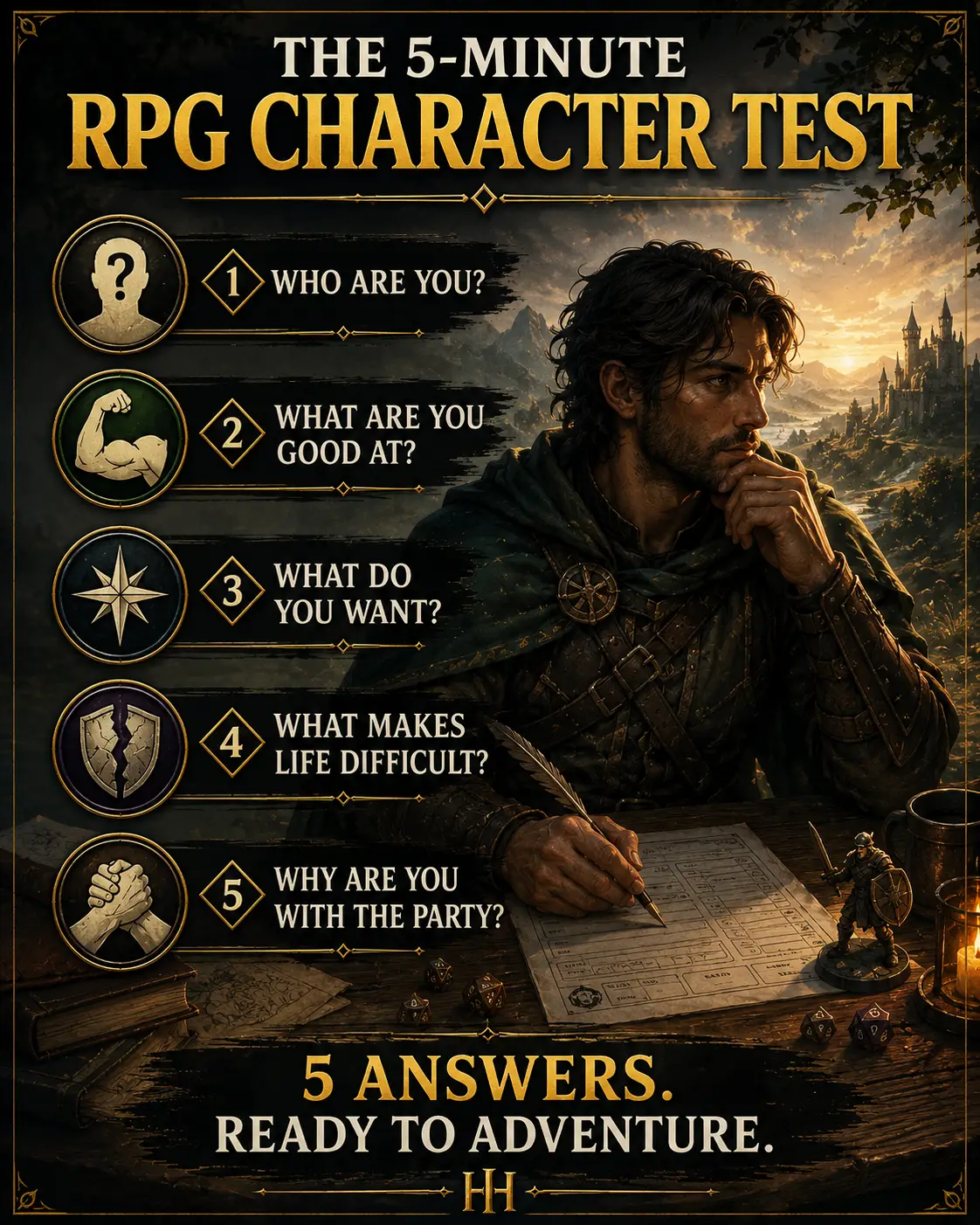
Before declaring your character finished, see if you can answer these questions without looking at your sheet.
Who are they?
A former city guard trying to become someone worth trusting again.
What are they good at?
Protecting people and noticing danger.
What do they want?
To find the person who framed them.
What makes life difficult for them?
They assume everyone is hiding something.
Why are they with the party?
One of the other characters helped them when nobody else would.
That’s a playable character.
We don’t know:
- Their favorite food;
- Their grandmother’s birthplace;
- The complete political structure of their hometown;
- Or the exact events of their childhood between ages seven and eleven.
We don’t need to. Not yet.
Let’s Build One From Nothing
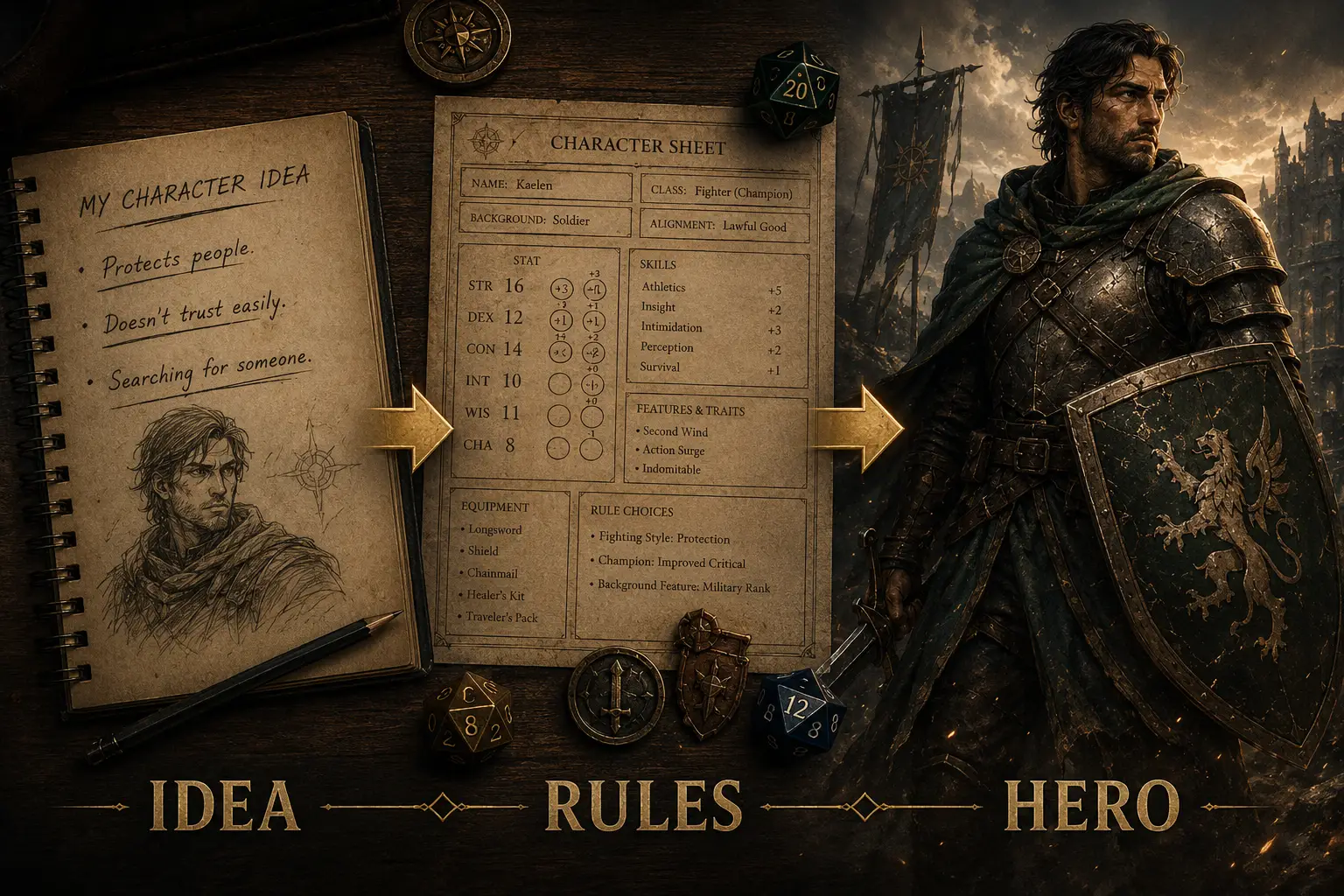
Let’s put the whole process together. We begin with absolutely nothing.
The idea
I want to play someone who protects people but has trouble trusting them.
Good.
The fantasy
We imagine a heavily armored traveler with a battered shield.
Someone who instinctively steps between danger and other people.
The strength
They’re resilient.
Observant.
Good at protecting others.
The weakness
They expect betrayal.
Sometimes even when there isn’t any.
The motivation
Someone they trusted disappeared after being accused of treason.
They want to find out what really happened.
The party connection
Another player character once defended them publicly when everyone else believed the accusation.
Now they owe that person.
The unanswered question
Was the missing person actually innocent?
We deliberately don’t decide.
Now the mechanics
Only now do we open the rulebook.
What character options express:
- Defense;
- Resilience;
- Perception;
- Protecting allies?
In D&D, that idea might lead toward one set of classes, backgrounds and abilities. In another fantasy RPG, the mechanical translation could be completely different. That’s fine, because the character survived the translation.
We didn’t start with:
“I want +2 to this statistic.”
We started with:
“I know who I want to be.”
And then used the rules to make that person playable.
Your First Character Doesn’t Need to Be Original
One last anxiety worth removing. You want to play:
- A noble paladin;
- A sneaky rogue;
- An old wizard;
- A reckless barbarian;
- A mysterious ranger.
Go ahead. Archetypes exist because they’re useful. You don’t need to invent a character concept nobody in fifty years of tabletop role-playing has ever considered. Originality usually emerges from specific choices during play.
Two people can both create:
Human fighter.
One becomes a former soldier terrified of commanding anyone again. The other is a cheerful village blacksmith who discovered they were surprisingly good at hitting monsters with a hammer.
Same broad archetype, but different character.
Don’t chase uniqueness before you’ve created someone you actually want to play.
Build for the Table, Not Just the Character Sheet
The best first character isn’t necessarily:
- The strongest;
- The most original;
- The one with the longest backstory;
- Or the one with the most optimized abilities.
It’s the character who gives you interesting decisions to make once the adventure starts.
Someone who wants something, someone who can contribute, someone with a reason to care, someone with enough definition that you know how to begin… and enough empty space that the game can change them. Because character creation doesn’t really end when you finish the sheet.
That’s just when you hand the character over to the adventure.
The first failed roll changes them.
The first person they trust changes them.
The first terrible decision changes them.
The first time another player says:
“Wait. I have an idea.”
changes them.
Eventually, the person you created before session one becomes someone you couldn’t possibly have written beforehand, and that’s the point.
Don’t create their entire story. Create someone worth discovering.
Musha
Handcrafted Heroes Founder