Can You Play a Tabletop RPG With 2 Players? A Guide to Duet RPGs
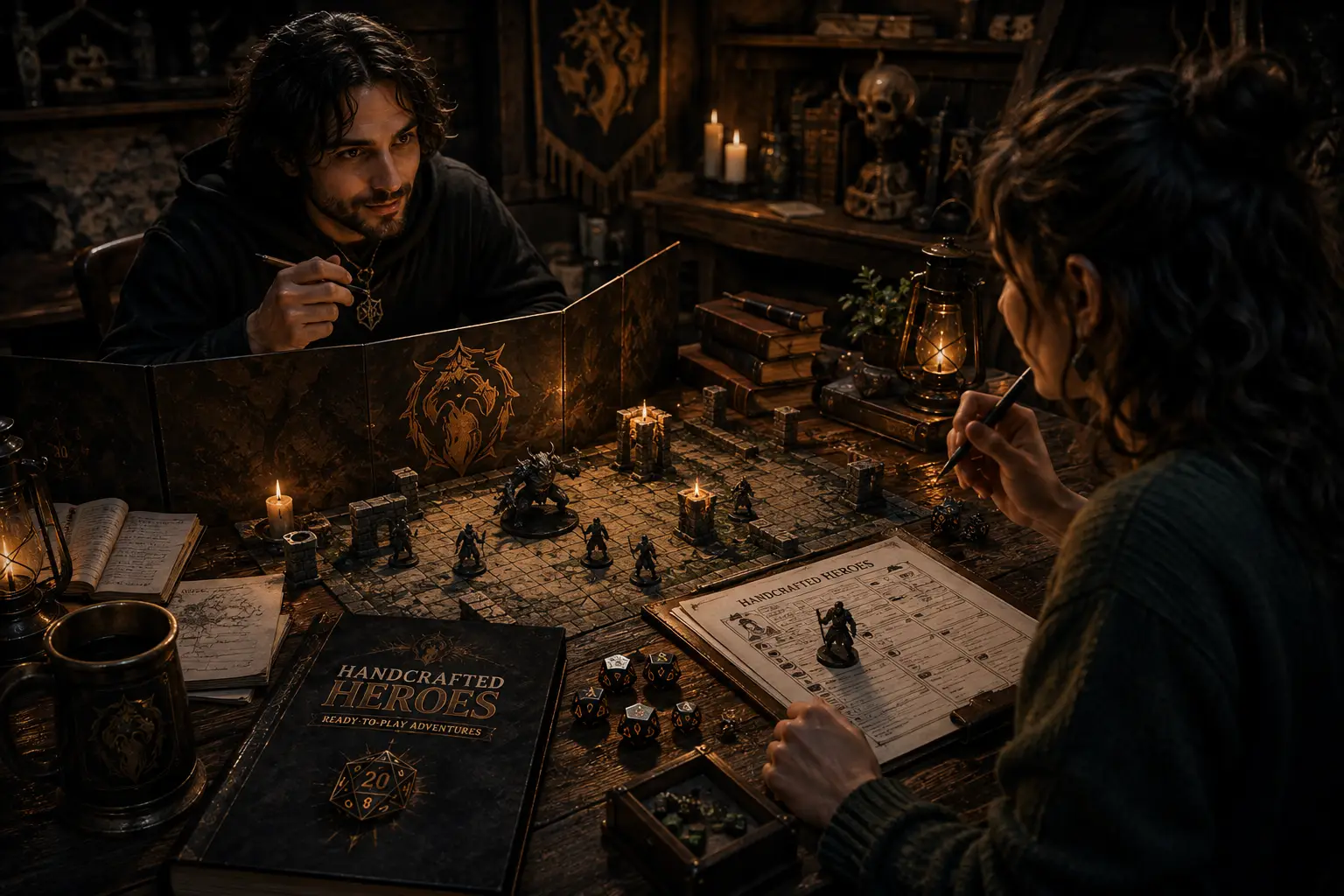
Can You Play a Tabletop RPG With 2 Players? Absolutely.
You don’t need five people.
You don’t need four.
You don’t even necessarily need three.
Sometimes the entire adventuring party is sitting across the table from you.
Two people can absolutely play a tabletop RPG.
Depending on the game, that might mean one person acts as Game Master while the other controls a single protagonist. That’s often called a duet RPG or one-on-one RPG.
Or both people may share narrative responsibilities in a game specifically designed for two players.
You can even adapt some traditional party-based RPGs to work with only two people — although the experience changes quite a bit.
Dungeons & Dragons itself has supported one-on-one play in official introductory material, and D&D Beyond has published guidance specifically for a single DM and single player.
So if the only thing stopping you from playing is:
“We don’t have enough people.”
You may already have enough.
Completely new to the hobby? Start with [What a tabletop RPG actually is].
What Is a Duet RPG?
A duet RPG usually refers to a tabletop role-playing game played by two people.
The most traditional setup is:
1 Game Master + 1 Player
The GM controls the world.
The player controls the main character.
Instead of following an entire party, the story focuses closely on one protagonist.
Think less:
“Five adventurers enter the dungeon.”
and more:
“One ranger follows a trail into the mountains, accompanied only by a stubborn wolf and the increasing realization that coming alone was probably a mistake.”
The basic TTRPG loop doesn’t change:
Describe → Decide → Resolve → React.
The world presents something.
The player decides.
The rules resolve uncertainty.
The story changes.
What’s different is where all the attention goes.
If you’re new to the basic rhythm of play itself, start with our guide to [How a tabletop RPG works].
One Player Doesn’t Mean One Character
This is important, particularly when adapting games designed around a party.
A single player can control:
- One hero;
- One hero plus a companion;
- A small party;
- Or a protagonist supported by NPC sidekicks.
D&D’s Essentials Kit used the sidekick approach specifically to support games with a DM and only one player, allowing the main character to bring an NPC companion into the adventure.
That helps with more than combat.
A companion can:
- Offer another skill set;
- Create dialogue opportunities;
- Cover weaknesses;
- Give the protagonist someone to care about;
and occasionally say:
“Maybe don’t touch the glowing skull.”
before the player inevitably touches the glowing skull.
The goal isn’t necessarily to reproduce a four-player party with one human controlling everything. It’s to give the smaller table the tools it needs.
What Changes When There Are Only Two People?
More than the player count.
Duet play creates a different kind of TTRPG experience.
The Story Becomes Personal Very Quickly
With five players, attention moves around the table. Each character gets moments in the spotlight. With one player?
The spotlight doesn’t move very far.
Their character’s decisions can become central to almost every scene. Backstory matters more easily. Relationships can receive more time. The GM can tailor mysteries, NPCs and consequences extremely closely to that character.
This can create an almost protagonist-driven form of role-playing that feels closer to following the lead character of a novel.
Everything Moves Faster
Five players encounter a locked door. One wants to investigate it. Another casts a spell. The rogue checks for traps. The bard starts questioning a nearby statue. Someone has gone to get another drink.
Now imagine the same door with one player.
“I check for traps.”
Roll. Next decision.
Duet games can move very quickly because there’s far less discussion between player turns and far fewer competing plans.
That means an adventure written for a traditional party may progress faster than expected. GMs adapting existing material should keep that in mind.
Every Decision Carries More Weight
In a normal party, one player might suggest doing something catastrophically foolish. Four other people can intervene.
In duet play? That safety committee has been disbanded.
One bad decision can redirect the entire story. That doesn’t mean the GM should protect the player from consequences. But it does mean encounters and failures may need more flexibility.
When the only hero gets knocked unconscious, there’s no cleric three squares away waiting with a healing spell.
Can Two People Play D&D?
Yes. But standard D&D assumes a party more often than duet play does, so you may need to adjust the experience.
Official D&D material has explicitly supported one-on-one gaming. D&D Beyond’s guide discusses duet adventures as a DM and a single player, while the Essentials Kit introduced sidekicks as a way to help round out the player’s adventuring party.
The most important thing to understand is: encounter balance changes dramatically.
An encounter designed to challenge four characters can destroy one character very quickly.
Likewise, abilities that assume allies are nearby become less useful. So don’t simply remove three players and run everything else identically.
Give the Hero Backup
A sidekick is often the easiest solution.
Maybe your wizard travels with a veteran guard.
Your rogue has a healer companion.
Your ranger has an animal ally.
Your fighter journeys with a nervous apprentice.
I’d keep companions simpler than the protagonist whenever possible. The player should still feel like the hero of the story. You don’t want the GM effectively playing half the party against themselves.
Reduce Enemy Action Economy
Four weak enemies against one hero can be much more dangerous than their individual strength suggests.
Why? They get four turns. The hero gets one.
So duel-style encounters often work better with:
- Fewer enemies;
- Lower damage spikes;
- More ways to escape;
- Environmental options;
- And objectives beyond simply reducing everything to zero hit points.
This isn’t “going easy.” It’s designing for a different party size.
Failure Shouldn’t Always End the Adventure
One protagonist fails to sneak past the guards.
In a traditional party, another player may improvise.
In a duet, consider:
failure creates a new problem
rather than:
failure means the story stops.
The guards notice you.
You’re captured. You escape without your weapon. Someone recognizes your face.
The adventure continues — just in a worse direction. That’s generally good RPG design anyway.
In duet play, it becomes especially valuable.
What About Games Designed Specifically for Two Players?
This is where things get really interesting.
Not every two-player TTRPG follows:
GM + player.
Some games are built so both people contribute more equally to the narrative.
Others use journaling, prompts, cards or GMless procedures to determine what happens.
The r/rpg community even maintains a dedicated two-player RPG resource covering games with equal roles as well as one-on-one adaptations, including systems such as GUMSHOE One-2-One.
Recent 2026 community requests also continue to ask specifically for games playable by couples or pairs, with recommendations spanning dedicated duet games and GMless systems designed to support two participants.
This means you have at least three broad approaches:
Traditional Duet
1 GM + 1 player
Best if one person enjoys running the world and the other wants a protagonist-focused experience.
Shared-Narrative Two-Player RPG
Both players have more equal narrative responsibilities.
Best if neither person wants the traditional GM/player divide.
GMless or Oracle-Assisted Play
Rules, prompts or an “oracle” answer questions normally handled by a GM.
Best if both people want to control characters while the system helps generate the world.
Two-Player RPG Doesn’t Mean “RPG for Couples”
Couples are one obvious audience. But don’t let that narrow the category.
A duet can be:
- Partners;
- Siblings;
- Parent and child;
- Two friends;
- A veteran GM introducing somebody new;
- Two people whose regular group cancelled;
- Or simply two players who prefer a more focused game.
The format changes the table dynamic, not the relationship between the people at it.
That said, duet RPGs can work particularly well for couples because scheduling suddenly becomes dramatically easier. Instead of coordinating five calendars, you coordinate two. Anyone who has tried to organize adult tabletop gaming knows that this may be the closest thing to actual magic in the hobby.
Are Two-Player RPGs Good for Beginners?
They can be excellent. Especially when one participant already knows the game.
Imagine an experienced GM teaching a new player at a table of five.
The beginner might hesitate. Everyone else understands the rules. Turns move quickly. They don’t want to slow anybody down.
Now remove the audience. Ask questions whenever you want. Pause. Look something up. Try something weird. Nobody is waiting for their turn.
D&D Beyond’s one-on-one beginner guidance explicitly presents duet play as a way to bring a new player into the game and learn in a focused environment.
For some newcomers, that’s ideal. But there’s a trade-off. A duet doesn’t teach you the social rhythm of party play.
You don’t learn:
- Sharing spotlight among four players;
- Building plans as a group;
- Supporting other characters;
- Or watching somebody turn your careful strategy into absolute chaos.
So duet play is a great introduction to TTRPG mechanics and role-playing. It isn’t exactly the same experience as joining a full party.
Best tabletop RPGs for beginners →
Duet RPG vs Solo RPG: They’re Not the Same Thing
This distinction is worth making now because the searches overlap.
Duet RPG
Two humans play.
Roles vary according to the game.
Solo RPG
One human plays.
The system uses prompts, procedures, tables, journaling or oracle mechanics to replace some of the functions usually provided by other people.
So:
Two people playing without a GM? Still a two-player RPG.
One person controlling several characters? Still solo.
The number of characters does not determine the format. The number and roles of the actual people do.
What Are the Advantages of Playing With Two People?
Quite a few.
Scheduling Is Almost Comically Easier
This may genuinely be the biggest one. Two calendars. That’s it.
No Doodle poll requiring archaeological interpretation.
No:
“I can do every Tuesday except this Tuesday and the third Tuesday of months containing the letter R.”
You want to play tonight? You might actually be able to.
The Story Can Be Built Around One Character
The lost brother in your backstory? Central plot.
The criminal organization hunting you? Central plot.
The strange necklace your grandmother left you? You already know where this is going.
Duet play makes personalized storytelling much easier because tailoring the campaign around one protagonist doesn’t leave four other players wondering why they’re watching someone else’s story.
More Role-Playing Time
If dialogue is what you love, duet games can be intense.
There’s less waiting. More direct interaction with NPCs. More room for subtle conversations. More space for character development.
Easy to Pause
Life happens.
If you haven’t played for three months, there aren’t five people trying to remember:
“Wait — why did we hate that wizard?”
The narrative history belongs to two people. Continuity becomes easier to maintain.
And the Downsides?
They’re real too.
Less Group Energy
You lose one of tabletop RPGs’ greatest pleasures: several brains attempting to solve the same fictional problem in completely incompatible ways.
A party produces chaos naturally. Duets are more intimate. That isn’t always better. It’s just different.
More Pressure on the Single Player
At a five-person table, you can occasionally lean back. Listen. Let someone else lead the scene.
In a duet, if the GM asks:
“What do you do?”
there’s a pretty good chance they’re talking to you.
Some players love that. Others may find it tiring.
Combat Can Be Fragile
We touched on this already.
One unlucky roll matters more.
Game systems designed specifically for groups may require adjustments.
The GM Has Fewer Moments to Think
Here’s one people don’t always expect.
When four players debate for ten minutes, the GM gets ten minutes to:
- Check notes;
- Prepare the next NPC;
- Look at the map;
- Quietly panic.
In duet play?
Player: “I go to the tower.”
GM: “Already?”
The pace can be relentless.
Duet GMs may actually benefit from preparing fewer things more clearly.
The HH Two-Player Test
Before choosing your approach, ask:
Does one of us want to GM?
Yes → Traditional duet is probably your easiest starting point.
No → Look at shared-narrative or GMless games.
Do we want one main protagonist?
Yes → Duet excels here.
No → Consider controlling multiple characters or using a system designed for two equal protagonists.
Do we want tactical combat?
Yes → Check carefully whether the system handles tiny parties well.
Is this our first RPG?
Yes → Choose something with strong onboarding, pregenerated characters or a clear introductory adventure.
Do we want a single evening or something ongoing?
Both work.
Duets are excellent for both one-shots and campaigns.
Can a Two-Player Game Be a One-Shot?
Absolutely. In fact, these two formats fit together extremely well.
Two people.
One free evening.
A pre-made character.
A focused adventure.
Very little scheduling.
You can start and finish something tonight. If you’ve never tried duet play before, a one-shot is also a sensible experiment. Nobody has committed to a year-long one-on-one campaign before discovering whether they actually enjoy the dynamic.
And if you’re deciding whether to keep playing afterwards: One-shot vs Campaign →
What Do Two Players Actually Need?
Mostly the same things as any other table.
- A game suited or adapted to two players.
- Characters.
- An adventure or narrative structure.
- Dice or whatever resolution method the system uses.
- Something for notes.
That’s it.
Miniatures, maps, terrain, music and props remain optional layers.
For duet play specifically, we’d add one more thing: a way to handle the jobs normally distributed across a larger table.
That might mean:
- A sidekick;
- An oracle;
- Shared narration;
- Or simply an adventure written specifically for a single protagonist.
What you need to play a tabletop RPG →
Two Players Is Not a Compromise
This is the idea we’d leave you with.
Don’t think of duet play as:
“Normal TTRPG, but we’re missing three people.”
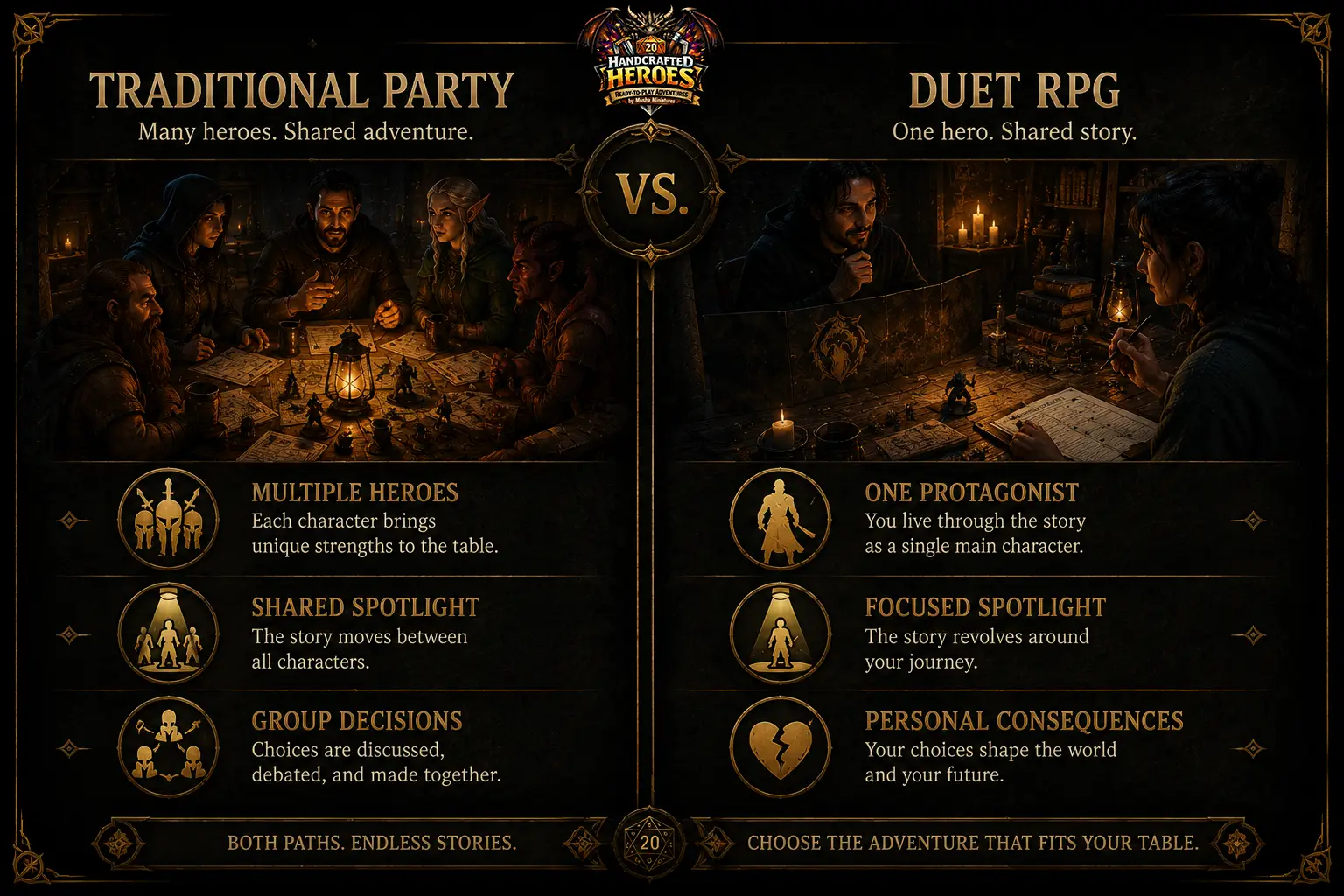
Think of it as its own format.
A full party gives you:
- Group chemistry;
- Multiple perspectives;
- Chaotic plans;
- Shared spotlight.
- A duet gives you:
- Focus;
- Speed;
- Personal storytelling;
- Easy scheduling;
- And enormous room for one character to matter.
Trying to make one behave exactly like the other misses what makes each interesting.
If you’ve got two people who want to play, you don’t necessarily have an incomplete party.
You have a table. Now you just need an adventure.
Musha
Handcrafted Heroes Founder