What Is a One-Shot RPG? A Beginner’s Guide to One-Session Adventures
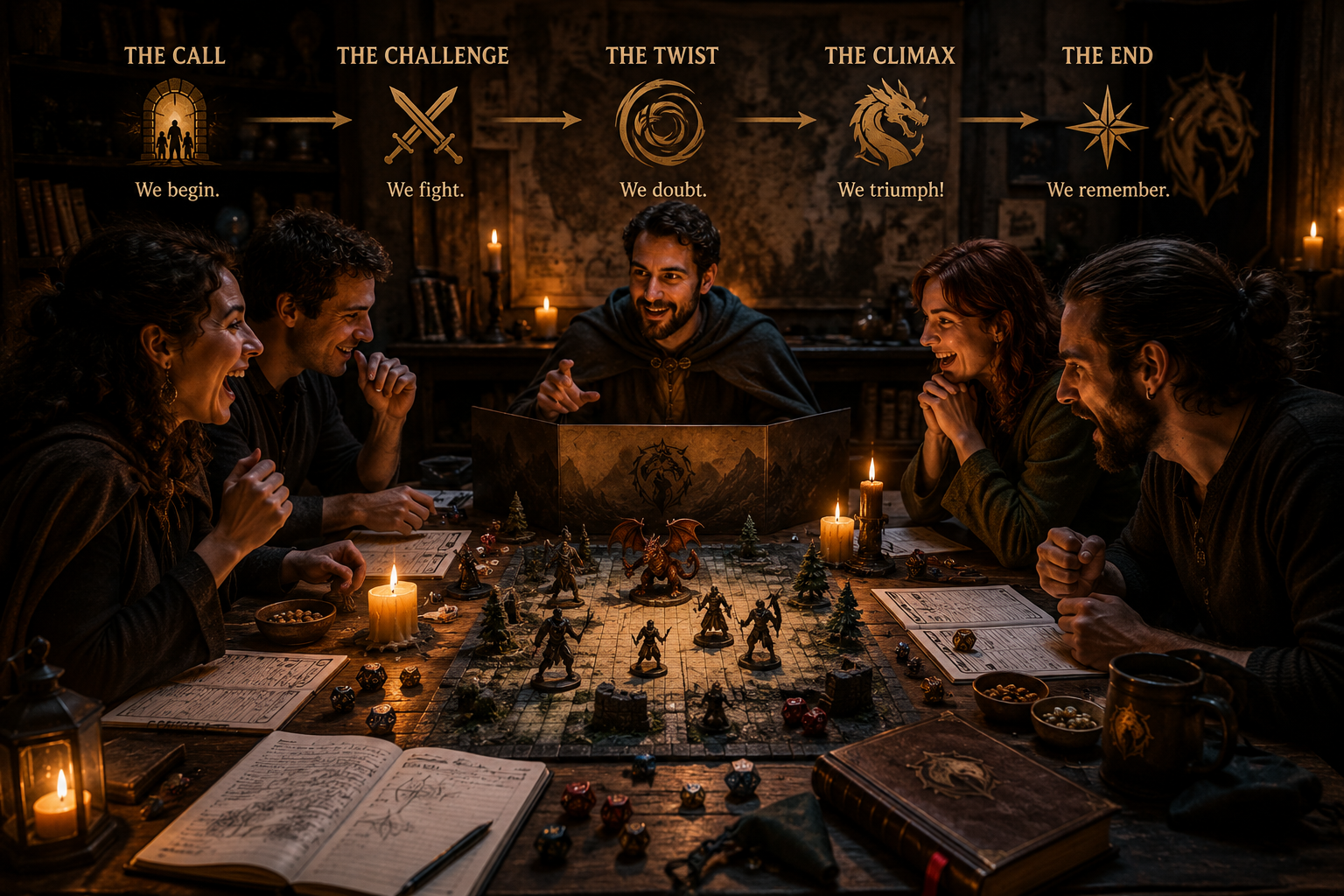
What Is a One-Shot RPG? One Night, One Adventure, One Complete Story
Friday night. Four friends are finally free. Nobody has committed to the next six months. Nobody has read a 200-page campaign. Nobody has promised to be available every Thursday until winter.
And yet, by midnight, the group has broken into a ruined temple, accidentally awakened something ancient, betrayed a suspiciously friendly merchant and somehow escaped with most of the party still alive.
The story is over.
That’s a one-shot RPG.
A one-shot is a [Tabletop role-playing adventure] designed to begin and reach a conclusion within a single session. In practice, that often means roughly two to five hours, depending on the game, the group and how aggressively everyone gets distracted by completely irrelevant NPCs.
It isn’t a “lesser” version of a campaign.
It solves a different problem.
Sometimes you don’t want to begin a saga.
Sometimes you want to sit down, roll the dice and tell a complete story tonight.
What Makes a One-Shot Different From a Campaign?
Time changes everything.
A traditional campaign can afford to introduce a mysterious stranger tonight and explain who they really are eight sessions later.
A one-shot can’t.
A campaign can let the party spend half an evening wandering around town, adopting stray animals and debating where to buy rope.
A one-shot usually needs to get moving.
The difference isn’t simply length.
It’s story architecture.
A good one-shot tends to have:
- A clear situation;
- A reason for the characters to act now;
- A limited number of important locations or scenes;
- Enough space for player decisions;
- And a conclusion the group can realistically reach before everyone has to go home.
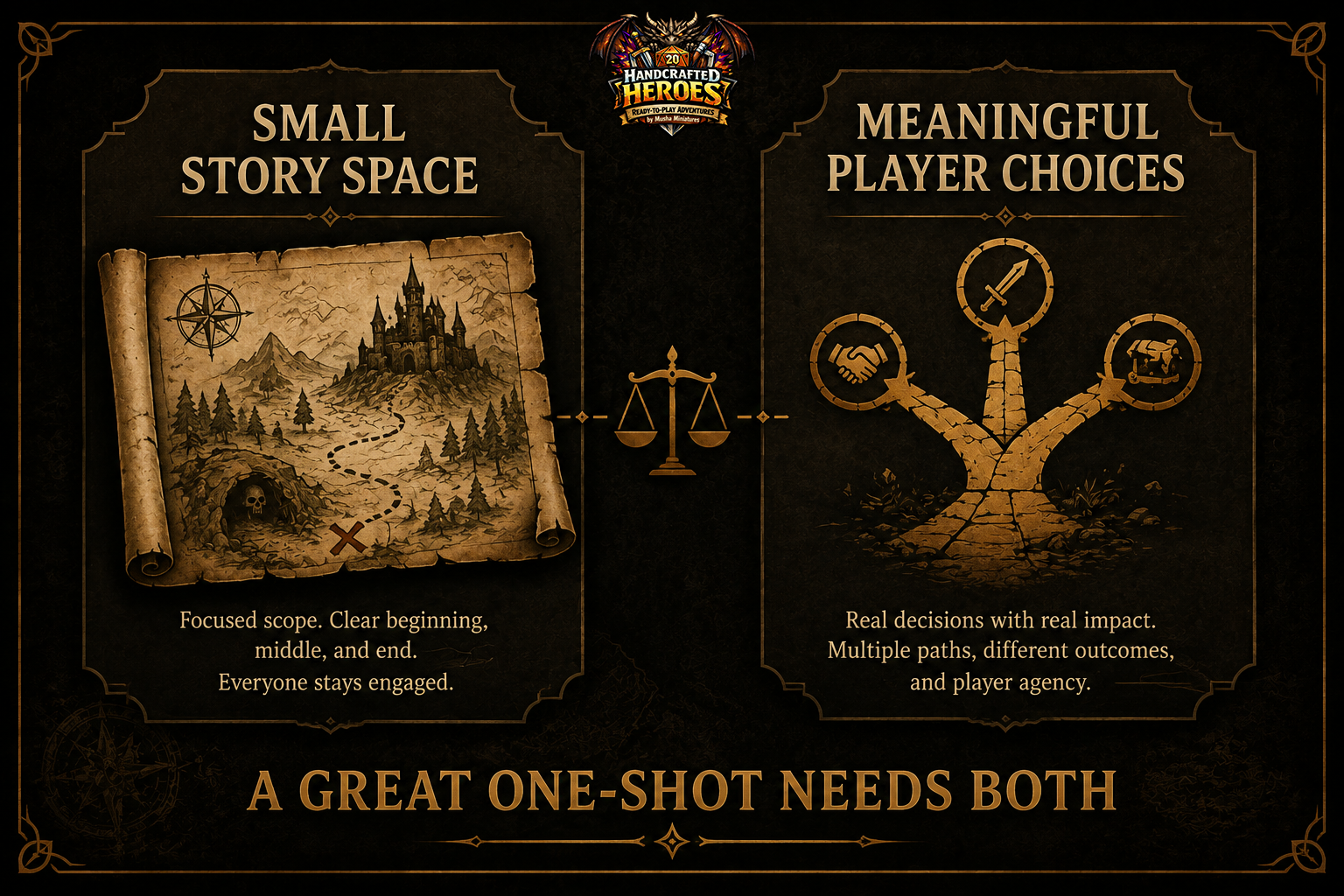
The story is compressed. The choices shouldn’t be. That’s an important distinction.
If you’re still learning the basic rhythm of a session, our guide to [How to play a tabletop RPG] walks through your first game step by step.
A One-Shot Still Needs a Beginning, Middle and End
Imagine the adventure starts with:
A merchant caravan disappears on the road outside the village.
That’s the hook.
The characters investigate. Maybe they discover strange tracks. A survivor. An abandoned wagon. Evidence that the attack wasn’t random. That’s the middle.
Eventually, the players reach whoever — or whatever — is responsible. They make choices. Things go well. Things go badly. Probably both. And the situation reaches some form of resolution. That’s the ending.
The entire arc exists inside one session. This is why one-shots often feel more immediate than campaigns.
There isn’t much room for:
“We’ll deal with that next month.”
The problem is already at the door.
How Long Is a One-Shot RPG?
There’s no universal stopwatch.
But most one-shots are designed around one normal gaming session, which commonly means somewhere around two to five hours. Current beginner-facing explanations tend to place them within roughly that range.
That doesn’t mean a one-shot magically stops being one if your group takes five hours and twelve minutes.
Nor does it mean every adventure advertised as a one-shot will actually finish in one sitting.
Anyone who has played tabletop RPGs knows the danger of this sentence:
“This should only take twenty minutes.”
But the design intention matters.
A one-shot is supposed to be completable in a single session.
If the adventure is designed from the start to require four sessions, you’re moving into mini-campaign territory.
And Yes, Sometimes a One-Shot Becomes a Two-Shot
It happens. Players take longer than expected. The GM underestimated a scene. The group spends forty-five minutes interrogating a chair because somebody is convinced it’s a mimic. Nobody dies. The tabletop police do not arrive. You simply finish next time.
But it’s useful to distinguish:
Designed as one session → one-shot.
Designed as several linked sessions → mini campaign.
That distinction helps people choose the right format for the time they actually have.
Why Are One-Shots So Good for Beginners?
Because they remove one of the biggest psychological barriers to tabletop RPGs: commitment.
Imagine you’ve never played before and somebody says:
“Would you like to try this game Saturday night?”
That’s easy to say yes to.
Now compare:
“Would you like to join a campaign every Thursday for the next year?”
Slightly different proposition.
- A one-shot lets a newcomer experience:
- Role-playing;
- Dice and resolution mechanics;
- Character decisions;
- Social play;
- Possibly combat;
- And the basic rhythm of a TTRPG,
- Without needing to decide whether this hobby is going to become part of their calendar indefinitely.
Beginner communities regularly use one-shots exactly this way: as a low-commitment opportunity to learn a system and see whether it fits the group before moving into something longer.
That’s why we consider them one of the strongest entry points into tabletop role-playing.
If you haven’t chosen your first system yet, we’ve also compared some of the [Best tabletop RPG games for beginners] by genre, complexity and play style.
Do You Need to Create a Character?
Not necessarily. One-shots are one of the places where pregenerated characters make enormous sense. You’re sitting down to tell a complete story tonight. Spending the first 90 minutes creating characters may not be the best use of that limited time.
A good pregen can give you:
- A clear role;
- Useful abilities;
- A personality hook;
- A relationship to the adventure;
- And enough space to make the character your own.
Instead of asking:
“Which of these seventeen abilities should I choose?”
you can ask:
“Why does my knight refuse to enter the temple?”
Much more interesting.
Character creation can be great fun. It simply doesn’t have to happen before every one-shot.
If you’d rather build your own hero, here’s [How to create your first RPG character without getting lost in the character sheet].
The Best One-Shot Characters Already Have a Reason to Care
This is one of the easiest ways to make a short adventure stronger.
Suppose the adventure begins:
A young prince has been kidnapped.
Generic characters might ask:
“Why should we help?”
Now imagine one character is the prince’s bodyguard.
Another is his estranged sister.
Another owes the royal family a debt.
Another secretly knows who took him.
We’ve just saved twenty minutes of:
“Why are our characters together?”
In a campaign, relationships can emerge slowly.
In a one-shot, good character hooks accelerate the interesting part. That’s not railroading. It’s efficient setup.
One-Shots Have Less Time — Not Fewer Choices
Here’s a misconception worth killing early.
A short adventure does not have to mean:
Scene 1 → Scene 2 → Fight → Boss → End.
If every decision leads to exactly the same result, the adventure may be short, but it isn’t necessarily good.
A one-shot can still let players decide:
- Who to trust;
- Where to go first;
- Whether to fight;
- Whether to negotiate;
- What they’re willing to sacrifice;
- And even what “success” means.
The key is to make the decision space wide enough to matter while keeping the story space small enough to finish.
That’s one of the most interesting design challenges in short-form tabletop RPGs.
What Does a Typical One-Shot Look Like?
There isn’t a universal structure.
But here’s a useful example.
The Hook
The problem appears quickly.
A child vanished into the forest.
The Discovery
The party investigates and learns what’s actually happening.
The “monster” may not be the real threat.
The Complication
Something forces a difficult decision.
The villagers haven’t told the whole truth.
The Confrontation
The players act on what they’ve learned.
Fight?
Negotiate?
Expose someone?
Run?
The Resolution
The consequences land. The story ends.
Notice that we didn’t say: combat encounter → puzzle → combat encounter → boss.
A one-shot is a story format. Not a checklist of encounter types.
One-Shot vs Mini Campaign vs Full Campaign
This is probably the easiest way to see where one-shots fit.
| Format | Typical commitment | Best for |
|---|---|---|
| One-Shot | One session | Trying a game, occasional groups, complete short stories |
| Mini Campaign | Several sessions | More character development without a long commitment |
| Full Campaign | Months or longer | Long-term characters, evolving worlds and deeper story arcs |
The important difference isn’t which one is “better.”
It’s what kind of experience your group can actually sustain.
A long campaign gives you time for slow character arcs, recurring villains and major world changes.
A one-shot gives you something else: immediacy.
The adventure has to matter now.
Not sure which format fits your group? Compare [One-shot vs Campaign] by time, preparation, character growth and commitment.
When Is a One-Shot the Better Choice?
There are situations where we’d actively choose one over a campaign.
You’re introducing new players
Nobody has to commit before knowing whether they enjoy the hobby.
You’re testing a new RPG system
Instead of rebuilding an entire campaign around a game you’ve never played, run one adventure first.
Your normal group is missing people
Rather than progressing the main campaign without them, you can play something self-contained.
You’re playing at an event or convention
You have a fixed time slot.
The adventure needs to fit inside it.
Your group can’t meet consistently
This is a big one. You may love the idea of a sprawling campaign. But if five adults can realistically meet once every two months, complete adventures may simply work better. And there is absolutely nothing “less serious” about adapting the game to your life.
At Handcrafted Heroes, we care a lot about this distinction. The best campaign isn’t always the longest one. Sometimes it’s the adventure your group actually manages to play.
When Is a Campaign Better?
One-shots aren’t a cure for everything.
Choose a longer campaign when your group wants:
- Slow character development;
- Long-term consequences;
- Recurring locations and NPCs;
- Complex political or narrative arcs;
- Characters who evolve over months of play;
- And the feeling of living inside the same world for a long time.
Some stories need space. If the villain’s betrayal only hurts because you’ve trusted them for eight months, a four-hour one-shot can’t reproduce that exact effect.
Different lengths produce different kinds of emotional payoff.
This isn’t: short = modern and good
versus
long = outdated and difficult.
It’s simply about choosing the right tool for the story and the table.
Are One-Shots Easier for the Game Master?
Sometimes. But don’t confuse shorter adventure with automatically easier adventure. A GM running a one-shot needs to manage time carefully.
If the party spends two hours in the opening tavern of a campaign, that can become part of the campaign. If they spend two hours there during a four-hour one-shot… your ancient dragon may need to start ordering drinks.
One-shot GMs often need to:
- Introduce the premise quickly;
- Make information easy to find;
- Keep scenes moving;
- Recognize when something can be skipped;
- And protect enough time for the ending.
Experienced GMs discussing short convention games frequently emphasize exactly this: embrace memorable decisions, don’t get stuck on minor rules, and remain flexible enough to keep the limited session moving.
So yes, there may be less total preparation. But pacing matters more.
A Simple One-Shot Test
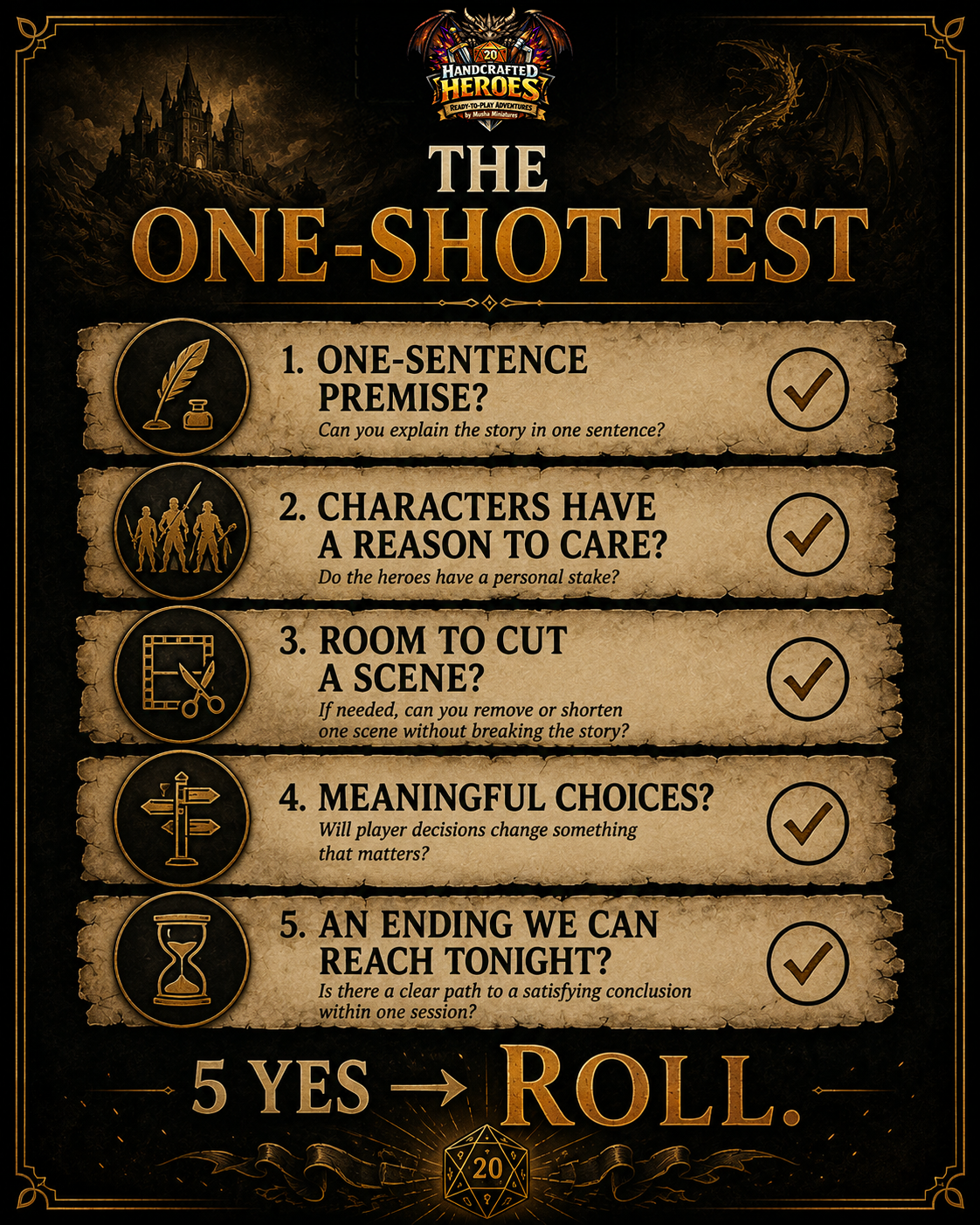
Before choosing an adventure, ask five questions.
Can we explain the premise in one sentence?
If you need twenty minutes of history before anything happens, it may be too large.
Do the characters have an immediate reason to participate?
Save the table from spending the opening hour forming a committee.
Can we remove one scene and still understand the story?
If not, your structure may be too fragile.
Are there meaningful decisions?
Short does not mean scripted.
Can we see the ending from here?
Not know exactly how it will end.
But understand what sort of resolution the adventure is moving toward.
If the answer is yes across the board, you’ve probably got something that can work.
What Do You Need to Play One?
Usually very little beyond what you’d need for any TTRPG session:
- The rules;
- The players;
- Characters;
- The adventure;
- The game’s dice or other resolution tools.
Depending on the game, you may also use:
- Miniatures;
- Battle maps;
- Terrain;
- Music;
- Cards;
- Props.
But none of those automatically makes an adventure a one-shot.
The format comes from the story and time commitment, not the components.
If you’re still putting together your first table, we’ve already built a full [Beginner checklist of what you need to play a tabletop RPG].
One Night Can Be Enough
Some of the biggest RPG stories take years. Others take four hours. A one-shot doesn’t give you enough time to tell every story. That’s the point.
It forces the table to focus on this problem, these characters and tonight’s choices.
You can meet a hero and say goodbye to them on the same evening. Defeat the villain. Fail completely. Save the town. Accidentally destroy the town while technically saving everyone in it. And then pack away the dice with an ending instead of another date to schedule.
For busy groups, new players, conventions or simply nights when everyone wants something different, that can be exactly the right amount of adventure.
Sometimes you don’t need a campaign. You just need everyone around the table long enough for someone to say:
“What do you do?”
Musha
Handcrafted Heroes Founder