What Is a Tabletop RPG? A Beginner’s Guide to TTRPGs
What Is a Tabletop RPG? Your First Adventure Starts Here
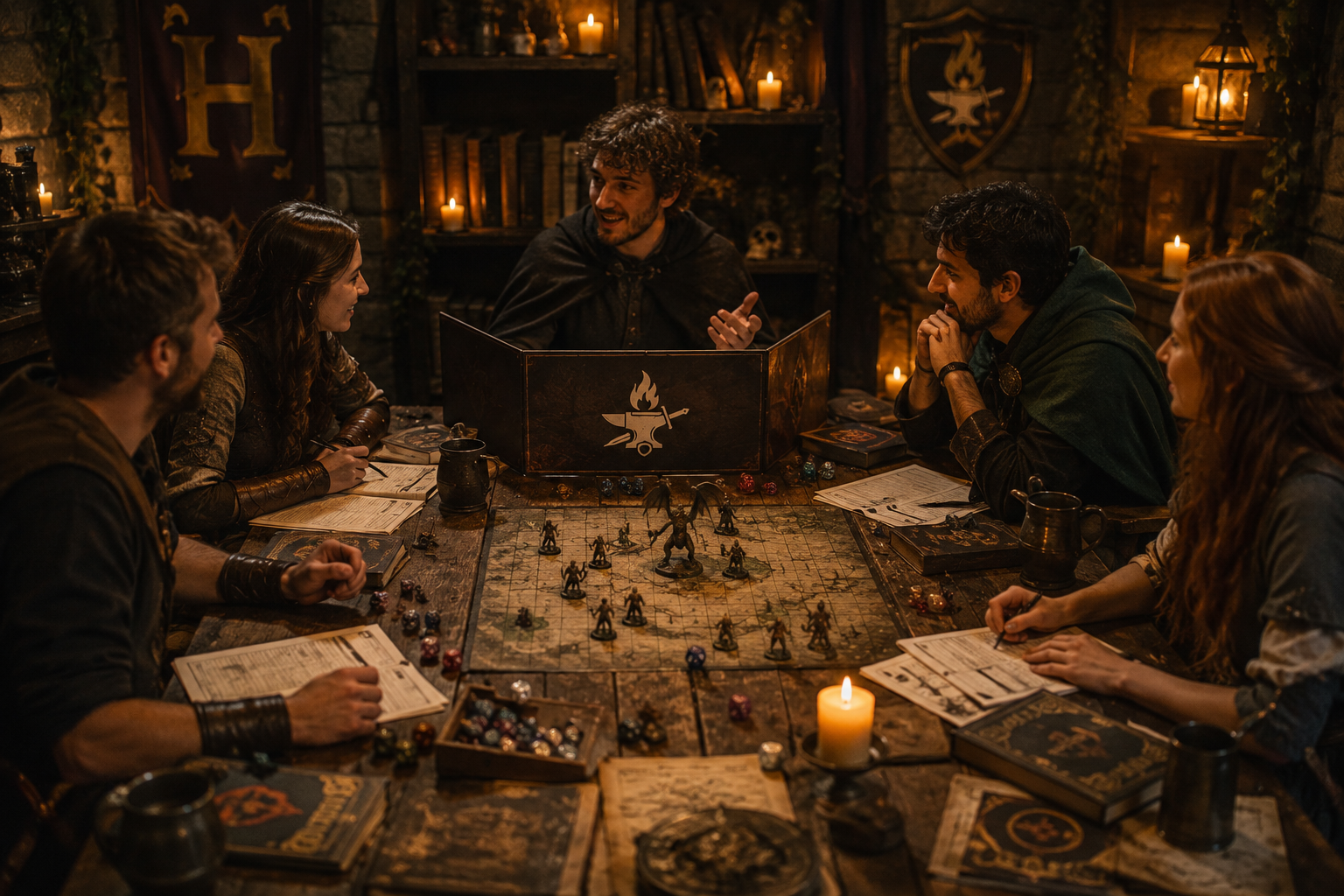
Five friends sit around a table.
One is a dwarven bard who has just insulted the wrong king. Another is desperately trying to convince the city guards that the fire was absolutely not their fault.
Someone rolls a die.
Everyone goes silent.
That, in its simplest form, is a tabletop RPG.
A tabletop role-playing game, usually shortened to TTRPG, is a collaborative game where players take the roles of characters inside an evolving story. They decide what their characters attempt to do, while a set of rules — often supported by dice — helps determine what happens when the outcome is uncertain.
There may be maps spread across the table, painted miniatures marching toward a dragon, character sheets covered in notes and enough dice to make a small dragon’s hoard.
Or there may be none of those things.
At its heart, a tabletop RPG needs something much simpler: people making choices inside a shared imaginary world and discovering what happens next.
So… What Actually Happens at a Tabletop RPG Table?
The easiest way to understand tabletop RPGs isn’t to read a definition. It’s to watch thirty seconds of an imaginary session.
The Game Master describes the scene: “The corridor ends at a heavy wooden door. You can hear something moving on the other side.”
One player responds: “I put my ear against the door. Can I tell how many creatures are in there?”
The Game Master asks for a Perception check. The player rolls a die. The result is high. “At least three. And one of them sounds much larger than the others.”
Now the players have a decision to make. Open the door? Find another entrance? Prepare an ambush? Walk away? Knock politely?
Convince the bard that this is absolutely not the moment for another song? There is no button containing the correct answer. The players decide what they want to attempt, the rules determine when an outcome needs resolving, and the story changes because of what happens.
That repeating rhythm — the world presents something → players make decisions → consequences change the world — is the engine underneath most tabletop RPGs. And it is why two groups can begin with exactly the same adventure and finish with completely different stories.
You Don’t Follow the Story. You Change It.
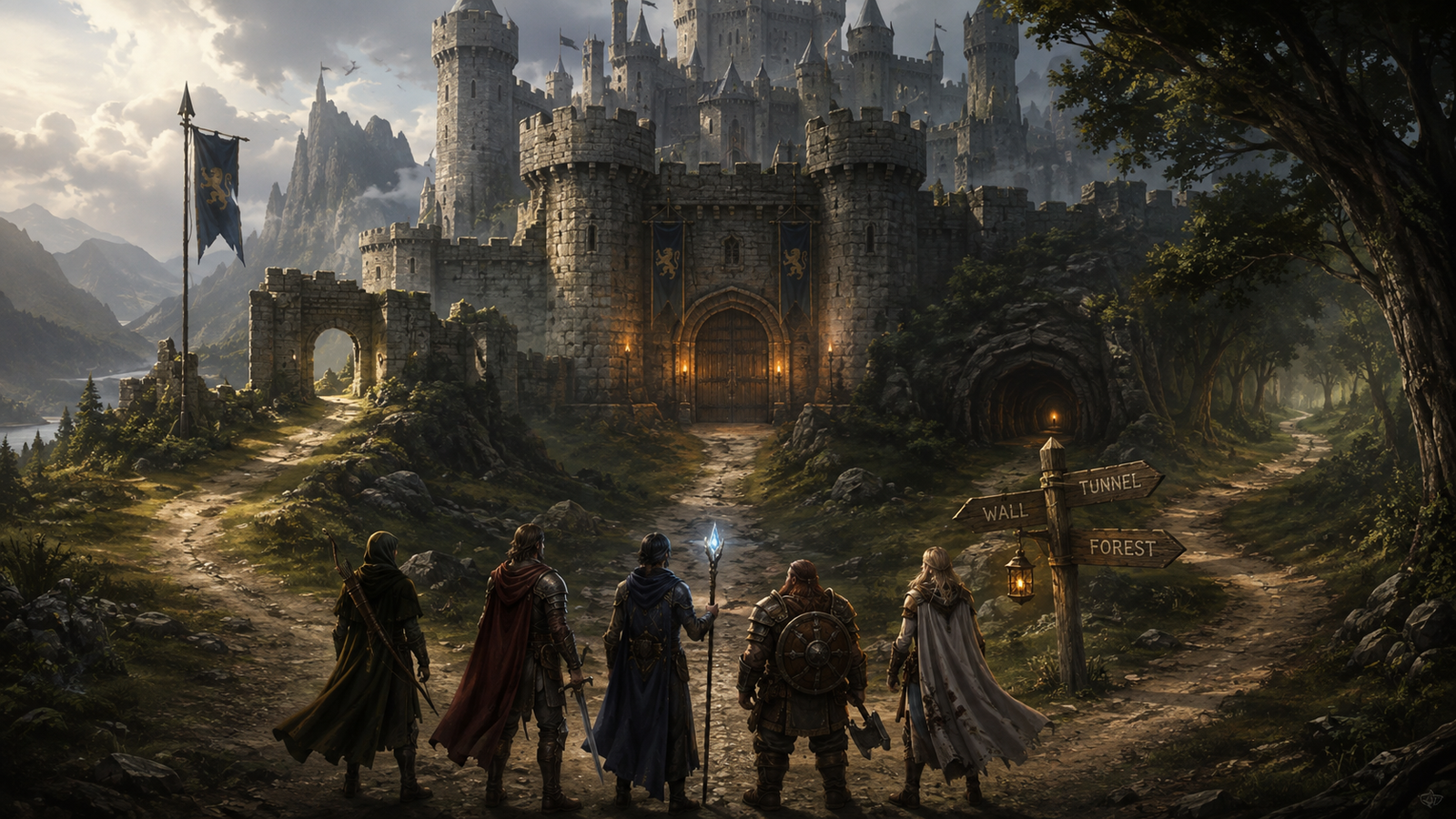
This is probably the biggest conceptual leap for someone coming from video games or traditional board games. A video game might give you three dialogue options. A tabletop RPG lets you invent option number four. And five. And the deeply questionable option number six that nobody at the table expected. Imagine your party needs to enter a fortified castle. You might fight the guards. You might bribe them. Disguise yourselves as merchants. Climb the walls after dark. Find a forgotten tunnel. Convince a local noble to invite you inside. Or abandon the castle entirely and pursue another lead. Whether those ideas work is another matter.
But you can try them. Rules provide structure and consequences; they do not normally provide a menu containing every action you are allowed to take. That capacity for improvisation is a defining characteristic of tabletop role-playing games.
The story therefore doesn’t simply happen to the players. The players help create it.
Who Is Actually Playing?
Traditionally, most tabletop RPG tables have two broad roles.
The players
Each player usually controls a Player Character, often shortened to PC. That character becomes their window into the world. You might play a battle-scarred fighter, an overly curious wizard, a rogue with an inconvenient relationship with the truth, or a cleric desperately trying to keep all three alive. You decide what your character thinks, says and attempts. You don’t need to be an actor. You don’t need a costume. And you certainly don’t need an accent.
Some players speak entirely in character: “I will not leave this village undefended.” Others simply describe what their character does: “My paladin tells them we’re staying to help.” Both are role-playing.
The Game Master
Many TTRPGs have another participant known as the Game Master, or GM. In Dungeons & Dragons, that role is traditionally called the Dungeon Master, or DM. The GM describes the world, portrays its inhabitants, presents situations and challenges, interprets the rules when necessary and reacts to whatever the players decide to do. They are not supposed to be the players’ opponent.
If a dragon attacks the party, the GM controls the dragon — but their real job is helping the entire table discover what happens. And there’s an important exception: not every tabletop RPG requires a traditional Game Master.
Some games distribute those responsibilities among the players. Others are designed specifically for solo play. Those are usually described as GMless or solo RPGs, and they deserve guides of their own.
What a GMless RPG is and how it works →
Playing a tabletop RPG by yourself →
Is D&D a Tabletop RPG?
Yes. Dungeons & Dragons is a tabletop role-playing game — but tabletop RPG does not mean Dungeons & Dragons. Think of the relationship this way:
D&D is to tabletop RPGs roughly what one famous game is to a much larger genre.
There are hundreds of tabletop RPG systems designed around different worlds, tones and styles of play. Some focus on heroic fantasy. Others on horror, science fiction, investigation, political intrigue or survival. Some have large rulebooks filled with tactical options. Others can explain most of their rules in a handful of pages. Some expect campaigns lasting months or years. Others are designed to tell a complete story in one evening.
D&D is therefore one doorway into tabletop role-playing, not the walls surrounding it. That distinction matters when you’re choosing your first game. The best starting point isn’t necessarily the most famous system. It’s the game that makes your group think: “We want to play that.”
Tabletop RPG games for beginners →
What Do You Actually Need to Play?
Probably less than you think. A tabletop RPG can accumulate an impressive amount of stuff over time.
- Dice.
- Miniatures.
- Maps.
- Terrain.
- Cards.
- Rulebooks.
- Dice towers.
- More dice.
- A suspicious number of dice.
But those aren’t all requirements.
What you actually need
At the most basic level, you need:
- A tabletop RPG system or set of rules;
- The people required by that particular game;
- Characters to play;
- Some way of resolving uncertain outcomes, if the system uses one.
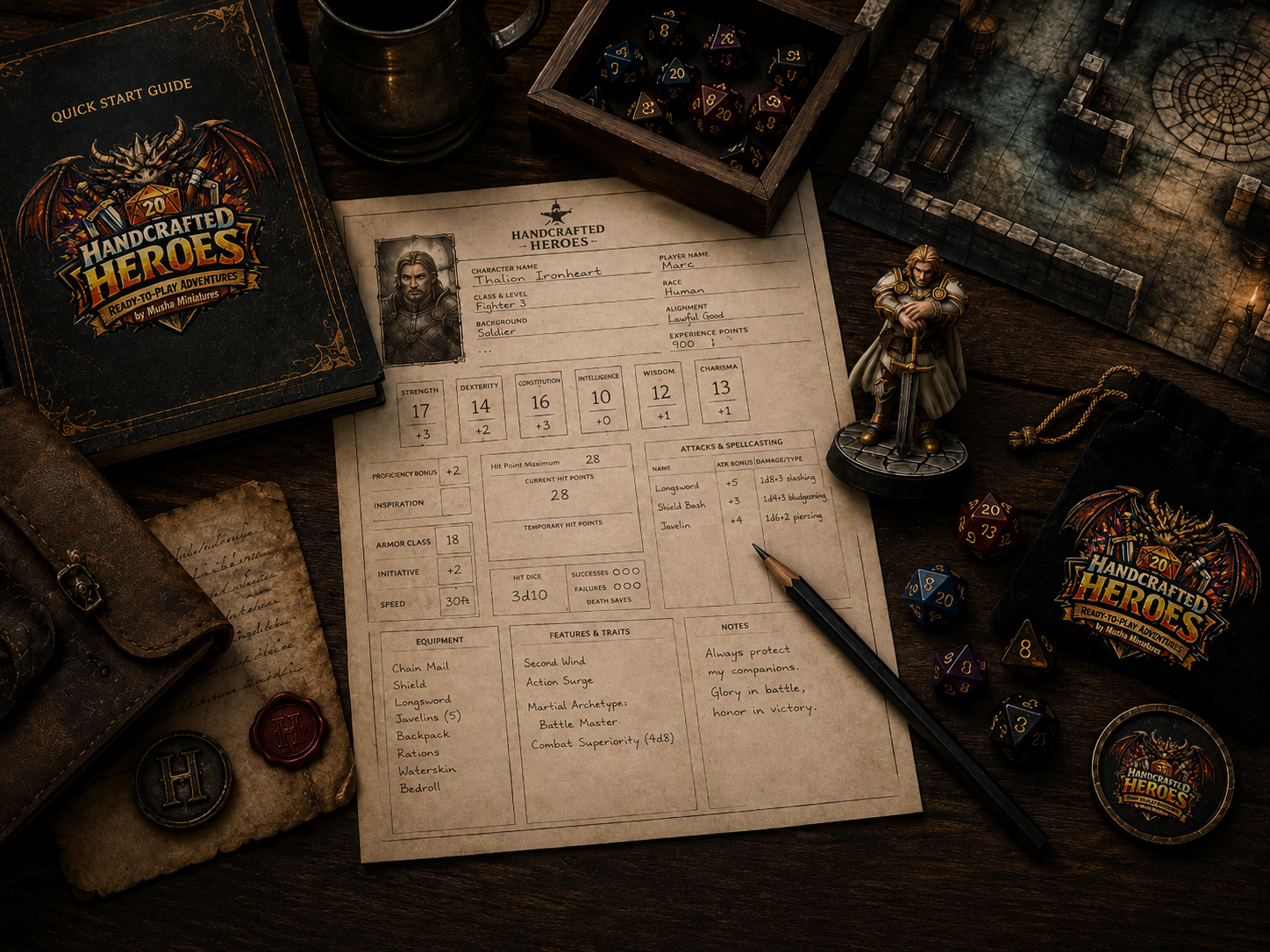
For many games, that means character sheets and a set of dice. For others, it might mean cards, tokens or another resolution mechanic. And because “tabletop” describes the format rather than a strict requirement to sit around a physical table, TTRPGs can also be played online. Cambridge’s current definition explicitly includes games played around a table or online.
What can make the experience richer
This is where the hobby becomes wonderfully personal. Painted miniatures can make characters and monsters physically present on the battlefield. Battle maps make positioning easier to understand. Terrain can turn an encounter into a tiny stage. Music changes the atmosphere of a room before anyone has said a word. Physical props can transform a fictional letter, key or mysterious artifact into something the players can actually hold. None of those things makes your game more legitimate. They simply change the way the imaginary world reaches the table. And for some groups, that tactile side of the hobby becomes part of the magic.
What you need to play a tabletop RPG →
Whether you actually need miniatures to play D&D →
Your First Adventure Doesn’t Need to Last Three Years
When people picture tabletop RPGs, they often imagine enormous campaigns. The same group meeting every week. Characters slowly growing from inexperienced adventurers into legendary heroes. A story unfolding across dozens — sometimes hundreds — of hours. Those campaigns can be extraordinary. They’re also not the only way to play.
One-Shot
A one-shot is designed to tell an adventure in a single session, although real tables occasionally spill into a second. You meet the characters. The problem appears. Things inevitably go wrong. The party deals with the consequences. The story reaches an ending. For new players, that can be an excellent way to discover what tabletop role-playing actually feels like without committing to a long campaign.
Mini Campaign
A mini campaign stretches the story across several sessions. There’s more room for character development and consequences, but the ending is still within sight.
Full Campaign
A traditional campaign can continue for months or years, with characters and storylines developing over a much longer period. None is the “proper” way to play. The right format is the one your group will actually enjoy — and actually manage to get around the table for. That’s something we care about a lot at Handcrafted Heroes. A brilliant 100-session campaign that your group never finds time to begin creates fewer memories than the four-hour adventure you actually play on Saturday night.
Choosing between a One-shot and a Campaign →
What a one-shot RPG is →
How Many People Do You Need for a Tabletop RPG?
There isn’t one correct party size. Many traditional games work particularly well with a Game Master and several players. But that’s only one configuration. There are TTRPGs designed or adaptable for:
- Two people, where one person may GM for another or both share narrative responsibilities;
- Small groups, including the familiar fantasy adventuring party;
- Larger groups, although giving everyone enough time in the spotlight becomes increasingly important;
- And even one player.
The system matters more than the number written on the invitation. If there are only two of you who want to play, you don’t necessarily need to recruit four strangers before rolling your first die.
Tabletop RPGs for two players →
TTRPG vs Board Game vs Video Game RPG
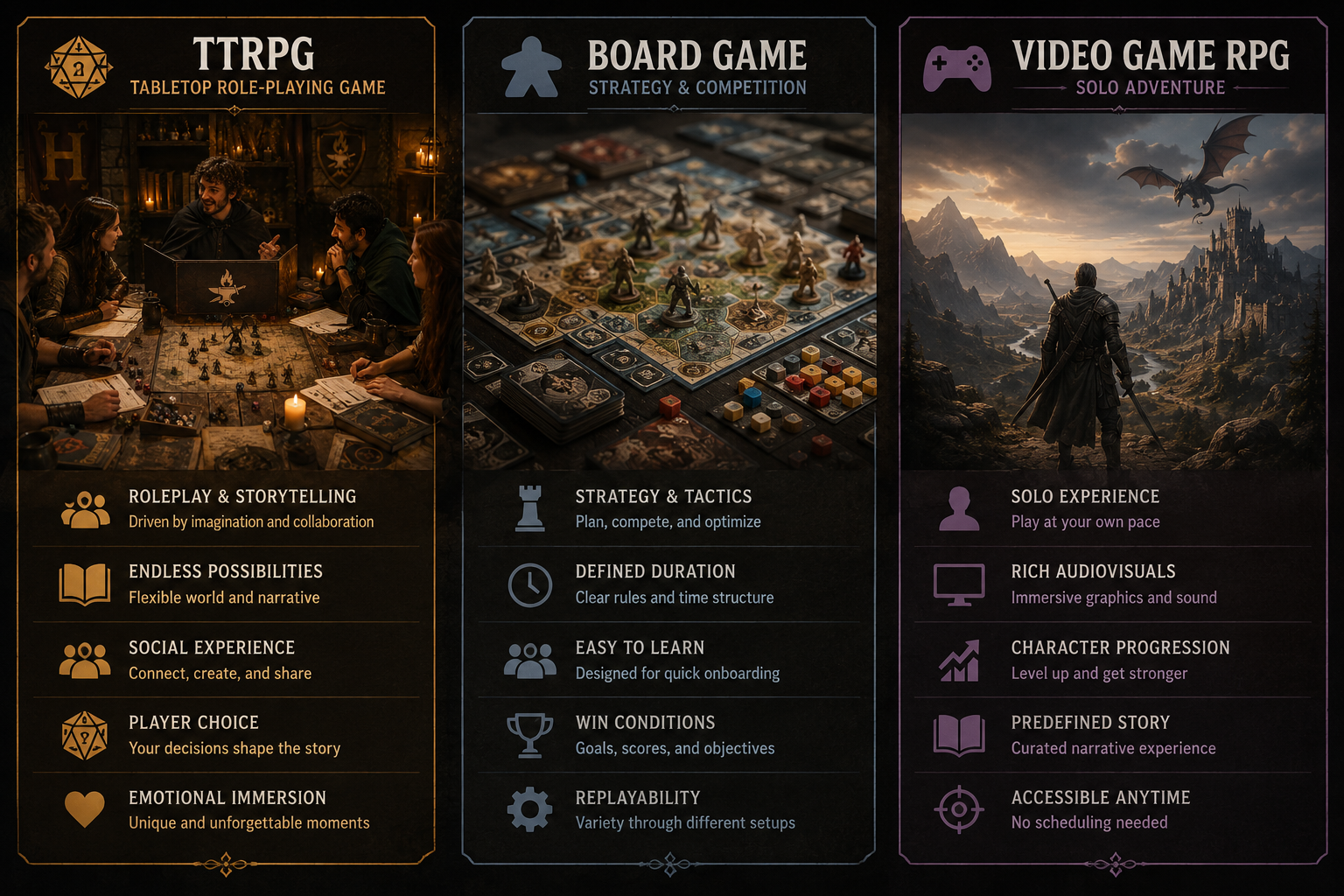
The borders can sometimes blur, but the experience is fundamentally different.
| Tabletop RPG | Board Game | Video Game RPG | |
|---|---|---|---|
| Who controls the world? | Usually a GM, shared system or players | Game rules | Software |
| Player choices | Highly open-ended | Defined by game actions | Limited to programmed possibilities |
| Story | Emerges through play | Often structured | Pre-written/programmed |
| Improvisation | Central | Usually limited | Limited |
| Character role-play | Usually central | Depends on the game | Varies |
| Physical components required | Depends on system | Usually yes | Hardware/software |
| Can the rules react to a completely unexpected idea? | Usually yes | Only if rules allow it | Only if programmed |
The easiest distinction is this:
A board game usually asks, “Which available action do you choose?”
A tabletop RPG can ask, “What do you want to do?”
Then everyone at the table discovers whether it works.
So, How Do You Start Playing?
You don’t need to become an expert first. You need a first session.
Pick a game that makes you curious.
Fantasy dungeon crawling isn’t mandatory. Choose a world, genre or premise your group genuinely wants to explore.
Find the people.
Maybe they’re friends who already play. Maybe they’re friends who have never played but would happily spend an evening pretending to negotiate with goblins. Maybe they’re people you meet through a local gaming community or an online group.
Start small.
A beginner-friendly game, starter adventure or one-shot removes the pressure of committing to a huge campaign before anyone knows whether they enjoy the experience. And then? Make a character. Sit down. Listen to the opening scene. Decide what your hero does. Roll when the game asks you to. You will learn far more about tabletop RPGs during your first hour of actually playing than you will by trying to memorize an entire rulebook beforehand.
Current beginner discussions still repeatedly revolve around exactly these practical barriers: what do I buy, where do I find people, and what should I try first? Community advice frequently points newcomers toward beginner/starter experiences and shorter introductory games rather than demanding mastery before play. Reddit Source
Ready to sit down at the table? Read our complete guide to [How to play a tabletop RPG] and see exactly what happens during your first session.
Musha
Handcrafted Heroes Founder