Best Tabletop RPG Games for Beginners: Choose Your First TTRPG
Best Tabletop RPG Games for Beginners: Find the Right First Adventure
There’s a strange piece of advice given to new tabletop RPG players:
Start with the easiest game.
We don’t entirely agree.
The easiest rules in the world won’t help much if nobody at your table cares about the world they’re attached to.
A group dreaming about tactical fantasy battles probably shouldn’t choose its first game because somebody said a minimalist mystery RPG was easier to learn. And a group that wants to investigate impossible murders by candlelight doesn’t necessarily need 300 pages of combat options.
Your first tabletop RPG should be approachable.
But more importantly: it should make your group want to play.
So rather than ranking ten games from “best” to “worst,” we’re going to do something more useful.
Tell us what kind of adventure you want.
We’ll show you where we’d start.
First: What Actually Makes a TTRPG Beginner-Friendly?
A short rulebook helps.
It isn’t everything.
When recommending a first tabletop RPG, we’d look at five things.
Can players understand what they’re supposed to do?
New players shouldn’t need extensive system knowledge just to make meaningful decisions.
Does the game teach the Game Master too?
This one gets overlooked constantly.
A simple player system can still be a terrible beginner game if running it requires an experienced GM to fill in all the gaps.
How quickly can you start?
Pre-generated characters, quickstart rules and introductory adventures can matter more than raw mechanical simplicity.
Do the mechanics reinforce the fantasy?
If players understand why they’re rolling something, learning becomes easier.
Does your group actually care about the premise?
This is the big one.
A slightly more complicated RPG your entire group is desperate to play will often make a better first experience than an extremely simple game nobody is excited about.
So our recommendations aren’t based purely on:
Which RPG has the fewest rules?
They’re based on: Which RPG gives this particular group a good first night at the table? →
“We Want the Classic Fantasy Adventure”
Start with Dungeons & Dragons
There’s a reason so many people’s first mental image of a TTRPG involves a fighter, wizard, rogue and cleric walking into a dungeon.
Dungeons & Dragons remains the obvious entry point if what your group wants is the familiar heroic-fantasy experience: characters with distinct classes, monsters, spells, exploration and increasingly powerful heroes.
The current free rules give new players access to the updated core rules and all twelve base classes, each with one subclass, meaning you can investigate the system before committing to the full books. D&D Beyond now labels these updated rules 5.5e, while the 2014 rules are labeled 5e; both remain supported and compatible.
We’d choose D&D first if…
Your group specifically wants D&D. That sounds obvious, but it matters. Maybe you’ve watched an Actual Play. Played Baldur’s Gate. Seen D&D in Stranger Things. Or somebody has spent the last three weeks sending dragon memes into the group chat. Interest removes a lot of friction from learning.
D&D also has an enormous ecosystem of adventures, communities, digital tools and educational material.
We’d think twice if…
Your group specifically wants a very rules-light first experience.
D&D isn’t impossibly complicated — millions of people have learned it as their first RPG — but neither is it the lightest system available.
Beginner verdict: ★★★★☆
Best for: the recognizable heroic fantasy TTRPG experience
Rules: Medium
GM required: Traditionally yes
“We Want Fantasy, but We Love Tactical Choices”
Try Pathfinder Second Edition
If the phrase “three actions per turn” makes somebody at your table lean forward rather than slowly back away, take a look at Pathfinder.
Pathfinder Second Edition offers fantasy adventuring with substantial mechanical depth and character customization. That might sound like the opposite of beginner-friendly.
But here’s the important distinction: complexity and poor onboarding aren’t the same thing.
The current Pathfinder Beginner Box is specifically designed to introduce the system progressively. It includes an introductory adventure that teaches rules during play, pre-generated characters, reference cards, dice, a double-sided map and more than 100 cardboard pawns.
That makes the Beginner Box much easier to recommend to a new group than simply handing everyone the full rules and wishing them luck.
We’d choose Pathfinder first if…
Your group enjoys tactical combat, character builds and having clearly defined mechanical options. Board gamers and players coming from tactical videogames may find that structure reassuring rather than intimidating.
We’d think twice if…
Half your table already gets nervous when somebody says “action economy.” Pathfinder rewards learning its systems. That’s a strength for the right group.
For another group, it’s unnecessary weight.
Beginner verdict: ★★★☆☆
With Beginner Box: ★★★★☆
Best for: tactical fantasy and character customization
Rules: Medium–High
GM required: Yes
“We Want Fantasy, but Less Homework”
Dragonbane Is Very Interesting
This is the game we’d particularly encourage new groups to investigate beyond the obvious giants.
Dragonbane describes itself as a game of “mirth and mayhem” built around fast play while still supporting substantial fantasy adventures.
More importantly for beginners, Free League provides a free Quickstart containing rules, pre-generated characters and the introductory adventure Riddermound, so your group can test the game before investing heavily.
Recent TTRPG community discussions in 2026 repeatedly recommend Dragonbane to first-time groups, particularly praising its core box as a self-contained starting point. That’s community opinion rather than an objective fact, but the consistency is noteworthy.
We’d choose Dragonbane first if…
You want recognizable fantasy adventure without immediately jumping into one of the heavier fantasy systems.
We’d think twice if…
What excites your group is specifically building highly intricate characters across dozens of mechanical options.
Beginner verdict: ★★★★★
Best for: accessible traditional fantasy
Rules: Low–Medium
GM required: Yes
“We Want Horror and Investigation, Not Heroic Fantasy”
Call of Cthulhu
Not every first adventure needs a dragon.
Sometimes a locked room, an old photograph and something moving where nothing should be moving are more than enough.
Call of Cthulhu is built around mystery, investigation and cosmic horror rather than the heroic power progression associated with games like D&D.
Its official Starter Set is explicitly designed for people with little or no previous RPG experience. It begins with a solo adventure that introduces the rules, then moves into additional scenarios and group play.
That progression is excellent onboarding design.
We’d choose Call of Cthulhu first if…
Your group gets more excited by:
“What happened in this house?”
than:
“How much damage does my sword do?”
We’d think twice if…
Your players want to feel like increasingly powerful fantasy heroes.
Call of Cthulhu has very different expectations.
Sometimes survival itself is an achievement.
Beginner verdict: ★★★★☆
Best for: mystery, investigation and horror
Rules: Medium
GM required: Yes
“We Care About Story More Than Tactical Combat”
Quest
Quest is worth knowing about precisely because it doesn’t assume that complexity is necessary for meaningful fantasy role-playing.
Its rules are available digitally, and the game’s own materials emphasize an approachable structure built around character abilities and a d20 resolution system.
This can be a useful bridge for people who love the idea of fantasy role-playing but aren’t particularly interested in detailed tactical simulation.
We’d choose Quest first if…
Your group wants to focus on characters, choices and adventure without spending much of the first session learning subsystems.
We’d think twice if…
Your group gets most of its enjoyment from tactical optimization.
Beginner verdict: ★★★★★
Best for: narrative-first fantasy newcomers
Rules: Light
GM required: Yes
“We Want Our First RPG to Feel Like a JRPG”
Fabula Ultima
This is where choosing by fantasy rather than by difficulty becomes useful.
If your group’s shared language is Final Fantasy, Dragon Quest, Xenoblade or classic console JRPGs, Fabula Ultima immediately gives you a recognizable fantasy vocabulary.
The game openly takes inspiration from Japanese-style console RPGs and focuses on collaboratively building worlds and heroic stories. Its official introductory material includes Press Start, designed as a tutorial scenario for learning the game.
We’d choose Fabula Ultima first if…
Someone at your table hears “JRPG-inspired tabletop game” and immediately asks when you’re playing.
That’s exactly the kind of excitement we’re looking for.
We’d think twice if…
Your group wants grounded medieval fantasy or highly simulationist combat.
Beginner verdict: ★★★★☆
Best for: JRPG fans and collaborative fantasy
Rules: Medium
GM required: Yes
“We Want Sci-Fi Horror and Everything Should Feel Dangerous”
Mothership
Perhaps your group doesn’t want taverns at all.
Perhaps you want a failing spacecraft, an unanswered distress signal and a motion detector that has just started making a deeply unpleasant noise.
Mothership is a science-fiction horror RPG built around survival in hostile environments.
The official game emphasizes streamlined character creation and survival-horror play, with a substantial ecosystem of scenarios available around it.
We’d choose Mothership first if…
Your group already loves Alien, survival horror and the idea that avoiding danger can be smarter than fighting it.
We’d think twice if…
The fantasy your players want is heroic competence. Mothership wants you nervous.
That’s rather the point.
Beginner verdict: ★★★★☆
Best for: sci-fi and survival-horror fans
Rules: Low–Medium
GM required: Yes
“Can We Just Play Something Completely Different?”
Yes. Please do.
The games above aren’t a definitive list of the best tabletop RPGs. They’re different doors. And there are many more. Maybe you want supernatural mystery in a small town. Maybe heroic fantasy isn’t your thing at all. Maybe you want a game about ordinary kids facing extraordinary events.
Kids on Bikes, for example, focuses on collaborative storytelling about small towns and strange adventures.
Maybe you want gothic paranormal investigation. Candela Obscura uses its own Illuminated Worlds system for that style of play.
Maybe you want something completely different from a traditional campaign. Good. One of the best discoveries a beginner can make is that TTRPG isn’t a synonym for D&D. It’s an entire medium.
Don’t Choose Your First RPG by Rulebook Size Alone
Here’s the trap.
A new player searches:
What is the easiest TTRPG to learn?
Then assumes the game with the fewest pages must be the correct answer.
But learning happens at the table.
Imagine two groups.
Group A has a 30-page game nobody is particularly interested in.
Group B has a more substantial system, but they’ve spent the entire week discussing which characters they want to create.
Which group is more likely to survive the learning curve?
Probably Group B.
Rules complexity matters.
Motivation matters too.
A beginner-friendly RPG isn’t merely one that asks little of you.
It’s one that rewards what it asks you to learn quickly enough that you want to keep going.
That’s the distinction we’d use when choosing.
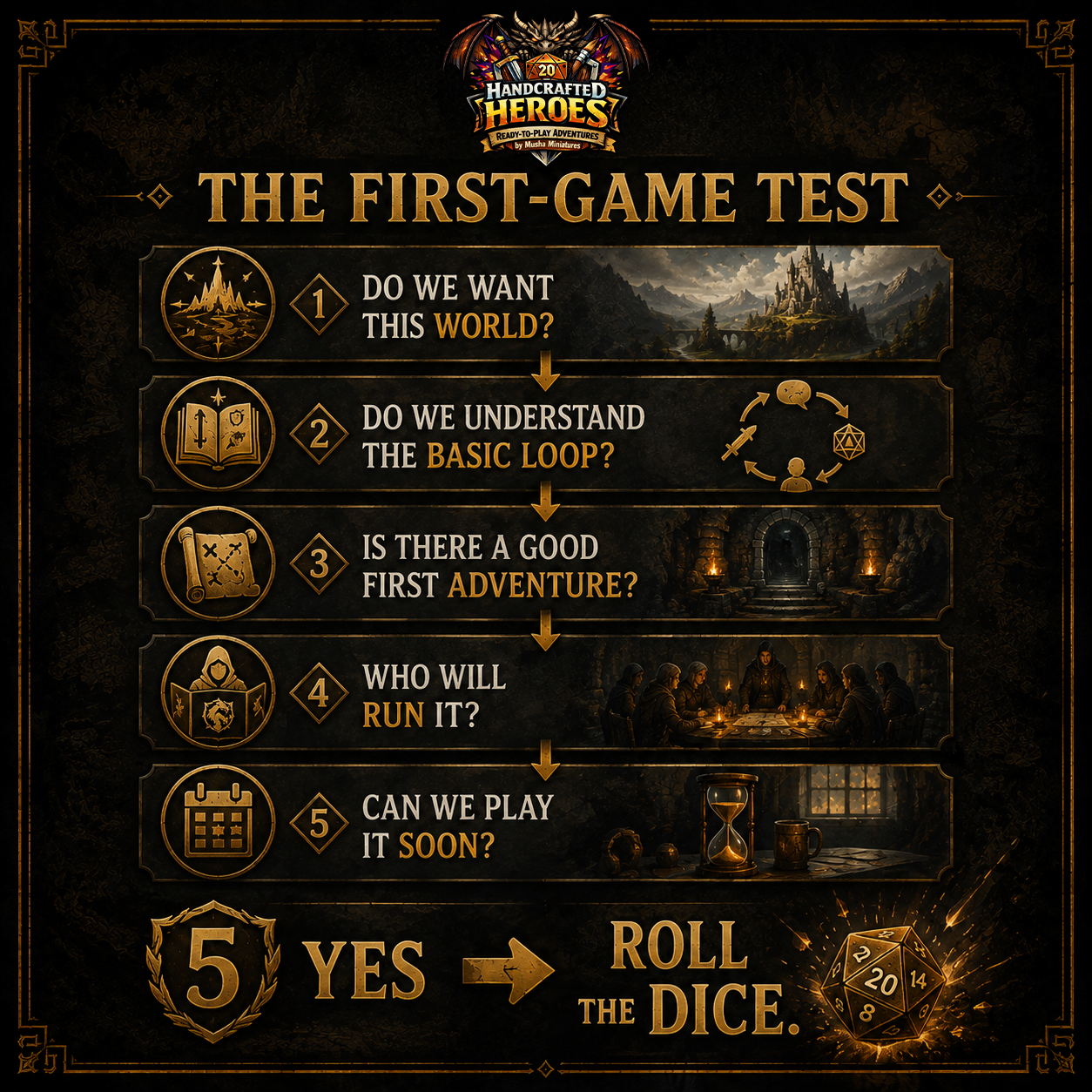
The Handcrafted Heroes First-Game Test
Instead of asking:
“Which RPG is objectively easiest?”
Put your candidate through five questions.
1. Does the premise excite everyone?
If not, stop there.
2. Can we understand the basic player loop quickly?
What do players actually do?
3. Is there a good first adventure?
A well-designed introductory scenario can matter more than a short rulebook.
4. Is someone willing to run it?
This is the question beginner guides often forget. A brilliant RPG doesn’t help if the book sits unopened because nobody wants to GM.
5. Can we realistically get it to the table?
Not someday. Not after everyone watches twelve tutorials. Can you imagine actually playing it? That’s our test.
Quick Comparison: Which Beginner TTRPG Fits Your Group?
Questa è una delle parti che vorrei assolutamente mantenere nel post perché può catturare molto bene l’intento decisionale.
| Game | Start here if you want… | Learning curve | Traditional GM? |
|---|---|---|---|
| Dungeons & Dragons | Classic heroic fantasy | Medium | Yes |
| Pathfinder 2e | Tactical fantasy & character options | Medium–High | Yes |
| Dragonbane | Fast, approachable fantasy adventure | Low–Medium | Yes |
| Call of Cthulhu | Horror & investigation | Medium | Yes |
| Quest | Rules-light narrative fantasy | Low | Yes |
| Fabula Ultima | JRPG-style adventure | Medium | Yes |
| Mothership | Sci-fi survival horror | Low–Medium | Yes |
Musha
Handcrafted Heroes Founder